









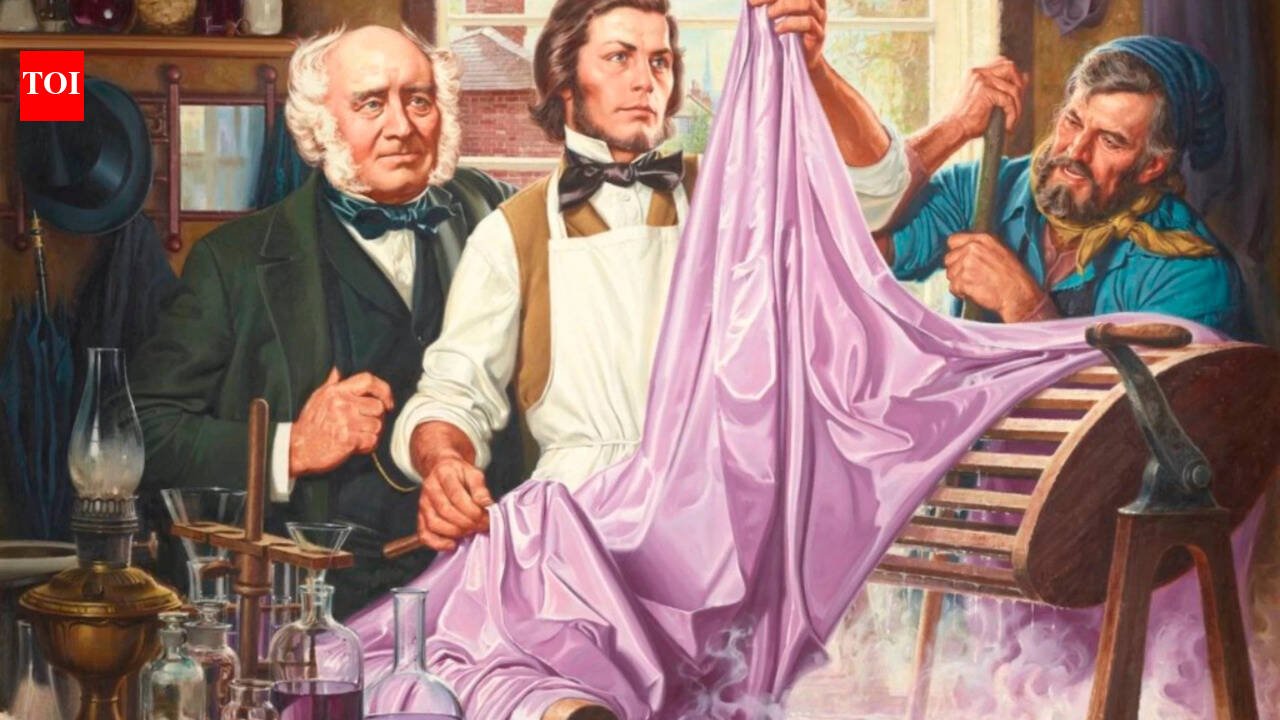
Some of the biggest breakthroughs in history have shown up when you least expected them: like penicillin from a neglected petri dish, or the microwave, inspired by a melted chocolate bar. And as wild as it sounds, one of the biggest shifts in fashion started with a disappointing chemistry experiment by a teenager who just wanted to cure malaria!That teenager was William Henry Perkin. At 18, while studying at London’s Royal College of Chemistry, Perkin was desperately trying to make quinine in the lab. At the time, quinine was the only reliable medicine for malaria, and making it from scratch would have been a huge deal. But his experiment got foiled, leaving behind a clumpy black mess in his beaker.Now, most people probably would’ve tossed it, but Perkin’s curiosity kept him going. He poured some alcohol onto the mixture to clean it, and out came a burst of brilliant purple that stained silk permanently.That’s the moment when Perkin stumbled onto mauveine, the first synthetic dye that actually worked well on fabric!That simple accident didn’t just upend the textile industry; it triggered sweeping changes across chemistry, manufacturing, and fashion. Today, it’s seen as one of those “happy accidents” that set off a chain reaction, giving rise to the dye and pharmaceutical industries we know today.
From a laboratory mistake to a scientific breakthrough
Perkin was working with August Wilhelm von Hofmann, a respected German chemist, during the spring of 1856. Back then, coal tar was just the sticky byproduct from making gas for lighting, but Perkin figured he’d give it a shot in his experiments. His goal was clear: create synthetic quinine to make malaria treatment cheaper and more accessible.He failed, at least in that original goal.He ended up with gloopy, dark residue that didn’t resemble any medicine. Yet, Perkin got curious about the odd color he noticed. He dissolved it in alcohol and was surprised to see an intense, rich purple. More impressive? It dyed silk in a way that refused to fade, something natural dyes struggled with at the time.Recognizing how valuable this could be, Perkin patented the dye the same year. With some help from his family, he set up his own factory to produce it. Not bad for someone who hadn’t even turned 19.
Purpling its way: from royalty to commoners
Nowadays, anyone can buy a purple T-shirt. But when Perkin made his discovery, purple clothes signaled power and unimaginable wealth.But before mauveine, getting purple dye was a laborious and expensive process, often relying on collecting thousands of Mediterranean sea snails just to color a single robe. That made purple fabrics a luxury for royalty, high society, and major religious figures; nobody else could afford them.Mauveine changed all of that.Suddenly, purple could be created from coal tar, which is considered a waste product, for a fraction of the price. The dye created bold, vivid colors that lasted. Purple fashion quickly shifted from a royal privilege to something almost anyone could enjoy.
The birth of the ‘Mauve Mania ’
Once the mauve got momentum, people went wild for it. Fashion designers and textile manufacturers couldn’t get enough of the new purple. Mauve took Europe by storm, so much so that historians later jokingly called that period “Mauve Mania.”This purple fever reached another level when Queen Victoria wore a mauve dress to the Royal Exhibition in 1862. The French Empress Eugénie followed, making the color even trendier. For the first time, a laboratory discovery was directly shaping international fashion.
More than a fashion revolution
Perkin’s accidental discovery did more than just change how people dressed. He showed that weird leftovers from making gas (coal tar) could be turned into valuable products. Scientists everywhere rushed to create new synthetic dyes, and, not surprisingly, the dye industry exploded. That boom pushed organic chemistry forward, paving the way for important advances in medicine, photography, plastics, and so much more.Historians now pick Perkin’s “mistake” as one of the first sparks that ignited the modern chemical industry.
A legacy that still colors the world
Almost 170 years later, synthetic dyes are everywhere: they color our clothes, our makeup, our books, and even our food and medicine. The textile industry relies almost completely on man-made color because it’s more reliable, durable, and opens up a rainbow of possibilities nature never offered.Of course, Perkin’s life didn’t slow down, either. He became one of Britain’s most honored chemists. His name now lives on in the Perkin Medal, awarded for major achievements in applied chemistry.Looking back, Perkin’s story is a reminder that huge leaps in science don’t always happen because of a perfectly planned experiment. Sometimes, they start with curiosity and a knack for seeing the value in what everyone else might have just thrown out! After all, what may look like a petty lab mishap can ultimately turn out to be one of history’s most vibrant breakthroughs!