








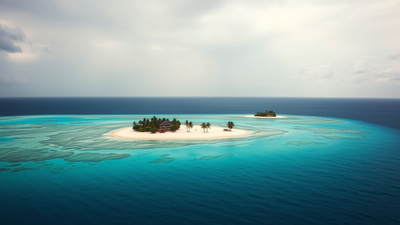
Tuvalu is one of the least visited countries on earth. A single airline, Fiji Airways, operates the only scheduled flights in and out, connecting the capital atoll of Funafuti to Fiji a few times a week, and there is no other way to reach the country by air. The entire nation is made up of nine coral atolls covering roughly 26 square kilometres, smaller than many major airports, and is home to just under 11,000 people. Life here has always moved differently from most of the world, shaped by close communal ties and a cash-based economy that only recently saw its first ATMs installed. But scientists now warn Tuvalu faces a far bigger question than isolation: whether the country will remain habitable at all as sea levels continue to rise.
Why Tuvalu is considered one of the most vulnerable nations on earth
Tuvalu’s islands sit at an average elevation of only about two metres above sea level, among the lowest of any country on the planet. According to a technical report titled Assessment of Sea Level Rise and Associated Impacts for Tuvalu, produced by NASA‘s Sea Level Change Team in support of the United Nations-backed Rising Nations Initiative, Tuvalu has already begun experiencing measurable impacts from the combined effects of rising oceans, storms and natural ocean variability, effects the report expects to worsen in the years ahead.
What NASA’s analysis actually found
According to NASA’s Jet Propulsion Laboratory, Pacific island nations including Tuvalu, Kiribati and Fiji will experience at least 15 centimetres of sea level rise over the next 30 years, a figure the agency describes as effectively locked in regardless of whether global greenhouse gas emissions change going forward. The analysis was carried out by researchers at the University of Hawaii, working alongside scientists from the University of Colorado and Virginia Tech, at the request of Pacific island governments themselves, and in coordination with the United States Department of State. Nadya Vinogradova Shiffer, who directs ocean physics programs within NASA’s Earth Science Division, noted that sea levels will continue rising for centuries, bringing more frequent flooding to coastal communities across the region regardless of near-term emissions decisions.
A rising tide already visible on the ground
Grace Malie, a youth leader from Tuvalu involved with the Rising Nations Initiative, told NASA that accurate science and data can help her community understand exactly what these sea level projections mean in practice, adding that this information also supports early warning systems the country is actively developing. Malie described the stakes bluntly, saying the future of Tuvalu’s young people is already at stake, and that climate change represents a matter of justice and survival rather than simply an environmental concern. NASA researchers noted a genuine shortage of on-the-ground measurement data in Pacific nations like Tuvalu, which is part of why the agency has begun combining satellite-based sea level data with ground station measurements and more detailed land elevation mapping specifically for these vulnerable coastlines.
Daily life on a shrinking runway between the ocean
Despite the scale of the threat it faces, Tuvalu remains almost entirely disconnected from global tourism. Fiji Airways is the sole carrier serving the country, and flights operate only a few times each week between Funafuti and Fiji, making Tuvalu one of the hardest countries in the world to simply visit. Funafuti International Airport itself is modest by international standards, a single terminal building sitting so close to the surrounding village that locals can walk directly onto the runway whenever no flight is scheduled.
A cash economy that only recently modernised
Until quite recently, every transaction in Tuvalu, by locals and visitors alike, had to be conducted entirely in cash, since the country had no ATMs anywhere on its islands. That changed in April 2025, when the National Bank of Tuvalu, the country’s only bank, installed the nation’s first five ATMs on Funafuti, including machines at Vaiaku village and the airport itself. Prime Minister Feleti Teo described the moment as a significant milestone for the country, while the bank’s general manager, Siose Teo, called it a transformative switch that would open doors to broader economic participation for Tuvaluans. Even with this change, banking infrastructure across the country remains extremely limited compared to almost anywhere else in the world.
Why a nation this small carries such outsized stakes
Whatever infrastructure changes come next, the core threat facing Tuvalu remains the same one NASA’s sea level science team has been documenting for years: a slow, largely irreversible rise in sea level that threatens not just periodic flooding but the long-term habitability of the country itself. With no natural elevation to retreat to and limited land available for adaptation, Tuvalu has become one of the clearest real-world test cases for what rising seas mean for entire nations, not just coastlines, making its quiet, rarely visited atolls a subject of growing scientific and diplomatic attention far beyond their tiny population and remote location in the middle of the Pacific.