










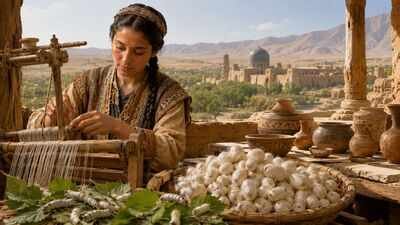
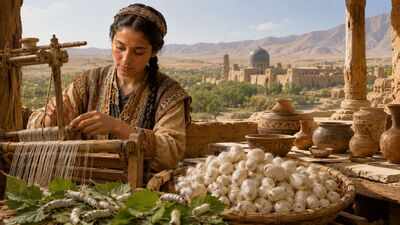
For generations, the history of silk has been told in a fairly straightforward way. Domesticated silkworms emerged in ancient China, silk travelled westward once the Silk Road developed, and the knowledge required to raise silkworms followed the same route. That sequence has shaped both archaeological research and popular history for decades. The story may be far older and rather less linear. Evidence recovered from Bronze Age settlements in present-day Uzbekistan suggests that people in southern Central Asia were already cultivating mulberry trees and raising domesticated silkworms around 2000 BCE. If the findings withstand further scrutiny, they would shift the accepted timeline for organised sericulture in the region by almost two millennia.
Ancient silkworm cocoons found at Bronze Age Sapalli Tepe in Uzbekistan
The research centres on Sapalli Tepe, a Bronze Age settlement in southern Uzbekistan belonging to the Oxus or Bactria-Margiana Archaeological Complex. During excavations, archaeologists recovered three ancient silkworm cocoons alongside plant remains preserved in archaeological deposits.According to the new study published in Science Advances, titled “Silkworm cultivation predating the Silk Road in southern Central Asia (2000 BCE)”, the cocoons were directly dated to between 1940 and 1765 BCE. Laboratory analyses, including protein fingerprinting, identified them as belonging to Bombyx mori, the domesticated mulberry silkworm, rather than unrelated silk-producing insects.The authors note that the cocoons resemble wild silkworms in appearance, yet their protein signatures align with domesticated Bombyx mori. That combination raises the possibility that these insects represent an early stage in the history of domesticated silkworm populations rather than modern forms.
Ancient mulberry trees and silkworm cocoons provide evidence of early silk production
The cocoons were not the only evidence pointing towards organised silk production. More than 1,200 fragments of ancient wood charcoal were analysed from three Bronze Age sites. Among them were charcoal remains identified as Morus (mulberry), the essential food source for domesticated silkworms. The study states that these are the earliest known archaeological remains of mulberry trees from Central Asia.The team also found that mulberry charcoal appeared at all three settlements and became increasingly common through time. Other cultivated plants, including grapes, figs, citrus, barley, wheat, millets and flax, were also identified, suggesting these communities managed a diverse agricultural landscape rather than relying on a limited range of crops.As per the study, the combination of domesticated silkworm cocoons and mulberry remains provides strong evidence that silkworm rearing was taking place locally instead of silk simply arriving through exchange.
Sapalli Tepe discovery suggests sericulture began long before the Silk Road
Traditional historical accounts place the spread of Chinese sericulture into Central Asia during or after the Han Dynasty, when Silk Road trade expanded from the late second century BCE.The new findings challenge that chronology. The discoveries at Sapalli Tepe indicate that communities in southern Central Asia were already practising mulberry-based sericulture roughly 2,000 years before the commonly accepted beginning of Silk Road exchanges.This evidence places silk production alongside other examples of prehistoric movement across Eurasia, including crops, livestock and horticultural knowledge that travelled between East, Central and South Asia during the third and second millennia BCE.The researchers also refer to a previously excavated silk-like textile fragment from Sapalli Tepe, together with numerous textile-making tools recovered from Bronze Age settlements in the region. While these objects alone cannot prove local silk manufacture, they fit the wider archaeological picture emerging from the new analyses.
How domesticated silkworms may have reached Central Asia before the Silk Road
The archaeological evidence currently represents a single well-documented case outside eastern China, making it difficult to identify the exact route by which domesticated silkworms and mulberry cultivation reached Central Asia.One possibility proposed in the paper is movement along the southern slopes of the Himalayas, supported by comparisons with archaeological evidence for mulberry remains and long-standing cultural connections between the Oxus civilisation and the Indus region. At the same time, the researchers emphasise that a northern route cannot yet be ruled out and that additional discoveries will be needed before any dispersal pathway can be confirmed.Reportedly, the evidence from Sapalli Tepe establishes the earliest documented occurrence of mulberry-Bombyx sericulture outside ancient China. Rather than presenting silk production as an innovation that spread only after the Silk Road emerged.