








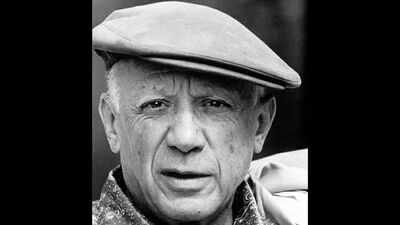
Quote of the day by Pablo Picasso: “When I was as old as these children, I could draw like Raphael, but it took me a lifetime to learn to…” – a profound lesson on creativity, simplicity and rediscovering the fearless artist withinChildren draw without hesitation, painting exactly what they imagine rather than what anyone expects of them. Pablo Picasso pointed at that exact quality with real admiration. “When I was as old as these children, I could draw like Raphael,” he said, “but it took me a lifetime to learn to draw like them.” A popular shortened version of this line, “it took me my whole life to learn to draw like a child,” circulates far more widely, but it leaves out the actual comparison that gives the thought its real bite, the specific gap between a technique that took years to master and a freedom that came naturally to children without any training at all.
Quote of the day by Pablo Picasso
“When I was as old as these children, I could draw like Raphael, but it took me a lifetime to learn to draw like them”
What the quote actually means
Picasso is not claiming children’s drawings are technically superior to a trained artist’s work. He is admiring what sits behind them, working entirely without fear, experimenting freely, driven by imagination rather than any concern for getting things exactly right. As artists become more skilled, they tend to become far more aware of rules, expectations and the possibility of criticism. Picasso believed genuine creativity meant combining real technical mastery with that same fearless imagination children have naturally, before anyone has taught them to be self-conscious about it.
Where this quote actually comes from
The fuller version of this line, with the direct comparison to Raphael, is documented in Ingo F. Walther’s book Picasso, part of the Basic Art series. The most widely repeated popular paraphrase reads, “It took me four years to paint like Raphael, but a lifetime to paint like a child,” which trims the wording slightly differently but keeps the same essential comparison. The much shorter version usually quoted today, “it took me my whole life to learn to draw like a child,” drops the Raphael reference entirely, which is really the detail that makes the original observation land properly, since it directly measures technical mastery against something children manage without ever being taught it at all.
Why real mastery is more than technical skill
Most people assume expertise simply means becoming more precise over time. Picasso’s own career complicates that idea directly. He had mastered classical, realistic drawing while still a teenager, essentially able to draw like Raphael long before he was an adult. Yet after reaching that level of technical ability, he spent decades deliberately simplifying his work and pushing into entirely new forms of expression. His own path shows that mastery was never only about knowing more. It was just as much about expressing an idea with real honesty and clarity, however simple the final result actually looked.
Why children create so freely in the first place
Children rarely worry about making a mistake before they even start. They paint purple trees and flying elephants without a second thought, because they have not yet learned to fear being wrong about anything. That openness is exactly what allows genuine experimentation, and plenty of real breakthroughs in science, business and art begin with someone willing to ask a question that sounds a little unusual or unrealistic at first.
Why fear so often gets in the way of real creativity
As people get older, they tend to become far more preoccupied with how something will be judged. Will people approve of it. Will the idea simply fail. Will it make me look foolish. These worries discourage the kind of experimentation Picasso is describing, and his own quote is really an invitation to recover the confidence to explore an idea without letting perfectionism quietly block the way first.
Why simplicity is often the harder, more impressive achievement
Complexity tends to impress people on the surface. Genuine simplicity usually requires a much deeper understanding underneath it. Whether in painting, writing or plain communication, expressing something genuinely meaningful in a clear, accessible way turns out to be remarkably difficult in practice. Picasso seemed to believe that simplicity earned through real experience represented a higher form of creativity than complexity created purely for its own sake.
Why curiosity should never really disappear with age
Children ask endless questions, why, how, what if, without any embarrassment about not already knowing the answer. Holding onto that same curiosity through adulthood tends to encourage genuine lifelong learning. People who keep exploring, questioning and experimenting well into their careers tend to stay more innovative than people who quietly stop asking those questions once they feel sufficiently expert.
A note on Picasso’s own artistic journey
Picasso showed extraordinary technical skill from a genuinely young age, producing highly realistic paintings while still a teenager. Later, he became a pioneer of Cubism, continually reinventing his own artistic style across an unusually long career. His quote reflects the belief that while technique can be taught fairly directly, holding onto imagination, spontaneity and real originality is closer to a lifelong pursuit than a skill someone simply finishes learning.
Other memorable quotes by Pablo Picasso
- “Everything you can imagine is real.”
- “Every child is an artist. The problem is how to remain an artist once we grow up.”
- “I paint objects as I think them, not as I see them.”
- “Learn the rules like a pro, so you can break them like an artist.”
Why this quote is relevant
In a world that often rewards efficiency, correctness and simply fitting in, Picasso’s line is a reminder of what imagination is actually worth, the courage to create freely, the willingness to get things wrong along the way, and the ability to see real possibility where other people only see limitations. None of that belongs exclusively to children. It stays available to anyone still willing to hold onto it.