










An intellectual sitting alone in a room may reach brilliant conclusions, but if those ideas never leave the desk, they remain unused. A candle burning inside a locked box lights only the box while leaving the hallway outside in darkness.This contrast between keeping wisdom to yourself and sharing it with others is at the heart of a famous idea from the thirteenth century: “Better to illuminate than merely to shine, to deliver to others contemplated truths than merely to contemplate.”The quote describes two different ways of living. Simply shining represents personal brilliance, an impressive display that asks nothing from others except admiration. Illuminating, however, helps other people see the world more clearly. It treats knowledge not as something to keep for yourself, but as a light meant to help everyone better understand reality.The idea remains powerful because it speaks to a basic human struggle between personal growth and public responsibility. Intelligence, expertise, and deep study can easily become self-focused pursuits. The quote reminds us that the real purpose of gaining knowledge is not personal success, but helping others understand a complicated world.
A medieval friar rethinking the monastic life
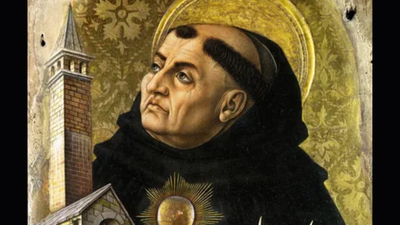
Italian philosopher, theologian, and Dominican friar Thomas Aquinas wrote these words in his great work, Summa Theologiae. Written between 1265 and 1274, the Summa was intended as a complete guide to Christian theology and Aristotelian philosophy for students and Dominican friars.To understand why Aquinas wrote this line, it helps to understand the debate that divided medieval religious orders. For centuries, the highest spiritual ideal in Western Europe was the contemplative life followed by monastic orders such as the Benedictines. Monks withdrew from society into isolated monasteries, spending their lives in prayer, meditation, and study, away from the distractions of the outside world.In the early thirteenth century, a different type of religious order appeared. The mendicants, including the Dominicans and Franciscans, lived among ordinary people instead of behind monastery walls. Founded by Saint Dominic in 1216, the Dominican Order focused on preaching and teaching in towns and universities.Critics argued that public preaching weakened the spiritual purity that came from silent contemplation. In Summa Theologiae (Secunda Secundae, Question 188, Article 6), Aquinas defended the Dominican mission. He compared the active life with the contemplative life and concluded that combining the two was better than choosing either one alone.The original Latin phrase, Sicut enim maius est illuminare quam lucere solum, ita maius est contemplata aliis tradere quam solum contemplari, became the defining statement of the Dominican mission. The shorter phrase Contemplata aliis tradere (“to hand down to others the fruits of contemplation”) remains one of the order’s main mottos today.
The philosophy of overflowing wisdom
At the heart of Aquinas’s argument is the difference between quietly gaining knowledge and generously sharing it. Contemplation requires patience, discipline, and deep thought to understand difficult truths. Aquinas never questioned its importance. In fact, he argued that teaching without first thinking deeply becomes empty words.However, Aquinas believed that stopping with personal enlightenment leaves the journey unfinished. Wisdom is not meant to be stored away like wealth. When someone truly understands an important truth, that knowledge should naturally lead to action.This idea builds on Aristotle’s concept of eudaimonia (human flourishing), which argues that people reach their full potential by acting within a community rather than living in isolation. It also reflects Plato’s allegory of the cave. The philosopher who leaves the cave and sees the sunlight cannot simply enjoy the view alone. He has a moral duty to return and help others find their way out of the darkness.Aquinas presented teaching, mentoring, and public discussion not as distractions from intellectual life, but as its highest purpose. Sharing knowledge means turning difficult ideas into clear language, testing them through public discussion, and using them to solve real human problems.
Translating deep work into public value
The difference between shining and illuminating still offers an important lesson for modern work, leadership, and media.In business, leaders often focus on shining by building personal brands, collecting achievements, and making public statements that highlight their own abilities. Good leadership, however, is about illumination. When Satya Nadella became CEO of Microsoft in 2014, he changed the company’s culture from one of “know-it-alls” to one of “learn-it-alls.” The focus shifted away from individual brilliance toward creating systems that helped every employee improve.The academic and scientific world faces a similar challenge. Thousands of research papers are published every year behind expensive paywalls and written in technical language that most people cannot understand. During the COVID-19 pandemic, many immunologists stepped away from their laboratories to write clear public health guides. By doing so, they moved beyond contemplation and helped fight misinformation with useful facts.In education, the quote shows the difference between an expert who uses complicated language to impress students and a teacher who explains difficult ideas simply enough for students to understand on their own. The late physicist Richard Feynman strongly supported this principle, arguing that if you cannot explain an idea in simple terms to a freshman, then you do not fully understand it yourself.Aquinas’s standard suggests that the real measure of expertise is not how impressive it appears, but how clearly it helps others understand the path ahead.