










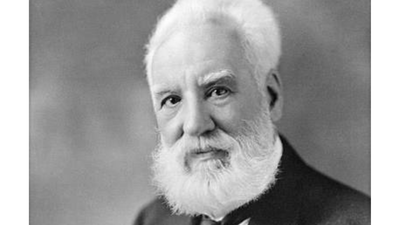
Alexander Graham Bell is best remembered for helping develop the telephone, an invention that transformed how people communicated across distance. Yet Bell himself recognised that major breakthroughs rarely belong entirely to one person. His statement, “Great discoveries and improvements invariably involve the cooperation of many minds”, reflects the collaborative nature of scientific progress. Bell worked with assistants, engineers and other researchers throughout his career, including Thomas Watson, who played an important role in developing and testing Bell’s telephone. Bell received US Patent No. 174,465 for his telephone on March 7, 1876, and three days later successfully transmitted intelligible speech to Watson.
Quote of the day by Alexander Graham Bell
“Great discoveries and improvements invariably involve the cooperation of many minds.”Alexander Graham BellThe quote captures an idea that remains central to scientific discovery: groundbreaking inventions are often built through a combination of ideas, experiments and contributions from several people.Bell reportedly followed the quotation by acknowledging that although he might receive credit for blazing the trail, later developments owed much to others. The statement is therefore particularly appropriate for Bell himself, whose telephone emerged from a wider history of experiments into sound, speech and electrical communication.
How Bell changed communication
Before the telephone, people could communicate over long distances through letters and telegraph messages. The telegraph had already transformed communication by allowing coded messages to travel rapidly over wires, but it could not transmit the human voice.Bell’s work sought to solve that problem.His experiments focused on converting sound vibrations into electrical signals that could travel through wires and then be converted back into sound. In 1876, he received the first US patent for an apparatus designed to transmit vocal sounds telegraphically.The invention eventually changed the way businesses, families and governments communicated.
The role of Thomas Watson
Bell’s famous telephone experiments were closely associated with his assistant, Thomas A. Watson.On March 10, 1876, Bell successfully transmitted intelligible speech through his experimental telephone. According to Bell’s surviving notebook, he spoke to Watson and said: “Mr. Watson–Come here–I want to see you.” Watson heard the words in another room. The Library of Congress preserves Bell’s notebook documenting the experiment.Watson’s contribution helps illustrate exactly what Bell meant about cooperation between minds. Bell developed the underlying ideas, but the experiments required another person to build equipment, test it and receive the transmitted sound.
The invention was part of a larger scientific effort
The history of the telephone is more complicated than the story of a single inventor suddenly creating the technology.Other inventors were experimenting with transmitting speech and sound electrically during the same period. Antonio Meucci, Johann Philipp Reis and Elisha Gray were among those whose work formed part of the broader history of telephone development.Bell’s achievement was to develop and patent a successful design and continue refining it into a working communication system. The Library of Congress credits Bell as the inventor of the telephone because his patent and demonstrations for an apparatus capable of transmitting vocal sounds were successful.
Bell did not stop with the telephone
The telephone was only one part of Bell’s scientific life.The Library of Congress holds a collection of more than 145,000 items connected to Bell and his family, including scientific notebooks, correspondence, blueprints, photographs and documents covering his work in telecommunications, aviation, education and other areas of science.His laboratory notebooks show that he continued experimenting and searching for new ideas rather than simply relying on the success of his most famous invention. The Library of Congress describes him as being driven by an enduring curiosity and desire to learn and create.
A lesson about how inventions really happen
Bell’s quote is particularly relevant to the way modern science works.Major breakthroughs often depend on people building upon earlier discoveries, sharing knowledge, testing one another’s ideas and improving existing technologies.The telephone itself illustrates that process. Bell’s work emerged from earlier research into sound and electricity, while his experiments depended on the practical skills of people such as Watson. Later engineers would continue improving telephone networks, switching systems and transmission technologies.Bell’s statement therefore carries a message that extends beyond his own invention. Scientific progress is rarely a single moment of genius. It is usually a chain of ideas, experiments and improvements contributed by many minds.More than a century after Bell’s telephone experiments, communication technology has advanced from wired telephones to mobile phones, satellites and internet-based communication.Yet the principle behind his quote remains relevant. The technologies people use today are built upon generations of discoveries, with researchers continually improving the work of those who came before them.