










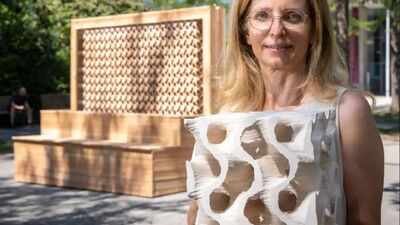
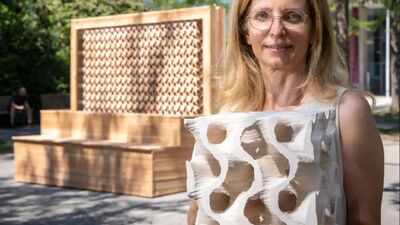
On a warm day, a wall is usually something to escape from rather than something that helps cool a room. At Graz University of Technology in Austria, that assumption is being turned around with a ceramic structure that uses little more than water, porous clay and evaporation. The experimental cooling cubes are made using 3D printing, allowing their interiors to be shaped into complex networks of channels and surfaces. When water moves through the fired ceramic and begins to evaporate, it takes heat from the air around it. In tests at the university, the effect was large enough to bring temperatures close to the cube down by almost 7°C.
The old science behind the new ceramic cubes
The basic idea is far older than 3D printing. Evaporative cooling has been used in different forms for centuries. Porous clay vessels, for example, can allow small amounts of water to reach their outer surfaces, where evaporation removes heat. Traditional buildings have also made use of air movement, shade and water to keep interiors more comfortable without mechanical cooling.According to the Open Access Government, the work at Graz University of Technology takes that principle and changes the shape of the object doing the cooling. Instead of relying on a simple clay container, the team has produced a highly porous ceramic cube whose internal structure is carefully designed on a computer.The cubes measure about 23 centimetres across. Inside, they contain a complex geometry known as a triply periodic minimal surface, or TPMS. It is a mathematical structure that can create a large internal surface while using relatively little material. The result is difficult to achieve with conventional manufacturing methods. A 3D printer, however, can build the intricate ceramic form layer by layer.
How water turns porous clay into a natural cooling system
Once water enters the ceramic structure, capillary action helps carry it through the porous material. Rather than remaining in one place, it can spread through the network of tiny passages and reach a much larger area.As water changes from liquid to vapour, it needs energy. Some of that energy comes from heat in the air immediately around the ceramic. The air consequently loses some of its thermal energy as evaporation continues. There is no compressor, refrigerant circuit or conventional air-conditioning system involved. The cooling comes from the interaction between water, porous clay and the surrounding atmosphere.Reportedly, in field testing carried out in an attic at TU Graz, the temperature close to a water-filled cube fell by nearly 7°C, or about 12.6°F. The cooling was not confined to a tiny patch directly beside the object either. The team observed an effect extending through the room.The result is significant as a demonstration of the principle, although it is not the same thing as replacing an air-conditioning system in a large building. The amount of cooling available from evaporation depends on conditions including humidity, air movement and the supply of water.
The strange role of fungi
Researchers working in the university’s Shape Lab have been investigating whether biological structures can help create a better porous network inside the clay. One approach involves sawdust and fungal mycelium.The mixture is printed while the organic material is still present. During firing, the combustible components disappear, leaving voids behind in the ceramic.Those spaces effectively become part of the cooling system. The resulting material contains a combination of larger and smaller pores, creating pathways through which water can travel.The idea is less about putting a living organism into a finished wall than using the shape of a biological network as a temporary template for the ceramic. What remains after firing is an intricate pore structure that can help move water through the material.It is a useful example of how 3D printing changes what can be attempted with clay. Instead of treating ceramics simply as a solid building material, the researchers are making the empty spaces inside it part of the design.
From dredged waste to clay for passive cooling structures
There is another strand to the project that has little to do with futuristic manufacturing.The team is examining whether sediment dredged from Lake Neusiedl can be used as a source of clay. Sediment removal is an established requirement in some water-management settings, and finding useful applications for that material could give it another role beyond being treated as waste.For the cooling structures, the question is whether locally available sediment can be processed into a suitable raw material without compromising the ceramic’s performance.If it works, the approach could link two otherwise separate concerns: the disposal or reuse of dredged material and the search for lower-energy ways of managing heat in buildings.That part of the research is still being tested, so it is not yet a ready-made replacement for conventional construction materials. But it points towards a broader idea behind the project: the cooling structure does not necessarily have to depend on newly extracted, highly processed raw materials.
How ceramic cooling walls could work beyond the laboratory
A 23-centimetre cube is easy enough to test in a controlled setting. A building, of course, is another matter.The Graz project has moved beyond individual laboratory-style objects with a free-standing demonstration wall measuring roughly 2 by 2 metres at TU Graz’s Campus Neue Technik. The installation gives visitors a chance to see the passive cooling principle working at a larger scale.The proposed uses are not limited to homes. The technology is being considered for places such as offices and schools, as well as outdoor public spaces where planting mature shade trees may be difficult.That last application is particularly interesting because a cooling wall could occupy a much smaller footprint than a tree canopy. It might be incorporated into a public structure, courtyard or sheltered area while providing a surface from which water can evaporate.The concept still depends on water, though. In hot, dry conditions evaporation can be highly effective, while humid weather reduces the amount of moisture the air can absorb. Any practical installation would therefore have to account for local climate, ventilation, water availability and maintenance.
Architecture becomes part of the cooling system
A conventional wall separates one side of a building from another. Here, its internal geometry is doing something active. It stores and distributes water, exposes a large ceramic surface to the air and creates the conditions for evaporation to take place.That could make architectural surfaces useful in places where conventional cooling equipment is difficult or expensive to install.The 3D-printing process is important for another reason. The cooling performance is tied closely to geometry, and digital fabrication allows researchers to alter that geometry without having to redesign a conventional mould or manufacturing line each time.Channels can be made narrower or wider. Surface areas can be changed. The density and arrangement of pores can be adjusted. Material can also be placed where it is structurally needed rather than filling the entire object.In that sense, the printer is not simply producing an unusual-looking ceramic object. It is allowing the internal architecture of the material to become part of its function.