










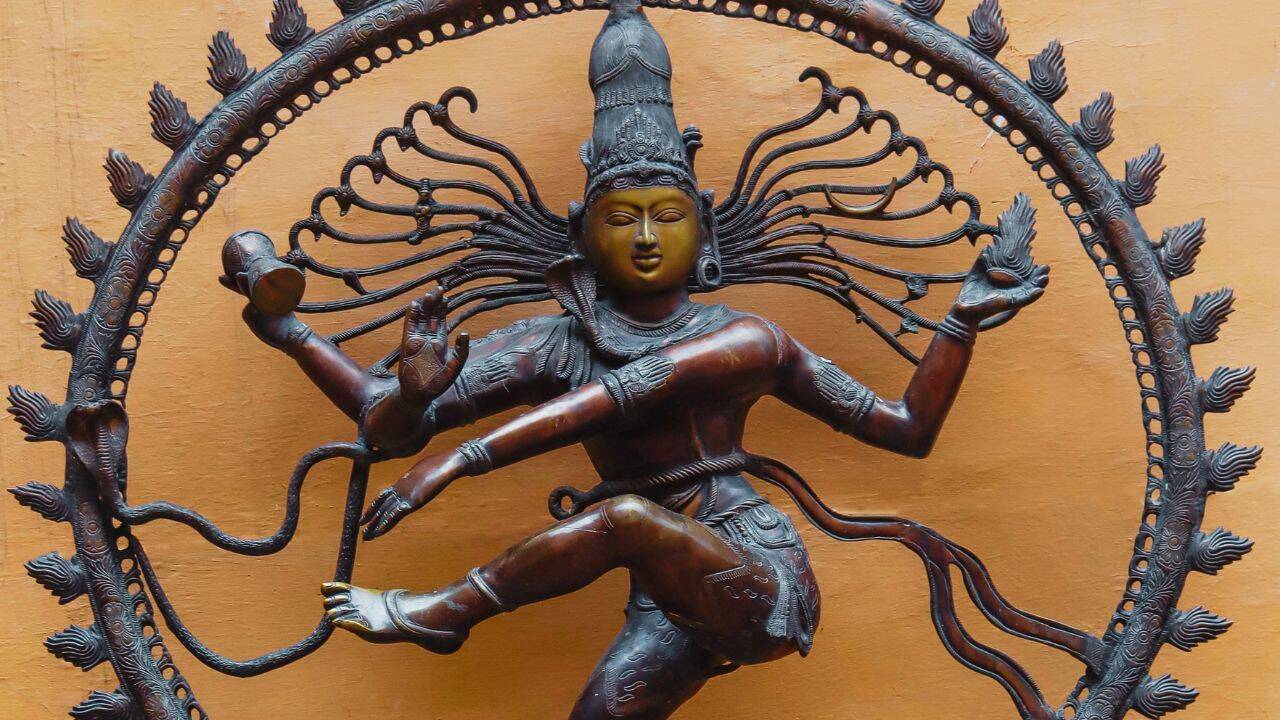
For those who don’t know, CERN is Conseil Européen pour la Recherche Nucléaire (European Council for Nuclear Research). It is the world’s largest particle physics laboratory near Geneva, Switzerland (near Franco-Swiss border). It is the lab where scientists accelerate particles to almost the speed of light. But beyond this fact, what surprises people when they enter this space is the unusual statue standing right in the centre of the campuses of one of the world’s most advanced centres of particle physics. It is a 2-metre-tall bronze figure of Shiva in his Nataraja form, the cosmic dancer.Let’s find out more about the cosmic statue:A gift from IndiaThe statue was a gift from India. It was gifted in 2004, and its presence is more than a cultural tribute. It represents a striking metaphor of the ancient Indian image of cosmic creation and destruction with the modern scientific attempt to understand the universe at its smallest scales.The statue, for Indian travellers, offers an intriguing reminder that the search for answers about the universe is not confined to lab or equations. Sometimes, it is also about thousands of years of mythology and art.What does the lab do?The laboratory is trying to recreate conditions of the early universe. It is officially the world’s largest particle physics laboratory equipped with the most famous machine, the Large Hadron Collider (LHC). Not many must be aware of the fact that it is the world’s largest and most powerful particle accelerator.
CERN Lab (Canva)
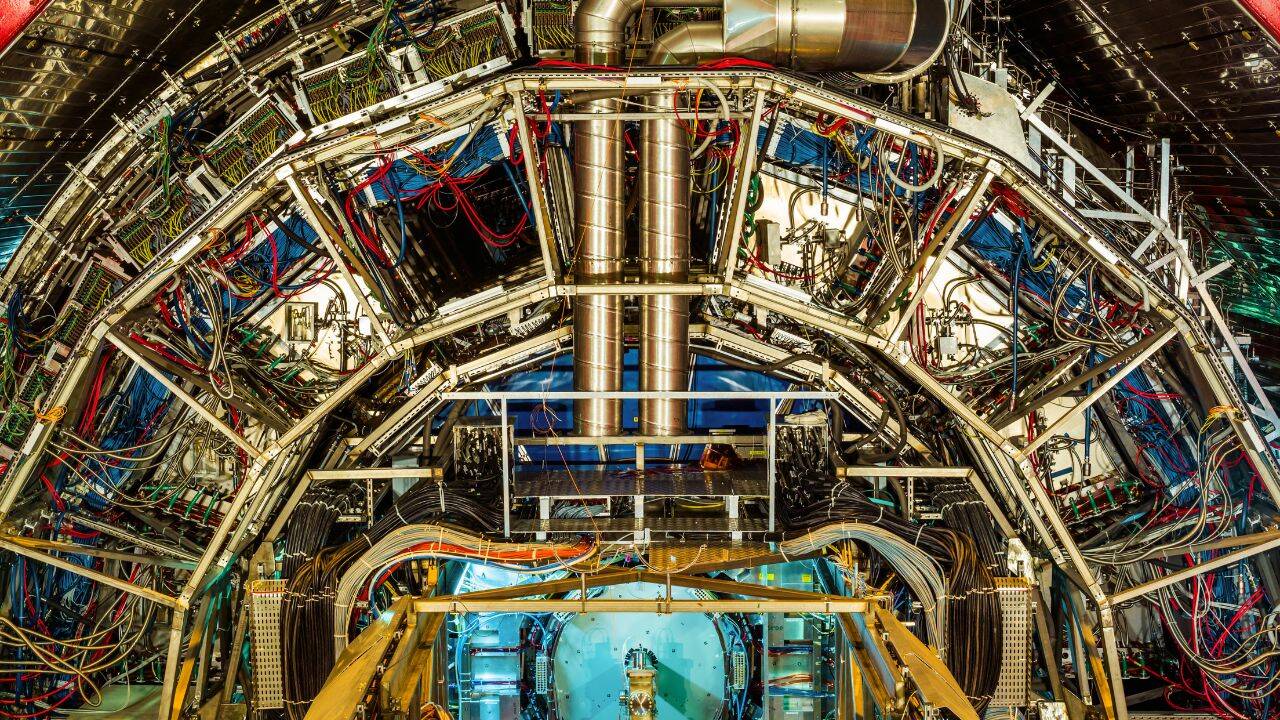
Understanding the LHCSo, LHC is a 27-kilometre ring lying about 100 metres underground. Inside it, two beams of particles travel in opposite directions at close to the speed of light before being brought into collision. Scientists study what emerges from these collisions to investigate the fundamental particles and forces that make up our universe.One of the extraordinary things CERN can do is recreate some of the extreme conditions believed to have existed in the universe’s earliest moments.And standing above this extraordinary underground world of collisions is Shiva.Why did India give CERN a statue of Nataraja?The answer goes back to India’s long scientific relationship with CERN.
Natraj Statue (Canva)
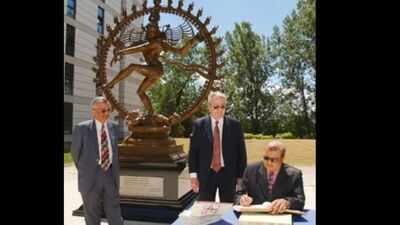
India’s collaboration with the laboratory dates to the 1960s, and Indian scientists and institutions have played an important role in CERN’s programmes. In June 2004, India gifted CERN a 2-metre-tall statue of Shiva Nataraja to celebrate this longstanding scientific partnership.The statue was unveiled on June 18, 2004, by CERN Director-General Robert Aymar, Indian Atomic Energy Commission chairman Anil Kakodkar and India’s ambassador K. M. Chandrasekhar.Tandav meets quantum physicsThe answer is because Shiva’s cosmic dance offered a powerful metaphor for the dynamic universe being investigated by particle physicists.
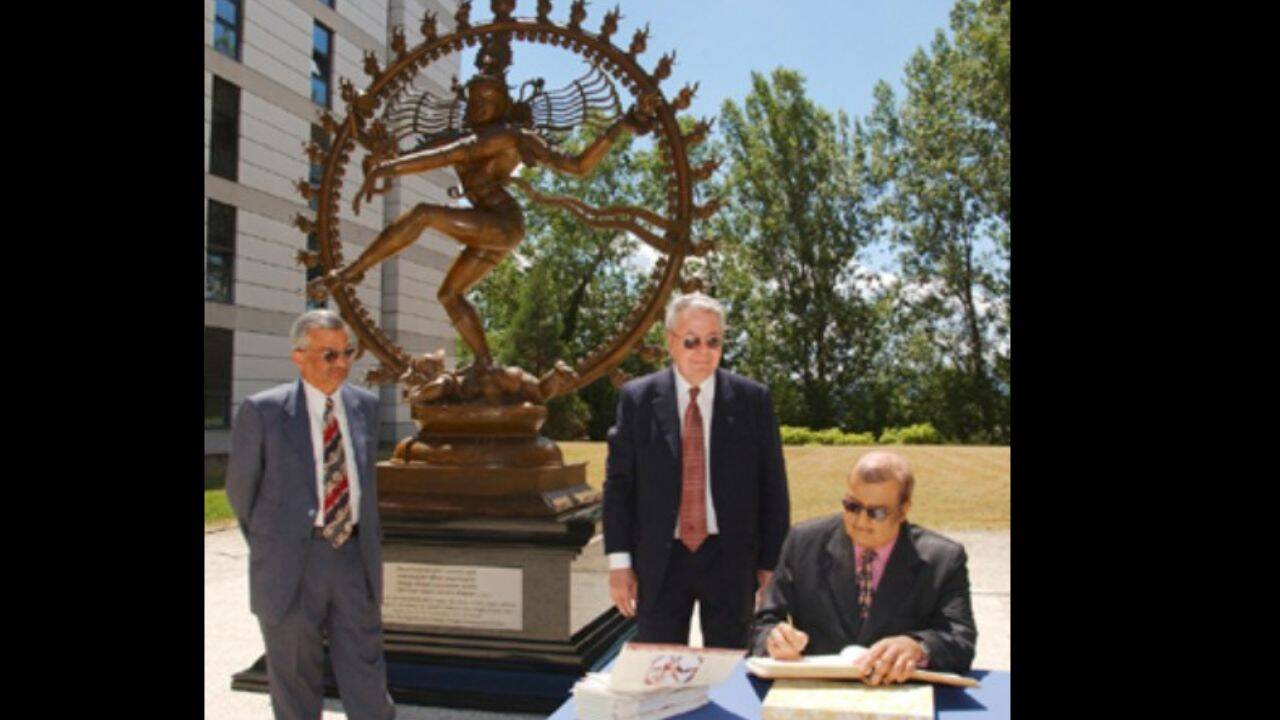
Statue (CERN Official)
The Nataraja is not simply Shiva depicted dancing. The image represents a universe in perpetual movement—creation, transformation and destruction.That symbolism fascinated physicist and author Fritjof Capra, who explored the relationship between the imagery of Shiva’s cosmic dance and modern physics. Capra first discussed the parallel in a 1972 article and later made it a central metaphor in his 1975 book The Tao of Physics.Classical physics encouraged an image of matter as consisting of solid, stable building blocks. Quantum physics revealed a far stranger microscopic world in which particles interact, transform and emerge in processes governed by quantum fields.As the plaque beside CERN’s statue explains through Capra’s words, “For the modern physicists, then, Shiva’s dance is the dance of subatomic matter.”The plaque goes on to connect the ancient bronze images of dancing Shiva with the patterns revealed through modern physics, describing the metaphor as a meeting point between ancient mythology, religious art and modern science.A statue worth seeking out on a CERN visitThe Nataraja statue adds an unexpected cultural dimension to a visit to CERN.

Inside the Large Collider at CERN (Canva)
The laboratory’s public spaces and exhibitions introduce visitors to particle physics, while the statue outside offers a very different way of contemplating the same enormous question: what is the universe made of, and how does it work?There is no claim that the statue represents a scientific theory, nor that Hindu philosophy and quantum mechanics are scientifically equivalent. Instead, its significance lies in the metaphor—a centuries-old artistic representation of cosmic motion standing beside a modern laboratory devoted to uncovering the behaviour of matter at its most fundamental level.