










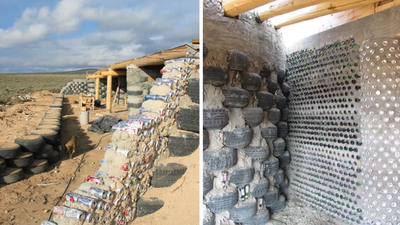
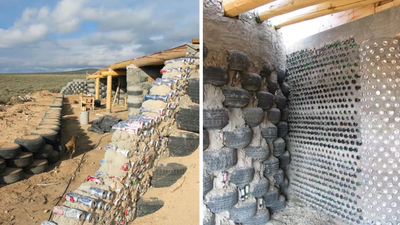
In the New Mexico desert, discarded car tyres, beer cans and bottles became the unlikely foundations of a different kind of home. Architect Michael Reynolds began developing his Earthship idea in the early 1970s, turning waste materials into thick walls designed to hold heat and houses built to produce and manage many of their own basic needs. For decades, the strange-looking buildings remained a niche experiment, often running into planning rules and scepticism. Now the idea is being viewed through a different lens. As hurricanes, floods, tornadoes and power failures leave conventional homes cut off from essential services, Earthships are attracting renewed attention for their ability to operate independently of the grid. What began as an experiment in using rubbish has gradually become a model for thinking about how homes might cope when the infrastructure around them stops working.
How Michael Reynolds turned discarded tyres, cans and bottles into Earthship homes
Reynolds began developing the idea in the early 1970s in New Mexico, after becoming dissatisfied with the limits of conventional architectural practice. His early experiments involved materials that had little obvious place in a building. Beer cans, bottles and discarded tyres became part of the construction rather than waste to be removed. The approach eventually developed into what Reynolds called the Earthship, a type of passive-solar home built around recycled materials and systems intended to reduce dependence on outside utilities. The Financial Times, writing about Reynolds’ work in the documentary Garbage Warrior, described his use of recycled cans, plastic bottles and earth-filled car tyres in houses designed to need little or no heating even during New Mexico’s severe winters.The tyres were not simply being used because they were available. Filled with compacted earth, they became part of the heavy walls, giving the buildings considerable thermal mass. That allowed the houses to store and gradually release heat rather than relying entirely on conventional heating and cooling equipment. An early house known as the Thumb House, built in 1972, is described in material accompanying Garbage Warrior as an early example of Reynolds’ use of discarded glass and plastic, tin cans and earth-filled tyres, alongside systems for handling heat, water and sewage.The idea was a long way from mainstream housing. For years, Reynolds’ early Earthships attracted little interest, with some of the first structures sitting empty. That changed gradually. According to NBC News, structures based on the concept have since been built in 35 US states as well as internationally. The same report notes that the houses are constructed with at least 40 per cent recycled material and are designed to use roughly one-sixth the power of a conventional home.
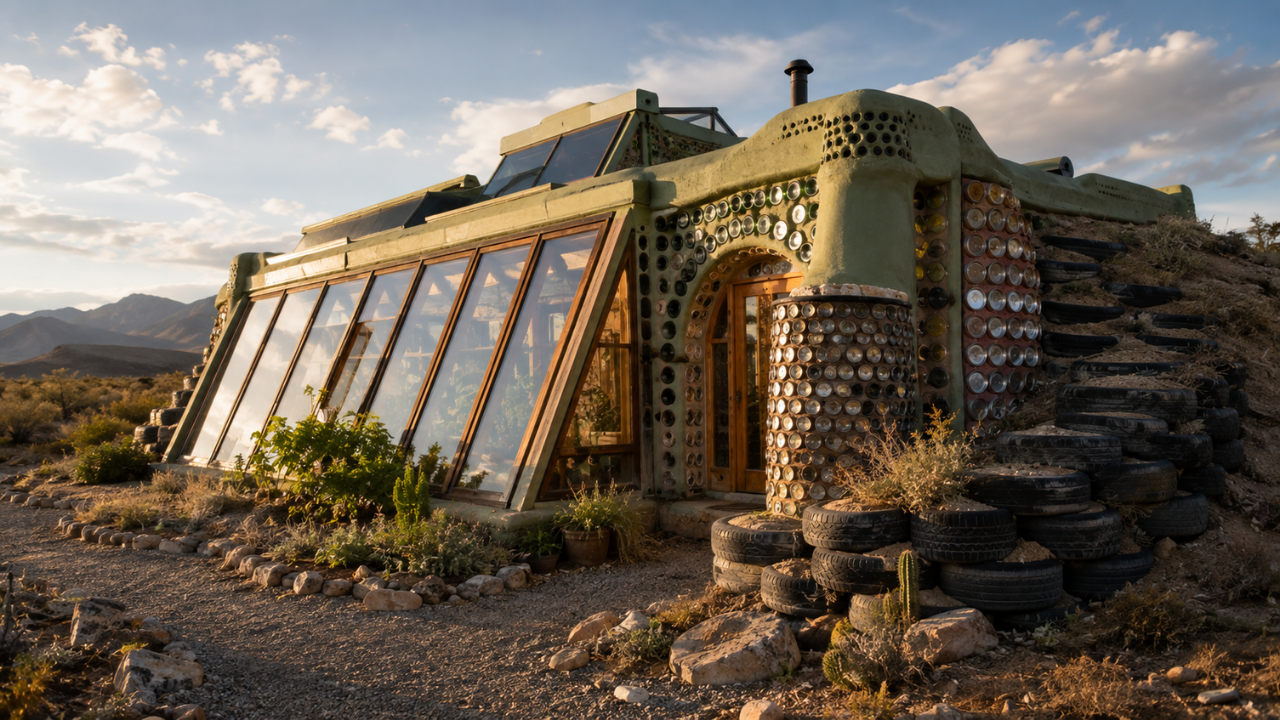
PC: Image AI generated
What are the six defining elements of an Earthship home
An Earthship is not defined simply by having tyres in its walls. Reynolds’ system brings several separate functions together inside the same building. His six defining elements include the use of natural and repurposed materials, passive or solar heating and cooling, electricity from solar and wind power, rainwater collection and reuse, contained sewage treatment, and the ability to grow food on site.That changes the relationship between a house and the infrastructure outside it. Rain falling on the roof, for example, does not necessarily leave the property as runoff. Collected rainwater can first be used for activities such as washing before passing through filtration systems, after which it can be used for toilets and plants. The basic principle is simple: a resource enters the building, is used more than once where possible, and is dealt with on site rather than depending entirely on a municipal network.The same thinking applies to electricity. Solar panels and, where suitable, wind generation are intended to supply power without a conventional connection to the grid. The result is a home designed to remain operational even when the wider utility network is unavailable. That does not mean every Earthship is identical or completely independent in practice. Owners can choose how closely they follow the full model, and this flexibility has attracted criticism from people who question whether a house should be called fully sustainable if it adopts only some of the principles.
How Earthship homes were used after the 2004 Indian Ocean tsunami
The idea became clearer when Reynolds’ work moved beyond the desert. After the 2004 Indian Ocean tsunami, his team travelled to the Andaman Islands in 2005 to work with communities dealing with the destruction left behind. The project was not a theoretical exercise. Local people needed buildings, materials were limited, and the normal processes of development were hardly suited to the circumstances. Architect Nileshe had discovered Reynolds’ work and invited him and his team to construct a demonstration building in the islands.The experience also showed why a building’s independence from central infrastructure could matter after a disaster. Reynolds and his crew constructed low-tech shelters in the aftermath of the tsunami using local materials and ideas drawn from the Earthship communities in New Mexico. The work offered a practical setting for methods that had spent years being tested in a very different environment.That history now sits alongside a newer interest in Earthships as disaster-resilient housing. Reynolds’ company had begun working in places affected by tornadoes and hurricanes, including southeastern Kentucky and Puerto Rico. The report also linked the renewed attention to events such as the 2021 Texas winter storms, when widespread power failures left households without electricity for days.The attraction is not difficult to understand. A conventional house may remain physically intact after a storm but become difficult to live in if electricity, water or sewage systems are knocked out. An Earthship attempts to keep several of those functions inside the building itself. The structures are designed to be more resistant to hurricanes, tornadoes and floods and can function as emergency shelter while remaining independent of a damaged power grid.
Why Earthship homes have faced building code and planning restrictions
Reynolds’ work has never fitted comfortably into ordinary planning systems. The same features that make an Earthship unusual also create regulatory problems. Conventional building codes tend to assume a house will connect to established electricity, water and sewage networks and will use familiar construction materials. Reynolds’ houses were deliberately designed around a different arrangement. His buildings therefore became entangled in disputes with authorities in New Mexico, including battles over licences, planning rules and whether experimental communities could operate outside standard requirements.That tension has not disappeared simply because interest in self-sufficient housing has grown. According to the Earthship Academy, students attending have reportedly travelled from different countries to learn about solar and wind systems, water management and indoor food production; practical lessons do not automatically translate into permission to build an Earthship anywhere. The case of a student who wanted to construct one but faced restrictions in Illinois over some of the materials used in the structures. An architect from Belgium attending the same course said he was interested in applying individual Earthship ideas to conventional buildings rather than necessarily reproducing the entire model.
Why Earthship ideas are becoming relevant beyond homes built with tyres and cans
That may be where the concept is becoming more relevant. The future of Earthship design does not necessarily depend on every new house being built from tyres and cans in the same form Reynolds developed in New Mexico. Parts of the system can be separated from the distinctive architecture: generating some household electricity on site, capturing rainwater, reducing heating and cooling demand, reusing materials and creating ways to continue operating when external services are interrupted. In that sense, the old New Mexico experiment is being treated less as a fixed house design and more as a collection of building ideas.The shift is a subtle one. Reynolds began by questioning why architecture needed to rely so heavily on conventional materials and centralised services. Decades later, the same question has acquired a practical edge in communities facing hurricanes, floods, tornadoes and prolonged power outages. The Earthship was never designed simply as a response to extreme weather; its emphasis on thermal stability, renewable energy, water reuse and independence from utility networks has given the old experiment context.