










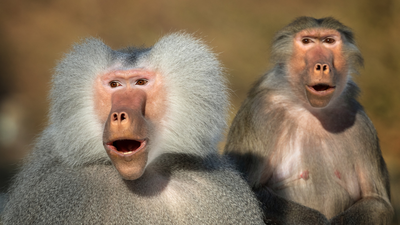
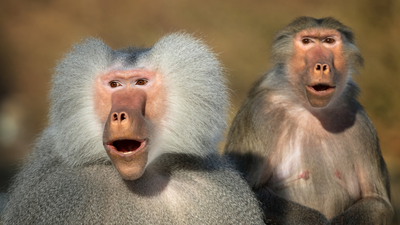
Ask most people across Africa what they think of baboons, and crop damage will probably be the first thing that anyone mentions before anything else!These primates are well known for raiding farms, which has given them quite a negative image in many cultures.Despite this, it is quite surprising to learn that an ancient civilisation didn’t just tolerate baboons; instead, they treated this species as a living god!
The Hamadryas baboon was revered as God by Egyptians despite the notorious image it has today
The ancient Egyptian civilisation worshipped the Hamadryas baboon, one of the two animal forms taken by Thoth, the Egyptian god of wisdom, writing, magic, and the moon.The sacred baboon can be seen again and again in ancient Egyptian art and religion, and not just for a short while, either. We can find it in Predynastic statuettes, later burial traditions, wall paintings, reliefs, amulets, and statues, a tradition that lasted more than 3,000 years, according to a study published in eLife Sciences.For a long time, this puzzled scholars, as Thoth’s other animal form, the sacred ibis, made sense with its curved beak looking like a crescent moon, and its black-and-white feathers fit a lunar deity perfectly, but the baboon could give no such easy explanation, especially since it isn’t even native to Egypt.A new study from researchers at the University of St Andrews and Dartmouth College may have finally cracked the mystery, and the answer comes down to something surprisingly literal: colour. Here’s what they found, and how they found it.
A God with two very different faces
Thoth was represented by two animals rather than one, which seemed unusual even by ancient Egyptian standards, where most deities were represented by a single animal form.The ibis part of the mystery had already been mostly figured out. But according to a statement from the University of St Andrews, the baboon was a different story altogether, calling it “far more puzzling.”Earlier scholarship had already traced the origin of Thoth’s Egyptian name back to North African linguistic terms meaning “bright” or “white thing,” a detail that aligned with the ibis’s white feathers. But that still left the baboon’s role unexplained, since its fur isn’t white at first glance.
Researchers measured the colours of the Baboons’ fur with light, not the human eye
Researchers then used spectroscopy to measure the actual light-wave frequencies given off by a colour rather than relying on how humans subjectively perceive it.As the university statement explained, this method was chosen specifically “to avoid the pitfalls of relying on human subjective impressions of colour, which are notoriously sensitive to cultural influences.”Using this method, the team discovered that both the ibis and the Hamadryas baboon “have spectral profiles indistinguishable from moonlight”. The researchers say this supports the idea that both animals were considered divine largely because their colours genuinely resemble moonlight, not just poetically, but measurably.