










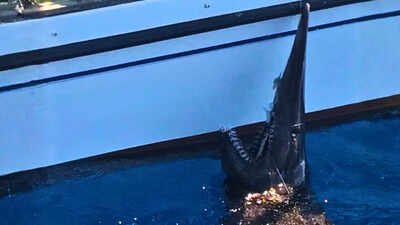
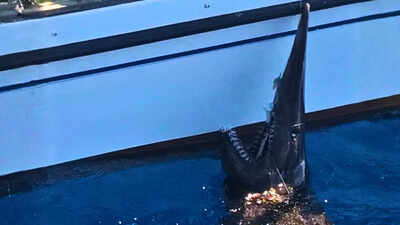
In May 2024, a group of recreational fishers off the coast of San Cristóbal, roughly 9.5 kilometres from Gran Canaria, hooked something none of them expected while fishing in 900 metres of water. What came up was a 2.5 metre goblin shark, a species so rarely seen alive that researchers had never before documented one in Canary Islands waters. The fishers photographed and filmed the animal before releasing it back into the sea, and those images later became the basis for a formal scientific record. Researchers from the University of La Laguna confirmed the sighting as only the second live goblin shark recorded across the wider Macaronesian region. The finding was formally published in Thalassas: The International Journal of Marine Sciences in January 2026, extending the documented range of this elusive deep-sea shark further into the Central-Eastern Atlantic and giving scientists an unusually detailed record of a species rarely observed in its natural habitat.
Why goblin sharks are among the least seen sharks on the planet
According to the study First record of the goblin shark, Mitsukurina owstoni, in the Canary Islands, published in Thalassas: The International Journal of Marine Sciences, fewer than 250 goblin sharks have been documented worldwide. The species, scientifically named Mitsukurina owstoni, is instantly recognisable, with a long, flat, paddle-shaped snout extending well past its tiny eyes, along with highly protrusible jaws lined with thin, needle-like teeth. Its body is unusually soft, while its pale pinkish-white colour comes from blood vessels visible beneath the skin. Goblin sharks are generally associated with deep water, with documented specimens found at depths extending from several hundred metres to more than 1,000 metres below the surface, where encounters with humans are exceptionally uncommon.
How the Canary Islands became an important location for studying deep-sea sharks
The researchers did not treat the sighting as merely a curiosity. They pointed to the Canary Islands’ deep-water environment as an important reason the region may support species that are rarely encountered elsewhere. Bottom trawling was prohibited across the archipelago in the 1980s, while there is no targeted fishery for goblin sharks in the surrounding waters. The islands’ underwater geography also creates a wide range of deep-sea habitats, with the seabed dropping sharply away from the coast in places.That combination makes the archipelago particularly valuable for monitoring deep-water species. The researchers argue that the goblin shark’s appearance highlights how much remains unknown about the biodiversity living below the waters surrounding the Canary Islands. A species can inhabit an area for decades without being recorded simply because it lives at depths where conventional observation is extremely difficult.
What the Gran Canaria shark reveals about a still-unsolved Atlantic mystery
The Gran Canaria specimen was provisionally identified as a female and measured approximately 2.5 metres long. Its discovery is significant not only because it represents the first recorded live goblin shark sighting in the Canary Islands, but also because it adds another piece to the incomplete scientific picture of where the species lives and how it uses the Atlantic. Goblin sharks have been known to science since the late 19th century, yet researchers still know surprisingly little about their behaviour, reproduction and population structure. Their deep-water habitat makes sustained observation extremely difficult, and most records come from animals accidentally caught by fishing vessels rather than from deliberate encounters.That scarcity makes every confirmed sighting unusually valuable. The 2024 encounter gave researchers photographs, video and precise information about where and at what depth the shark was found, allowing the animal to become part of the scientific record without being killed for examination. The University of La Laguna researchers say continued monitoring of the Canary Islands’ deep-sea ecosystems will be important for determining whether the goblin shark was simply an isolated visitor or evidence of a previously undocumented population living in the region’s deep waters.