









A critically endangered shrub that once came close to disappearing from the Galápagos Islands is showing signs of a slow but important recovery after a careful conservation effort lasting nearly three decades. According to findings published in the journal Nature Conservation and reported by Phys.org, the wild population of the Galápagos snapdragon (Galvezia leucantha subsp. leucantha) has grown to 28 mature plants. The recovery is a major success for botanists, who found only six surviving wild plants nearly two decades ago in remote lava fields. The increase follows a reintroduction programme led by the Charles Darwin Foundation and the Galápagos National Park Directorate. Field teams grew plants in nurseries and later transplanted 94 young shrubs into the difficult volcanic landscape of northern Isabela Island.
Decades of decline on young lava flows
The Galápagos snapdragon is a rare flowering shrub found only in the Galápagos archipelago in the eastern Pacific. For years, scientists feared the subspecies could disappear completely. The story of its conservation began with a single herbarium specimen collected near Caleta Tagus in 1962. For more than 30 years, the dried plant was the only clear evidence that the subspecies had existed in the area. Dr Patricia Jaramillo Díaz, a senior researcher at the Charles Darwin Research Station, repeatedly returned to the specimen over the years with one question in mind: “Does this plant still exist?” That question led to field expeditions in 1998 to the rough, young lava flows of Darwin Volcano on northern Isabela Island. Scientists eventually found that the plant had survived, but only in very small numbers. By 2007, detailed surveys showed that years of grazing by feral goats and other introduced herbivores had badly damaged native vegetation. Only six wild snapdragons remained, growing in narrow cracks in the black basalt.
Growing hope in nurseries
Scientists knew the remaining plants could disappear because of a single drought, landslide or other natural event. They therefore began an emergency programme to collect seeds from the last six wild plants. Growing the species in nurseries was difficult. Seeds collected from the wild went through laboratory testing, cleaning and manual scarification at the Charles Darwin Research Station’s plant propagation facilities. Technicians carefully controlled light, temperature and moisture to copy the conditions needed for the seeds to germinate while protecting the young plants. After the seeds germinated, nursery workers cared for the young shrubs until they developed strong root systems that could survive in the harsh conditions of the lava fields. In total, conservation teams successfully raised 94 healthy young shrubs. They were then prepared for a return to the volcanic slopes where the species had evolved.
Returning to the lava fields
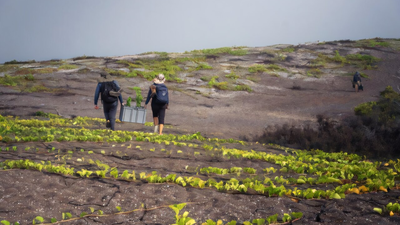
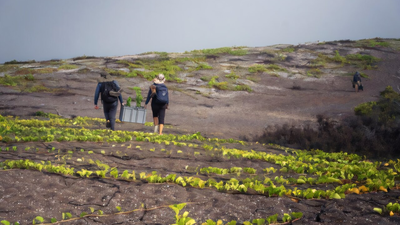
Moving the nursery-grown plants to the restoration site at Playa Tortuga Negra and nearby lava fields required careful planning. The areas are difficult to reach, with much of the journey requiring travel by sea followed by difficult walks across rough volcanic ground. Field workers placed the 94 young shrubs inside deep cracks in the lava. Protective mesh covers were used to shield them from strong tropical sunlight, sea spray and invasive pests. Later monitoring showed that many of the transplanted plants developed strong root systems inside the volcanic cracks. Over time, the young shrubs grew and became part of the natural ecosystem. Their survival helped increase the number of mature, flowering plants from just six to 28.
Natural reproduction brings new hope
The restoration programme reached another important milestone when researchers recorded the first natural regeneration of seedlings in the wild. For the first time in decades, transplanted adult plants produced seeds that germinated naturally in the surrounding basalt without help from conservation workers. A later dry period killed those first wild seedlings, but their appearance was still an important sign. It showed that the reintroduced plants were capable of producing viable seeds and reproducing naturally in their original habitat. Water remains the biggest challenge for the recovering subspecies. Northern Isabela Island is dry, and unpredictable weather can cause large changes in available moisture from one year to the next. Botanists continue to monitor the 28 adult plants, checking their health, seed production and long-term survival. The Galápagos snapdragon remains critically endangered, but its recovery from just six wild survivors to a growing population of mature plants shows how carefully planned conservation can help rescue even highly threatened island species from extinction.