







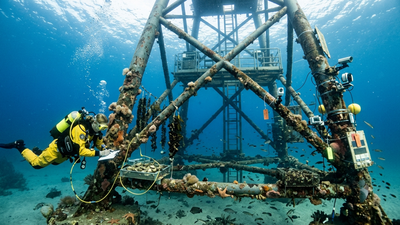
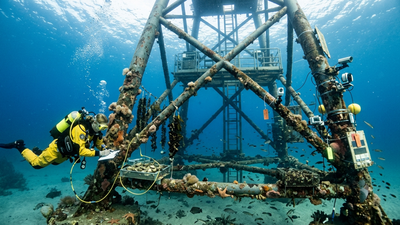
Far out in the Atlantic, the concrete base of a floating wind turbine has been given an unusual second role. Instead of serving only as the underwater support for renewable energy equipment, parts of the structure are now carrying ropes, nets and collectors designed to grow marine species. Commercial divers attached equipment for oysters, clams, mussels and green algae to the submerged columns of the DemoSATH floating platform off Spain. The arrangement is part of a research trial looking at whether offshore wind infrastructure can accommodate aquaculture without interfering with its main purpose. It is a small-scale experiment, but the idea behind it is fairly simple: use the same patch of ocean for more than one activity while creating additional habitat beneath the turbine.
Oysters, clams, mussels and Ulva form an experimental underwater farming system
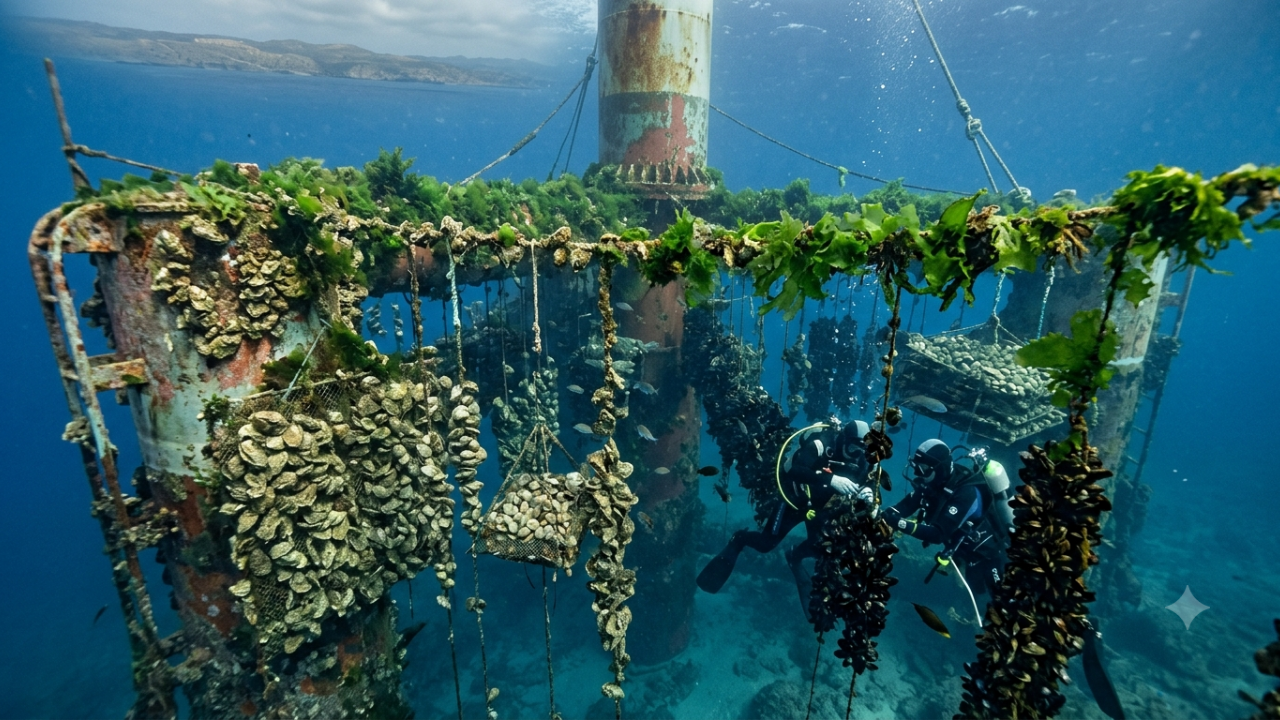
According to The International Aquafeed website, the equipment installed around the platform includes lantern nets for European flat oysters, collectors for pullet carpet shell clams, ropes carrying mussels and lines supporting Ulva, a type of green seaweed. Each component serves a different biological role, bringing several forms of cultivation into the same underwater space.The arrangement is intended to resemble a small multitrophic farming system rather than a collection of unrelated cages. Filter-feeding shellfish can obtain food from the surrounding water, while the algae take up nutrients. In theory, placing these organisms together could make better use of the material and nutrients circulating around the structure.It is still an experiment, though. The equipment has to withstand open-sea conditions, and the species themselves must survive and grow in an environment that is very different from a sheltered coastal farm.
How the offshore aquaculture system was prepared and installed
Getting the system onto the floating turbine involved considerably more work than simply lowering cages into the water. Before the offshore installation, live specimens were collected from supplier Mar Ceibe and the equipment was temporarily fitted to a mussel raft at Mutriku.That stage gave the teams an opportunity to prepare the cultivation units before they faced the conditions around the offshore platform. Instituto Kardala provided technical support, while Grupo Peñascal Kooperatiba helped fabricate units designed around the particular shape of the turbine foundation.There was also a practical matter that could easily become a problem underwater. Every component needed to be identifiable during installation, so equipment was marked with identification numbers and material labels and given colour coding. With divers, vessels and multiple pieces of equipment working at the same time, keeping track of what went where was part of the operation.
The underwater installation turned the turbine base into a test farm
Once the equipment was ready, the project moved offshore to the DemoSATH site. Support vessels positioned themselves around the floating platform while commercial divers retrieved the prepared aquaculture equipment and secured it to the concrete columns below the waterline.A central mother rope provided the main support for the various cultivation lines. Lantern nets, mussel ropes and collector ropes could then be attached to it rather than each being independently secured to the turbine structure.The work required several teams to operate together. Amarradores de Santander supplied the main support vessel and handled maritime operations associated with positioning and mooring, while diving company Kotazero carried out the underwater work. Saitec Offshore Technologies coordinated the installation, including documentation, safety procedures and installation checks.It was a technical exercise as much as an aquaculture trial.
Four types of marine life are being tested together
The AQUASATH trial brings four cultivated species or groups into the same offshore setting: European flat oysters, pullet carpet shell clams, mussels and Ulva algae.Their inclusion is linked to the idea of multitrophic aquaculture, where organisms occupying different positions in the food system are grown together. Shellfish such as oysters, clams and mussels feed by filtering particles from seawater. Seaweed, meanwhile, absorbs dissolved nutrients as it grows.The arrangement could create a more varied biological environment around the otherwise engineered foundation. Shells and ropes also introduce additional surfaces and structures into the water, potentially giving other marine organisms places to attach or shelter.But the trial is not designed to assume that this will happen. The purpose is to measure what actually occurs once the equipment and organisms are exposed to the sea.
Can floating wind platforms also support marine farming
Offshore wind farms occupy areas that can be difficult to use for other activities. Floating systems introduce another possibility because their foundations remain offshore while the surrounding water can potentially accommodate carefully designed co-use activities.AQUASATH is being carried out under the DemoSATH Lab biodiversity initiative, with support from the Basque Government and the European Regional Development Fund. The project is examining whether aquaculture can operate alongside a floating wind installation rather than requiring an entirely separate area of ocean.That distinction matters. The experiment is not simply about producing oysters or mussels offshore. It is also about finding out whether renewable energy infrastructure can be designed or adapted to accommodate other marine uses.
The next challenge is keeping the marine farm alive offshore
Attaching the equipment successfully is only the first step. The more difficult questions will take months or years to answer.The teams need to see how well the oysters, clams, mussels and Ulva survive through changing seasons. Growth rates will matter, but so will losses, fouling, maintenance requirements and the ability to reach the equipment for inspection and harvesting.The offshore setting introduces its own practical complications. Waves, currents and storms can place considerable stress on ropes and cages. Equipment can become covered by organisms that were not part of the original trial, while harvesting from a floating wind platform may require vessels and procedures that differ from those used in conventional aquaculture.For that reason, an installation that works physically does not automatically translate into a commercially viable farming system.