









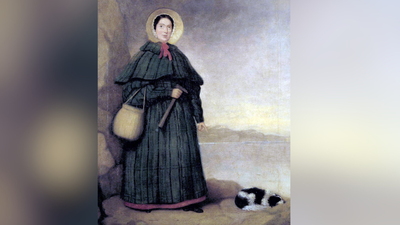
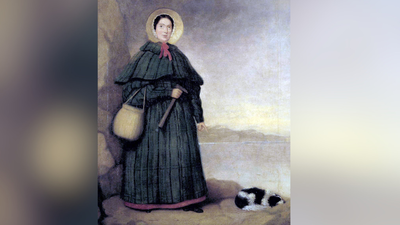
Mary Anning did not have a university degree, a laboratory or a prestigious scientific title. She had a hammer, sharp eyes and the dangerous cliffs of Lyme Regis. Born in 1799, Anning grew up on England’s Jurassic Coast, where storms regularly exposed fossils from rocks formed when the area lay beneath an ancient sea. What began as a way for a struggling family to earn money became a remarkable fossil-hunting career.
A childhood spent searching the shore
Anning’s father, Richard, was a carpenter who also collected fossils and sold them to visitors. He took Mary and her brother Joseph fossil hunting and taught them how to clean their finds.After his death in 1810, the family faced serious financial hardship. Mary continued searching the beaches and cliffs, often working in difficult weather, because fossil sales helped keep the household going.She became remarkably skilled at recognising, preparing and piecing together fossils. Her work was not simply about finding unusual stones. She was gradually learning how ancient animals had lived.
The “sea monsters” beneath the cliffs
One of her earliest major discoveries involved an ichthyosaur. In 1810, Joseph found its skull after a rockfall. Mary later helped expose and assemble much of the roughly five-metre skeleton. Scientists eventually identified it as an ichthyosaur, an extinct marine reptile.Then came an even stranger find.In 1823, Anning discovered the first complete, articulated skeleton of Plesiosaurus dolichodeirus, a marine reptile with an extraordinarily long neck. The specimen became one of the most important fossils associated with her name.In 1828, she also discovered the first pterosaur found in Britain, later known as Dimorphodon. Unlike the marine reptiles she usually encountered, this was a flying reptile.
She even studied fossilised poo
Perhaps the most unexpected part of Anning’s work involved coprolites, fossilised animal faeces.She was among the first to recognise that some strange, spiral-shaped fossils found around Lyme Regis were actually ancient droppings. Their contents could provide clues about what extinct animals had eaten.That detail captures something important about Anning. She was not merely collecting spectacular skeletons. She was trying to understand the lives behind them.
A scientist without the recognition
Anning’s discoveries helped scientists think differently about extinction, ancient life and the enormous age of Earth. Yet the scientific world of 19th-century Britain was not built to give someone like her an equal place.She was working-class and a woman. The Geological Society did not admit women during her lifetime. Scientists and collectors bought her fossils and sought her expertise, but her contribution was often poorly acknowledged.Her story is therefore not only about fossils. It is also about who gets remembered as a scientist.Mary Anning died in 1847, aged 47. Today, her fossils are held in major collections, including the Natural History Museum in London, while Lyme Regis continues to preserve the landscape where she made her discoveries.The cliffs still look like cliffs. But beneath them lies a record of life from roughly 200 million years ago. Anning was one of the people who learned how to read it.Disclaimer: This article is based on historical records and information from museum and scientific sources.