









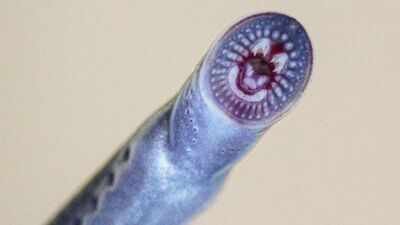
In 2022, Australian ecologist Dr Luke Carpenter-Bundhoo set out to study how the Black Summer bushfires had affected ecosystems in K’gari, Queensland. Instead, while surveying a creek, he encountered an unexpected creature: an eel-like fish with seven gills and a mouth lined with circular rows of teeth. The animal was an ‘Australian brook lamprey,’ an ancient and little-known species that had never previously been recorded on the island. Its presence was especially startling because K’gari lies roughly 1,400 to 1,500 kilometres, or about 900 miles, north of the lamprey’s previously documented range. The discovery challenged assumptions about where the species could survive and opened new questions about its future. Now, Carpenter-Bundhoo is leading further research into the fish, popularly known as the ‘vegan Dracula,’ to discover just how much of Queensland it may inhabit.
How did Luke Carpenter-Bundhoo find the ancient ‘vegan Dracula’ fish so far beyond its known range
According to Griffith University, Carpenter-Bundhoo was on K’gari investigating the ecological effects of the Black Summer bushfires when he and his colleagues used electrofishing to survey one of the island’s creeks. There, he spotted the strange creature and immediately recognised that it was a lamprey. His next thought was ‘what was it doing there.’ The Australian brook lamprey, (Mordacia praecox), had previously been documented much farther south, in streams near the border between New South Wales and Victoria. Griffith University reported that the species was found around 1,400 kilometres north of that known location.The discovery was remarkable for another reason. Scientists had long assumed that this lamprey could not survive in warm waters. Yet the fish had apparently been living in tropical Queensland, with records suggesting lampreys had also reached as far north as Rockhampton for more than a decade. According to Carpenter-Bundhoo, Queensland may therefore be home to the world’s first tropical lamprey.
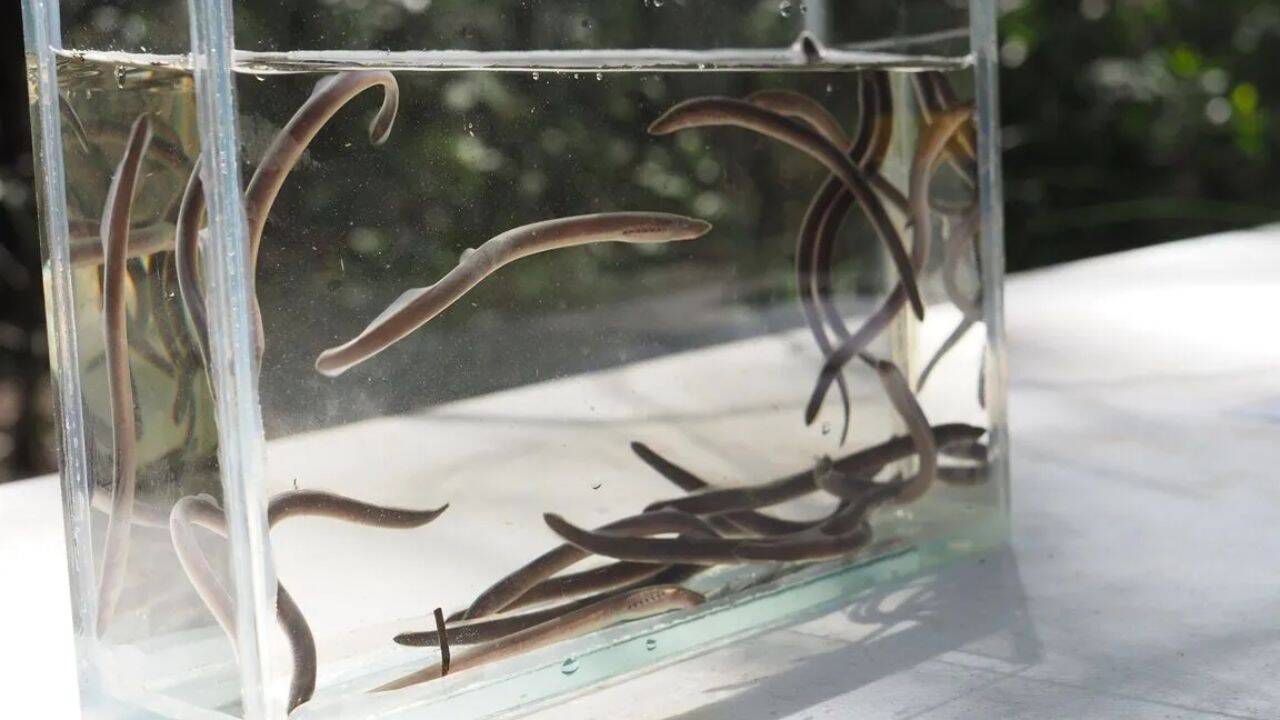
Australian brook lamprey caught in field. Image Credit: Griffith University
Why the ‘vegan Dracula’ fish does not drink blood
The lamprey’s nickname comes from its appearance rather than its behaviour. Its mouth is lined with sharp, circular teeth, giving the small fish a distinctly vampire-like look. However, as Griffith University explained, the Australian brook lamprey is non-parasitic. Unlike many lampreys, it does not feed on the blood or flesh of other animals. That unusual lifestyle earned it the nickname ‘vegan Dracula’. Carpenter-Bundhoo described most lampreys around the world as parasitic, while this species skips that feeding stage. The Australian brook lamprey is also among the country’s smallest lampreys, growing to only about 15 centimetres.For much of its early life, the creature is even harder to notice. According to Griffith University, its first three to four years are spent as a sightless larva living on the bottom of creeks, where it filters microscopic algae from the water. Later, it undergoes a transformation into adulthood, stops feeding and directs its remaining energy towards reproduction. Its adult life ends within roughly eight months after that transition.
The lamprey offers a glimpse into early vertebrate evolution
Lampreys are among the most ancient living vertebrates. Griffith University reported that the evolutionary line leading to humans and lampreys diverged about 485 million years ago, while the basic form of lampreys has changed remarkably little for around 150 million years. In evolutionary terms, that makes them older than Australia’s famous lungfish and even older than dinosaurs. Their age is not simply a curiosity. Carpenter-Bundhoo believes that studying their biology and DNA could help scientists understand how more complex vertebrates, including humans, developed. Griffith University described lampreys as valuable model species because their relatively simple biology provides researchers with a glimpse of an earlier stage in vertebrate evolution. As PEOPLE reported, their unusual genetic makeup could also contribute to research relevant to human medicine.
New funding will take the search deeper into Queensland
The discovery of K’gari may have been only the beginning. In August 2026, Carpenter-Bundhoo received $90,116 through Queensland’s ‘Protecting Queensland’s Threatened Species Applied Research Grant Program.’ Working with ‘David Moffatt,’ a principal scientist with the Queensland Department of the Environment, Tourism, Science and Innovation, Carpenter-Bundhoo will now investigate remote and difficult-to-reach habitats across the state. The aim is straightforward but important: find out exactly where these lampreys live.This knowledge is particularly urgent because, according to Griffith University, the Australian brook lamprey was thought to be extinct in its original documented range. Queensland may now be the only place where the species survives. The team also has evidence of something even more intriguing. Researchers have identified two smaller lampreys in Queensland that have not yet been formally described. If further study confirms that they are separate species, Australia could have 5 lamprey species rather than 3, with three of them occurring in Queensland.
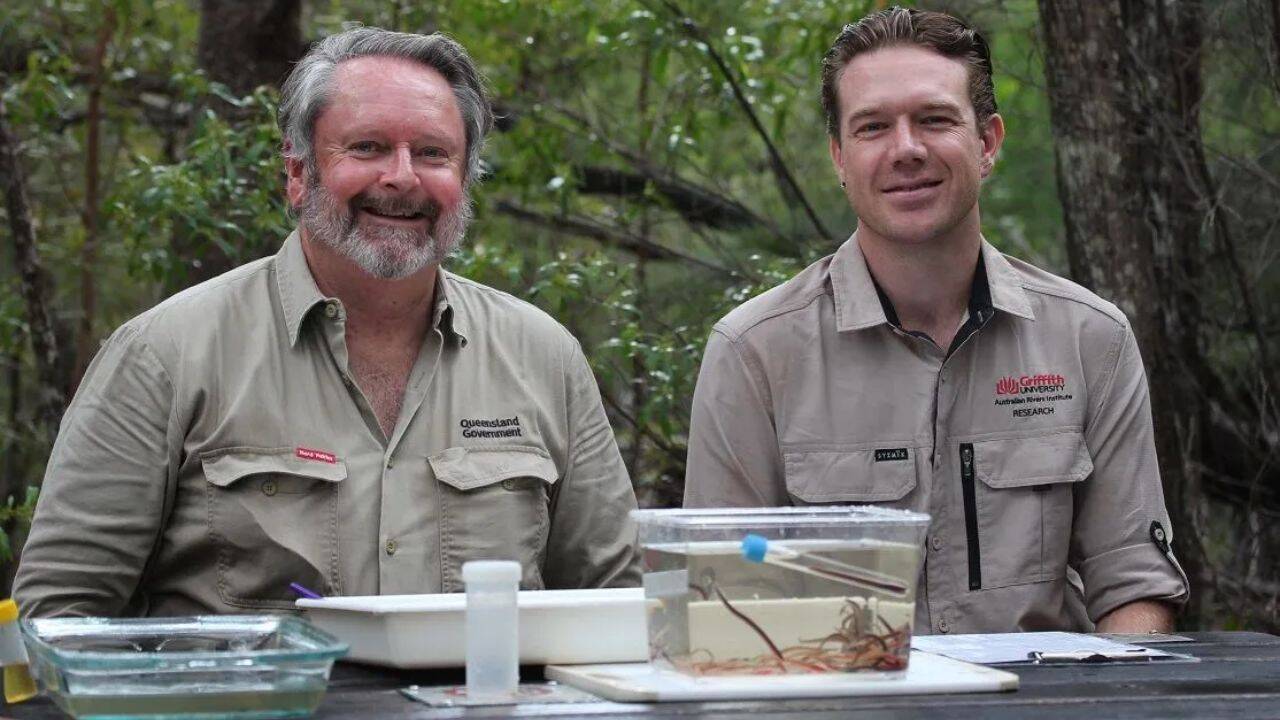
DETSI Principal Scientist David Moffatt and Griffith University’s Dr Luke Carpenter-Bundhoo. Image Credit: Griffith University
Finding hidden lampreys is crucial for their survival
Griffith University reported that Australian brook lampreys often bury themselves beneath sand, making established populations extremely difficult to locate. That creates a conservation problem. Scientists cannot effectively protect a species if they do not know where its populations are. Carpenter-Bundhoo and his colleagues will therefore return to K’gari and explore other parts of Queensland in search of more evidence. Each newly sampled creek could help redraw the known range of one of Australia’s most elusive fish. The 2022 encounter ended with a discovery that pushed an ancient species hundreds of miles beyond its expected range. Four years later, that accidental meeting has become the starting point for a larger search into the hidden waterways of Queensland.