










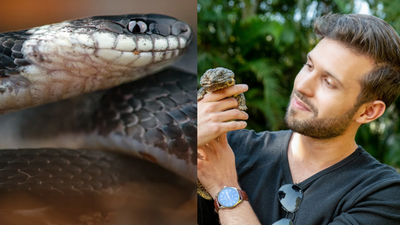
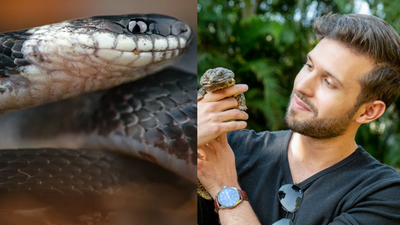
Alejandro Arteaga went into the cloud forests of Ecuador with a very specific mission, he was searching for reptiles to document for a book on the country’s extraordinary herpetological diversity. Instead, one of his field trips produced something far more significant, a snake that science had not formally recognised before.In 2017, Arteaga encountered a small, dark-coloured snake on a road to Mindo in Ecuador’s Pichincha province. The animal would eventually be identified as a new species, Ninia guytudori, now known as Tudor’s Coffee-Snake. It was formally described several years later after researchers compared its physical characteristics, genetics and distribution with related snakes.The discovery was made by biologists associated with the Khamai Foundation and Liberty University and formally published in the journal Evolutionary Systematics. The paper, ‘A new species of Ninia (Serpentes, Colubridae) from western Ecuador and revalidation of N. schmidti,’ was written by Alejandro Arteaga and Kyle J. Harris in 2023.What makes the story particularly striking is that the snake was not found in some untouched corner completely beyond human influence. Like other coffee snakes, it appears able to use coffee plantations, a reminder that even landscapes altered by people can harbour species that have escaped scientific notice.
Alejandro Arteaga found the new coffee snake while searching for reptiles for a book
Arteaga first encountered the snake in Pichincha province in July 2017, while working on his broader effort to document Ecuador’s reptiles. The search was connected to a book project on the Reptiles of Ecuador.The specimen that became the species’ holotype was an adult female collected by Arteaga on July 27, 2017, on the road to Mindo at an elevation of about 1,676 metres. That individual was later catalogued as JMG 1327 and became the scientific reference specimen for the new species.Arteaga has described the discovery as part of a much larger personal goal. In material released about the discovery, he said it was the 30th species he had discovered, out of a target of 100. The search illustrates how fieldwork aimed at documenting known biodiversity can still reveal animals that have never been formally described.Khamai Foundation’s account of the discovery says its biologists and researchers from Liberty University subsequently worked together to establish that the snake represented a species new to science. The foundation now highlights the discovery among its work in Ecuador’s cloud forests, where it supports biodiversity protection and research.
The black snake with a white collar was hiding in plain sight
The new species is relatively small. The scientific description records males measuring between 181 and 243 millimetres in snout-to-vent length, while the single female measured 183 millimetres. Its most recognisable feature is its largely black body combined with a white collar that connects with a white band around the lips, giving the snake a distinctive bridle-like appearance.The researchers named it Ninia guytudori, giving it the proposed English name Tudor’s Coffee-Snake. The species was named in honour of naturalist and scientific illustrator Guy Tudor, recognising his contribution to the conservation and appreciation of South American birds through his artwork.The scientific paper did not rely on appearance alone. Arteaga and Harris examined morphological characteristics and genetic evidence to determine the snake’s position within the genus Ninia. Their analysis placed Ninia guytudori as a distinct lineage and separated it from species with which it had previously been confused.The researchers also revalidated Ninia schmidti, another taxon whose identity had become confused within the broader Ninia atrata complex. The study therefore did more than add one name to Ecuador’s reptile list, it also helped clarify relationships among several closely related coffee snakes.
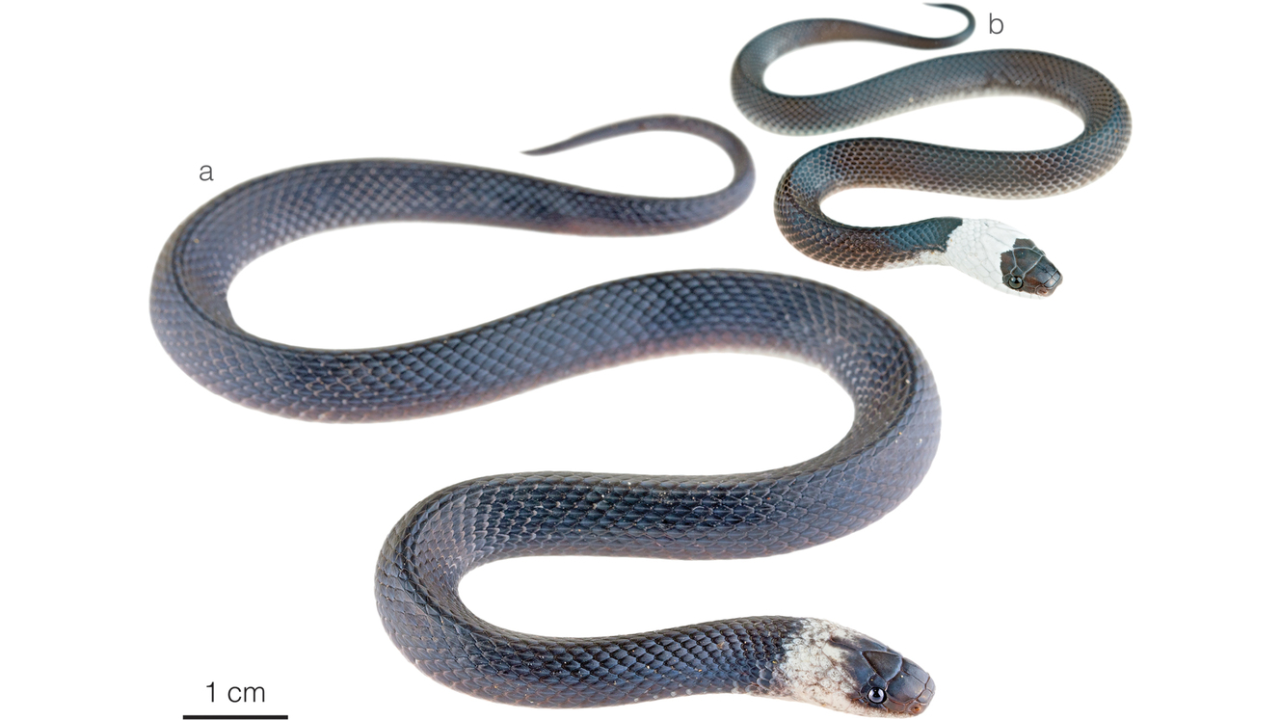
The black snake with a white collar was hiding in plain sight (Image: Alejandro Arteaga)
Ecuador’s cloud forests are home to a snake that can live among coffee plantations
Tudor’s Coffee-Snake is endemic to the Pacific slopes of the Andes in northwestern Ecuador, where it has been recorded at elevations of roughly 1,000 to 1,500 metres. Its known range includes several locations in Pichincha and neighbouring provinces, including cloud-forest reserves.Its habitat tells another important part of the story. The species, like other members of the genus, uses coffee plantations, apparently allowing it to persist in areas where parts of the original Andean cloud forest have been cleared.That does not mean plantations provide an equivalent replacement for native forest. Instead, the finding shows that wildlife can sometimes survive in landscapes that have been transformed by agriculture, making those modified habitats worth exploring rather than treating them as biologically empty.The discovery also reinforces the conservation value of Ecuador’s remaining cloud forests. Arlequín Reserve in the Mindo cloud forest is a sanctuary protecting at least 14 globally threatened amphibians and reptiles. The organisation’s work in the region combines species discovery with efforts to protect habitat from further loss.
The new species shows why there are still discoveries waiting in Ecuador’s forests
The discovery is a reminder that finding a species is often only the beginning. Researchers must establish that it is genuinely distinct, compare it with related animals, document its characteristics and determine where it occurs. In this case, the process turned a snake encountered during a book project into a formally recognised species.The discovery lies within a wider conservation message, exploring cloud forests and the human-modified landscapes around them can reveal species that might otherwise remain unknown. Ninia guytudori was found because a biologist was looking closely enough to notice something that did not quite fit the snakes already known from Ecuador.For Arteaga, the journey into the cloud forests was part of a much larger attempt to document the country’s reptiles. But the small black snake with the white collar became an unexpected chapter in that project, and another reminder that even well-studied forests can still hold species waiting to be recognised.