









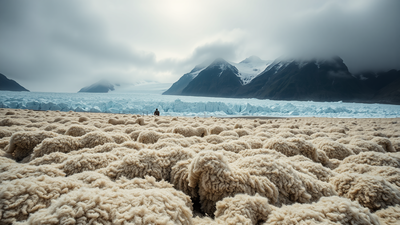
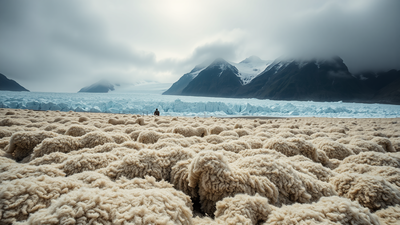
As Switzerland’s glaciers continue to lose ice, researchers are testing an unusual material that could offer a more environmentally friendly way to slow melting in small, protected areas: sheep’s wool. The “Keep It Wool” project, a collaboration between the Summit Foundation and the University of Lausanne, placed two wool covers on the Tsanfleuron Glacier at Glacier 3000 in Les Diablerets, Switzerland, in June 2026. Each cover measures 10 by 10 metres, giving the experiment a combined area of 200 square metres. A conventional synthetic geotextile of the same size was installed alongside them for comparison. The experiment is examining whether wool, which is natural, renewable and biodegradable, can perform similarly to the plastic-based covers already used in some Alpine locations to slow the loss of snow and ice. Initial observations after the summer found the wool covers provided protection comparable to the conventional geotextile, although the collected data still needs to be analysed.
Why Swiss scientists are testing wool
For around two decades, synthetic geotextiles have been used at selected glacier sites during the summer to reduce local melting. The covers reflect part of the incoming solar radiation and limit heat exchange, helping preserve snow and ice beneath them. Studies of conventional glacier-protection covers have found that they can reduce melting by roughly 50% to 70% beneath the protected areas. The problem is that many of these covers are made from materials such as polyester or polypropylene. Wind, precipitation and repeated wear can cause fibres to detach from the material, raising concerns about microplastic pollution in snow, ice and meltwater.The Keep It Wool project is therefore investigating whether sheep’s wool could provide a biodegradable alternative for situations where temporary glacier or snow protection is already being used. The material is locally available in Switzerland and has insulating properties. The Summit Foundation estimates that up to 70% of Swiss wool is destroyed, partly because sheep are primarily raised for meat, milk and landscape maintenance. Reuters has similarly reported that around 40% to 70% of Swiss wool is discarded each year.
200 square metres of wool on a glacier
The two wool prototypes were installed on 22 June 2026 at Glacier 3000 in the canton of Vaud. Manufactured by Swiss company Fisolan, the covers were made in two different thicknesses, allowing researchers to compare how the material performs under high-mountain conditions. A conventional geotextile cover measuring the same size was placed alongside the wool prototypes. Stakes positioned within the covered areas allowed the researchers to monitor changes in snow and ice, while measurements were taken every two weeks through September.The project also involved researchers from GLAMOS, the Swiss Glacier Monitoring Network. Mathias Huss and Mauro Fischer provided scientific expertise in designing the experiment and determining the measurements required. The project was developed in partnership with the Interdisciplinary Centre for Mountain Research at the University of Lausanne, while the Association Filature de l’Avançon helped connect the project with the Swiss wool sector and Fisolan produced the covers. The first observations were encouraging. According to the Summit Foundation, after one summer the two wool covers appeared to provide protection comparable to the conventional geotextile. Reuters also reported that measurements taken during the summer showed the wool covers limited melting about as effectively as the synthetic material. However, the result should not yet be treated as proof that wool is definitively as effective as synthetic geotextiles. The Summit Foundation says the initial observations are promising, but the data collected during the experiment still needs to be analysed.
A local experiment, not a way to save glaciers
The experiment is deliberately small. Protective geotextiles currently cover only around 0.02% of Switzerland’s glacier surface, and the Summit Foundation estimates that these coverings preserve roughly 300,000 cubic metres of snow each year. That is tiny compared with the scale of Switzerland’s overall glacier loss. The foundation estimates that almost one billion cubic metres of ice are lost each year. That means even a successful wool covering cannot prevent the long-term retreat of Alpine glaciers. Such materials can only slow melting in the particular areas where they are deployed, and covering glaciers on a much larger scale would be difficult and expensive.Instead, the researchers see the project as a test of whether a locally available natural material could replace synthetic geotextiles in situations where temporary protection is already considered useful. The question is not whether wool can reverse glacier loss, but whether it can reduce the environmental impact of a technique already being used at selected sites. Switzerland has lost a substantial share of its glacier mass over recent decades, with climate change driving the broader retreat. Protective covers can therefore provide only a local and temporary intervention. Reducing greenhouse gas emissions remains central to limiting the long-term loss of glacier ice.
From a student project to a field experiment
The idea for Keep It Wool emerged from an academic project involving four master’s students at the University of Lausanne: Maxime Galley, Elliot Gaffiot, Jose Bastidas and Léonard Duloube. They worked with the Summit Foundation to identify a source of Swiss wool, develop suitable prototypes, find a test location and bring together the technical and scientific expertise needed for a field experiment. The project also received support from Innosuisse. At Glacier 3000, the wool covers were held down using repurposed malt bags filled with gravel, another small example of the project’s emphasis on reusing local materials.The experiment’s initial findings suggest that wool can withstand Alpine conditions better than the researchers initially expected and may have potential as an alternative to synthetic covers for some applications. But the results remain limited to a small test area and a single summer. Further analysis will determine how the different wool thicknesses performed and how durable the material was under prolonged exposure to mountain conditions. For now, the experiment is less about covering entire glaciers with wool than about finding out whether a material that is often discarded in Switzerland can serve a useful purpose in places where artificial protection is already being used.