









US President Donald Trump on Friday signed into law the Lindsey O Graham Sanctioning Russia and Iran Act of 2026, giving his administration expanded powers to impose sanctions and tariffs on Russia and countries that continue significant purchases of Russian oil and gas.The White House said the law expands statutory sanctions, tariffs and prohibitions targeting Russia and extends existing sanctions on Iran for five years.The legislation is significant for India because New Delhi remains one of the world’s biggest buyers of Russian crude. However, the law does not automatically impose a 100% tariff on Indian goods. Instead, it creates a legal pathway for the Trump administration to impose such tariffs under specified conditions.What does the Russia sanctions law do?The legislation targets Russian officials, financial institutions, defence-related networks and the country’s so-called “shadow fleet” of vessels used to transport energy while circumventing Western restrictions.A key provision gives the US president authority to impose tariffs of up to 100% on goods from the five largest importers of Russian petroleum or natural gas, subject to conditions laid down in the law.It also includes provisions targeting countries that facilitate Russian oil sanctions evasion and extends the Iran Sanctions Act for another five years.The Senate passed the bill 86-11 on August 7, while the House of Representatives approved it 262-159 on Wednesday, sending it to Trump for his signature. The law was named after the late Republican Senator Lindsey Graham, a leading supporter of the legislation.India’s Russian oil purchaseIndia’s crude sourcing pattern has changed sharply since 2022. Before the Ukraine war, Gulf countries accounted for more than 55% of India’s crude supplies, while Russia’s share was below 15%, according to the Global Trade Research Initiative (GTRI).Since then, India’s purchases from Russia have increased substantially, while the Gulf’s share has fallen below 30%.The Centre for Research on Energy and Clean Air (CREA) estimates that between December 2022 and August 2026, China accounted for around half of Russia’s crude exports, followed by India at 37%, Turkey at 5% and the European Union at 5%.Indian refiners have also secured supplies from the US, Brazil, Canada, Venezuela and African producers, but Russian crude remains a major part of India’s import basket.
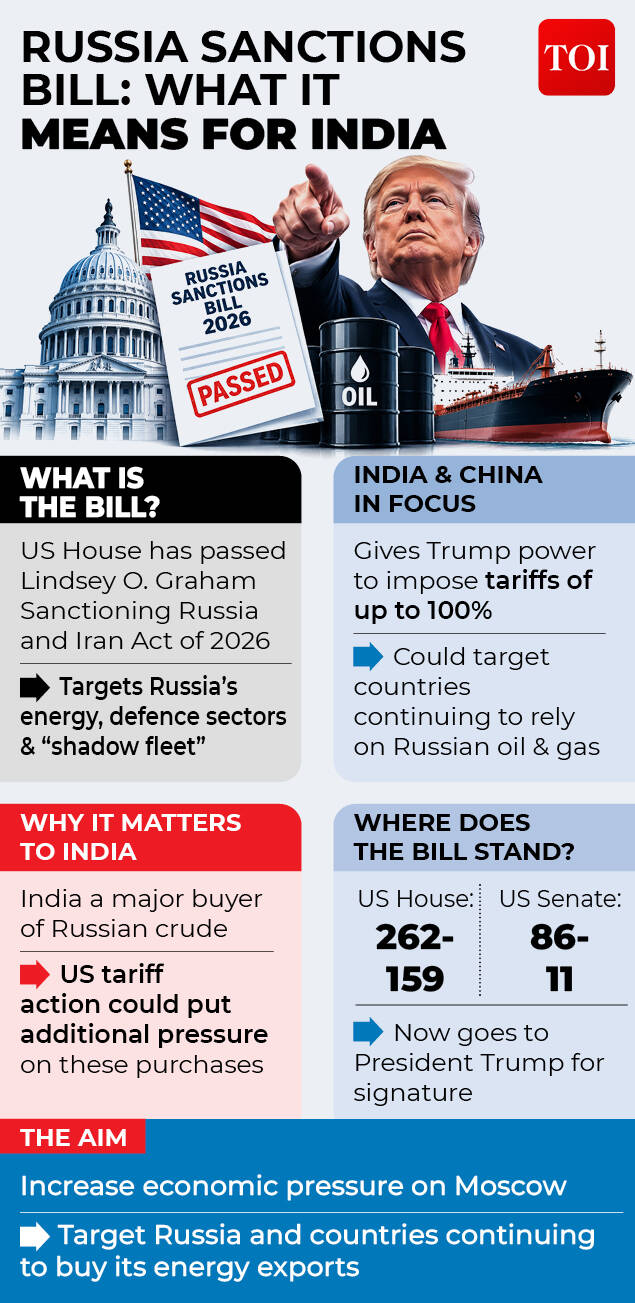
Russia Sanctions Bill: What It Means For India
What has India said?India has repeatedly defended its Russian oil purchases, saying its energy policy is driven by the need to secure affordable and reliable supplies for its population.New Delhi said it was “monitoring further developments on this matter” and remained “firmly committed to ensuring energy security” for its people.“This issue has been discussed at high levels in recent months with various US interlocutors. Its potential implications for not just the bilateral relationship but also the international energy market have been very clearly articulated by the Indian side,” the external affairs ministry said.The ministry also said India was determined to take all necessary measures to protect its trade and economic interests.Indian ambassador to the US Vinay Kwatra said: “India imports over 85% of its crude oil and around half its natural gas. Our sourcing reflects a fundamental national responsibility: looking outside our borders to secure adequate, affordable and uninterrupted energy for our people.”“India is the world’s fastest-growing major economy and its third-largest energy consumer. Yet the average Indian consumes less than one-third of the global average and one-tenth of an average American. Our energy needs will, and must, grow,” Kwatra added.What could a 100% tariff mean for India?New Delhi has repeatedly argued that its purchases of Russian oil are driven by energy security and commercial considerations.“India should not allow US tariff threats to determine its energy policy,” GTRI said, adding that India should continue buying Russian oil as long as it remained commercially competitive and negotiate with Washington without granting unilateral trade concessions.Ajay Srivastava, founder of GTRI and a former trade ministry official, said the legislation was a pressure tactic against India.“The bill is a blunt and dangerous attempt to pressurise India to sign the bilateral trade agreement on one-sided terms. India buys Russian oil to secure affordable energy for 1.4 billion people, not to finance war, and these purchases have helped stabilise global supplies and prices,” he said, according to BBC.“Tariffs of up to 100% would punish Indian exporters and American consumers, disrupt trade and give the US president excessive power over major partners,” he added.If the US eventually imposes steep tariffs on Indian goods under the new law, the biggest impact would be on Indian exports to the US rather than directly on the price of Russian crude.A tariff of up to 100% could make Indian products substantially more expensive in the American market and affect exporters across sectors.Higher import duties could reduce the competitiveness of Indian goods, although the actual impact would depend on the rate imposed, the products covered and how Washington implements the measure.The legislation therefore adds another layer of uncertainty to India-US trade ties, at a time when Washington and New Delhi are already negotiating a broader trade agreement, while India’s dependence on Russian crude remains substantial.Will India actually face a 100% tariff?Not immediately. The law gives Trump the authority to impose tariffs of up to 100% on countries that meet specified criteria, but it does not itself impose a 100% tariff on India or China.India is particularly exposed because it remains one of the world’s biggest buyers of Russian crude, while China is the largest buyer of Russian oil.The legislation also gives the president waiver authority under specified conditions, including certification to Congress that a waiver is in the national interest.This means the impact on India will depend on whether and how the Trump administration uses the new powers, as well as the eventual tariff rate, products covered and implementation timeline.The legislation is intended to increase economic pressure on Moscow by reducing the revenues Russia earns from energy exports. Supporters of the measure have argued that sanctions and tariffs can increase pressure on Russia and push it towards ending the war in Ukraine.Ukrainian President Volodymyr Zelenskyy welcomed the legislation, describing sanctions as an important tool to pressure Russia towards peace.Russia, however, criticised the move. Kremlin spokesman Dmitry Peskov said Moscow was monitoring the legislation and described additional US sanctions as “unfriendly actions”.“We are, of course, monitoring the progress of this document. It falls under the category of unfriendly actions, and of course the imposition of any additional sanctions by the US would certainly complicate efforts to find a peace settlement in Ukraine,” Peskov told reporters, according to Reuters.What has China saidChina has also rejected the US use of tariffs against countries buying Russian energy. Chinese foreign ministry spokesperson Guo Jiakun said Beijing opposed US “long-arm jurisdiction”.“China consistently opposes long-arm jurisdiction that lacks a basis in international law and is not authorised by the United Nations Security Council,” Guo said.“China has always conducted normal economic and trade cooperation with countries around the world on the basis of equality and mutual benefit,” he said. “Such cooperation neither targets any third party nor is subject to interference or coercion from any third party,” Guo added.China buys more Russian crude than India, but much of its Russian energy imports are transported through pipelines across the two countries’ land border.