










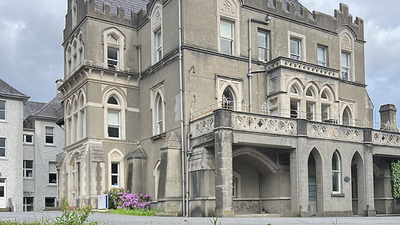
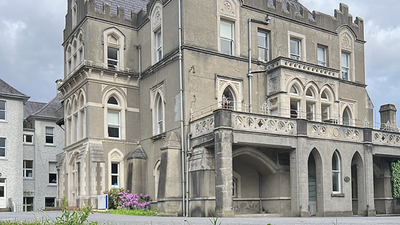
A medieval castle believed to have disappeared around 150 years ago has turned out to be hiding in plain sight inside a university building in Dublin, with researchers finding that its ancient walls and courtyard survived beneath the later structure.The discovery concerns Roebuck Castle on the Belfield campus of University College Dublin (UCD). The Norman castle was long thought to have been cleared away when the present Roebuck Castle was developed during the 19th century. New research by UCD medieval architectural historian Professor Tadhg O’Keeffe has now shown that substantial parts of the medieval structure remain intact within the building.
A castle hidden behind a Victorian facade
From the outside, the building appears to be a much later Victorian structure. But O’Keeffe’s research, published in Archaeology Ireland, found that the medieval castle was not completely demolished as previously assumed. Instead, later builders appear to have incorporated the old structure into the newer building. Its medieval walls remain beneath layers of plaster, while features of the original castle can still be identified inside.Perhaps the most striking part of the discovery is the courtyard. What appears today to be the courtyard behind the university building is actually the courtyard of the medieval castle, according to O’Keeffe. “From the outside, the present building looks to be entirely Victorian. Inside, though, the walls of the old castle are preserved,” O’Keeffe said.“The medieval features are still there. They’re hidden under plaster but they can be made out. We are incredibly lucky that the Georgian and Victorian modernisers of the property simply built around the medieval castle rather than demolish it. And we are also lucky that they built very little else on the site. The courtyard at the back of the house today is actually the medieval castle courtyard!”“UCD can now claim to have the oldest standing building on any university campus in Ireland,” he added.The survival of the structure is particularly significant because many medieval castles in south Dublin disappeared over the centuries. Some were demolished, and their stones reused in newer, more comfortable buildings, leaving little physical evidence of the structures that once stood there.
Castle dates back to the early 13th century
Historical evidence suggests that Roebuck Castle was constructed in the early 13th century, only a few generations after the Norman invasion of Ireland began in 1169. The exact date of its construction still requires further archaeological investigation, but O’Keeffe believes the oldest surviving portions can be dated to the early 1200s. That would make the building an unusually old surviving example of medieval architecture.UCD said the finding could mean Roebuck Castle is the oldest standing building on an Irish university campus.The castle was also more than simply a residence. Roebuck occupied an important position on one of the approach roads into medieval Dublin and underwent several alterations during the Middle Ages. Its occupants included a medieval Lord High Chancellor of Ireland. The castle is also traditionally associated with James II, who reportedly stayed there in 1689 after losing his throne.
An artist may have left the clues behind
One of the most important pieces of evidence came from an 18th-century artist. By the 1700s, Roebuck Castle had fallen into ruin. Around 1765, Dutch-born artist Gabriel Beranger visited the site and produced watercolours depicting what remained of the medieval castle. Those paintings proved unexpectedly valuable nearly three centuries later.Rather than simply showing the general appearance of the ruins, Beranger’s drawings included small architectural details that helped O’Keeffe reconstruct the earlier building and compare it with the structure surviving today.The comparison revealed that parts of what had been assumed to be a completely new building corresponded with the form and layout of the medieval castle.According to O’Keeffe, the Georgian and Victorian owners who modernised the property appear to have built around the medieval remains rather than destroying them. They also made relatively few additional changes, helping preserve the original layout.
A lost chapter of Dublin history returns
The discovery matters beyond UCD because relatively few medieval castles have survived in south Dublin. Over time, many were demolished, altered beyond recognition or dismantled for building materials. As a result, archaeologists and historians have had to rely heavily on documents, maps, drawings and other fragments to reconstruct Dublin’s medieval landscape.Roebuck offers something different: a physical piece of that landscape that survived inside a much newer building without being recognised as such.“Lost buildings are lost historical records. They leave gaps in our knowledge,” O’Keeffe said.The latest research does not mean every part of the original Norman castle survives. Further archaeological work is needed to establish its precise date and understand the surviving medieval elements in greater detail.But the discovery has already changed the story of Roebuck Castle. What was thought to have vanished beneath 19th-century redevelopment was, in fact, still there, concealed behind plaster and incorporated into the building that stands on the UCD campus today.For generations, students and visitors could walk through the site without realising that the walls around them belonged partly to a castle that had stood there since medieval Dublin.