








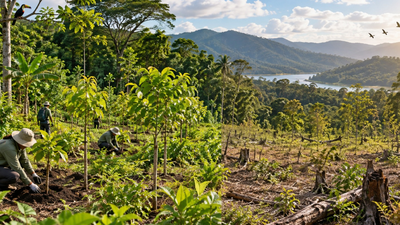
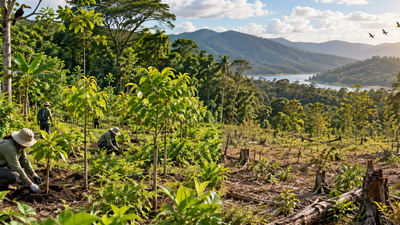
A forest can return without being planted, but the pace and character of that recovery can depend heavily on what happens at the beginning. In southern Costa Rica, researchers have been following three different restoration approaches for about two decades, allowing them to compare how much woody biomass accumulated under each one. Some plots were simply left to regenerate. Others received small clusters of planted trees, while the most intensively treated plots were planted across the site. After 18 to 20 years, the difference was substantial. The fully planted plots contained about 6.5 times as much aboveground biomass as areas left to recover naturally, although the heavier intervention also changed how much biomass came from trees that arrived on their own.
Costa Rica’s three forest restoration approaches were tracked for 20 years
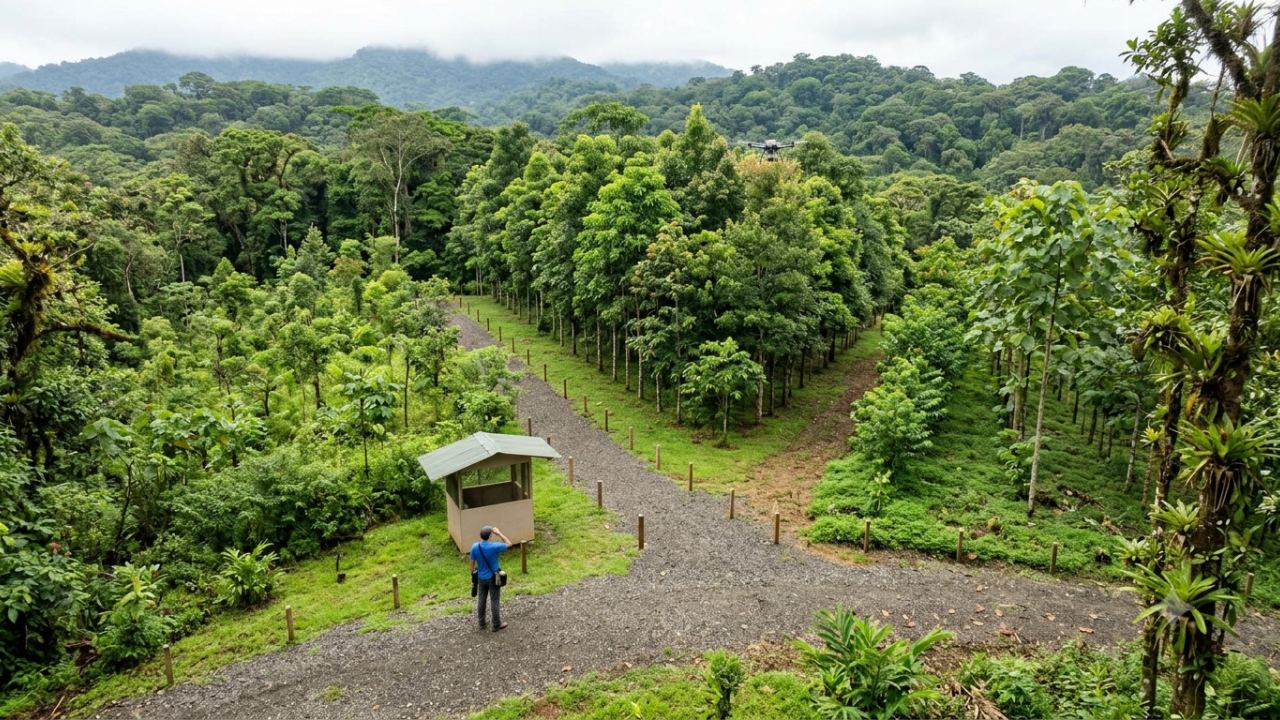
The experiment began between 2004 and 2006 at degraded sites in southern Costa Rica. Rather than testing a single restoration recipe, the researchers established plots representing different levels of intervention. At one end was natural regeneration, where no trees were planted and the forest was allowed to develop from the plants and seeds already able to reach the area. The second approach, known as applied nucleation, involved planting clusters of trees rather than filling the entire plot. The third was a conventional plantation treatment, with trees planted throughout the restoration area.That arrangement gave the researchers something that is often difficult to obtain in restoration research: long-term comparisons between different approaches carried out at the same general sites.According to the study published in Wiley Open Access Collection, titled ‘Aboveground Biomass Accumulation Over Two Decades Across a Gradient of Tropical Forest Restoration Interventions’, by the time the measurements were taken, the plots had been developing for roughly 18 to 20 years. The study focused on aboveground biomass, or AGB, which represents the living plant material held above the soil surface and is commonly used when assessing how much carbon vegetation can store.
Planted plots built 6.5 times more biomass than natural recovery
The clearest difference appeared in the plantation plots. Their aboveground biomass was around 6.5 times greater than in the naturally regenerating plots after two decades. They also held about twice the biomass recorded in the applied nucleation treatment.Most of that difference came from the trees that had originally been planted. Even though a substantial number of those planted trees had died during the experiment, the surviving planted vegetation still accounted for most of the biomass in the intensively planted areas.This makes the result less straightforward than simply saying that planting always produces more forest biomass. The plantation treatment accumulated more biomass in planted trees, but the dense planting also affected what happened underneath and around them.
Natural regeneration produced a different mix of trees
Trees that arrived without being planted made up a much larger share of the biomass in the less intensive treatments. In the applied nucleation plots, naturally recruited trees accounted for four times the proportion of aboveground biomass seen in the plantation plots. The researchers also found that the plantation treatment had suppressed the amount of biomass accumulated by naturally recruited vegetation.That creates a trade-off between the biomass supplied by planted trees and the contribution made by species that establish themselves naturally. In the natural regeneration plots, naturally recruited trees accumulated about half the amount of biomass found in the plantation treatment’s planted trees. The difference in total biomass was still large, but the composition of that biomass was quite different.
Fewer planted trees meant a larger role for natural recruits
Applied nucleation occupied the middle ground. Instead of covering the restoration area with planted trees, it concentrated them into clusters. That left more room for naturally arriving vegetation to become part of the developing forest. Although the treatment did not match the plantation plots in total aboveground biomass, it produced a much larger contribution from naturally recruited trees.The findings therefore show two different outcomes from restoration intervention. Heavy planting can accelerate the accumulation of aboveground biomass, while a more spatially limited approach can allow a greater share of naturally established vegetation to develop alongside planted trees.For restoration projects where carbon accumulation is the only measure being considered, those differences could be interpreted one way. For projects also concerned with forest structure and biological diversity, the composition of the biomass becomes relevant too.
LiDAR helped reveal how the recovering forests differed
According to the study, the team also used airborne LiDAR data collected after roughly 16 to 18 years of recovery. The technology provided measurements of the developing vegetation structure, including canopy characteristics that could be compared with the biomass recorded in the plots.A different relationship emerged depending on the restoration treatment. Leaf area index (LAI), was more closely associated with total aboveground biomass in naturally regenerating plots. In the plantation and applied nucleation areas, canopy height had a stronger relationship with the biomass contained in planted trees.Those differences suggest that the visible structure of a recovering forest does not relate to biomass in exactly the same way under every restoration strategy. A naturally regenerating stand and a densely planted stand can reach different physical arrangements even when they are being assessed for the same broad measure.
What happens after planting may matter as the forest matures
The experiment also points to the importance of what happens after the early years of restoration. The planted trees were responsible for much of the biomass accumulated in the more intensively treated plots, but mortality meant that not every tree established at the beginning remained in place. The researchers argue that species selection therefore matters over longer periods, particularly where the aim is to maintain carbon storage as the forest matures.Species with different life histories may contribute to biomass at different stages of recovery. A planting scheme that performs strongly during the first decade may not necessarily provide the same contribution later if its trees have short lifespans, grow at similar rates or fail to make space for other vegetation.The Costa Rican experiment provides a rare long-term view of that process because the treatments have been observed for around 20 years rather than only during the first few years after planting.