









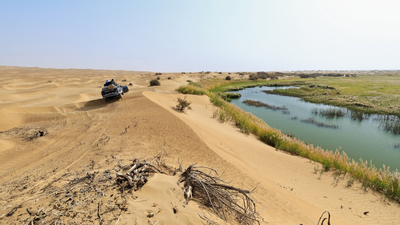
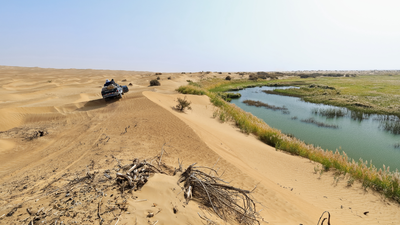
After surrounding the Taklamakan desert with a green belt, China now finds groundwater in the desertDeserts aren’t usually associated with greenery, but China’s largest desert, the Taklamakan, overturned the ordinary.In fact, the desert, which locals nicknamed the “sea of death,” was treated as a hostile, resource-starved stretch of sand in the country’s northwest.Now, the region has become a site of some unique discoveries and engineering efforts, from a vast green belt built by planting trees to hold back the sand. There are hints that there might be far more water might be hidden beneath the dunes than anyone assumed.
After building a green belt around Taklamakan, scientists now find hints of large water reservoirs in the desert
Geologists in China have identified two substantial groundwater sources beneath the Taklamakan Desert, a discovery that could give the arid northwestern region a valuable new resource for both sand-control projects and agriculture. The findings came out of a water-finding project carried out by the Geological Bureau of the Xinjiang Uygur Autonomous Region, according to reports by CCTV, a part of China Media Group, and China Xinhua News.One of the sources was located at the desert’s southern edge, in Andir township within Minfeng county, while the second was found further inside the desert, south of the Mazartag Mountains. Earlier, it was believed that “there is only stagnant water and salt water underground in the desert”.
The newly identified water resource could be fit for use
Stagnant groundwater, or water that has slowed or stopped moving over time, tends to accumulate bacteria and chemicals, making it unfit for drinking or food production. But the newly identified sources appear to be different, opening up possibilities that go beyond what stagnant supplies could offer.As part of the same project, researchers also set up a test station to find out how brackish water, which is saltier than fresh water but less salty than seawater, could be used for irrigation and desert-control efforts along the Taklamakan’s edge.
This is not the first time hidden water in the Taklamakan Desert has been discussed
Back in 2015, researchers from the Chinese Academy of Sciences’ Xinjiang Institute of Ecology and Geography reported that an underground reservoir beneath the Tarim Basin could hold more water than all five of North America’s Great Lakes combined, describing it at the time as a “terrifying amount of water.”The desert, that ranges at nearly 337,600 sq km, has also been at the centre of China’s anti-desertification efforts. In 2024, engineers completed a 3,050km green belt of trees, shrubs, and sand-blocking solar panels encircling the Taklamakan, part of the wider Great Green Wall initiative.Alongside that, China has been growing crops such as desert wheat along the desert’s southern edge in places like Kunyu and installing solar panels along the belt to help the trees in the region grow better.