










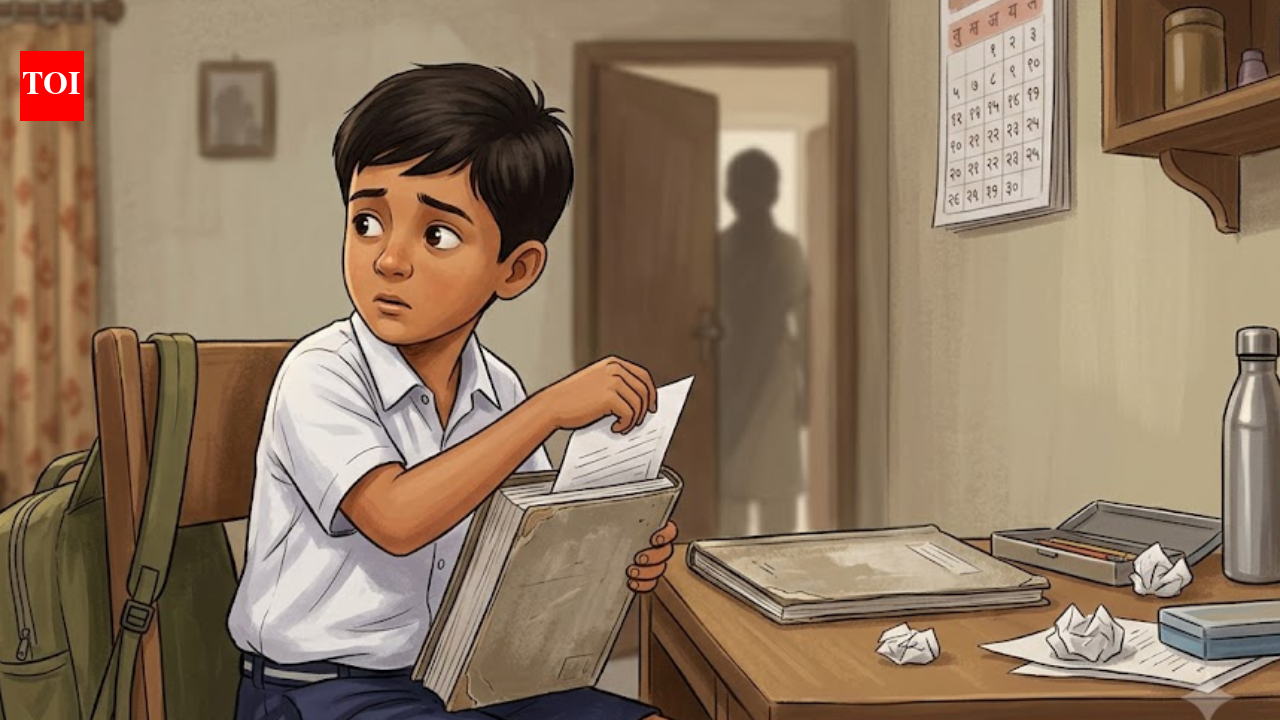
A child comes home after a test, puts the answer sheet deep inside a schoolbag and says nothing. Another quickly changes the subject when a parent asks about the exam. Some children may even wait for their parents to discover a report card rather than handing it over themselves. But psychology suggests there can be more behind this behaviour than simply not wanting to admit a poor score. For some children, the difficult part may not be the number on the paper. It may be what they expect to happen once their parents see it.
Relationship with parents influences how the child deals with setbacks
10 Sept 2026 | 12:19
What’s one thing you swore you’l never do as a parent now you find yourself doing?

Photo: Canva
Research on academic stress and coping has found that the way children experience their relationship with parents can influence how they deal with setbacks at school. A child who scores 48 already knows that the result is disappointing. What may create additional stress is the conversation that follows. “Why did you get so little?” “Your friend scored much more.” “You were not studying properly.” “What will happen in the final exam?” For some children, hiding the paper can temporarily help them avoid that conversation.A study of 839 Australian students in Grades 5 to 10 examined how parental support and negative parent-child interactions were related to the ways adolescents coped with academic stress. The researchers found that students who reported more negative interactions with their parents were more likely to use ‘disengagement coping,’ which included behaviours such as concealment and escape. Students who reported greater parental support were more likely to use engagement coping, such as strategising and seeking help. This does not mean that every child who hides a poor mark is afraid of their parents. But it does suggest that the parent-child relationship can influence how a young person responds when academic problems arise.
When marks start feeling personal
Marks are supposed to tell a child how well they understood a particular piece of schoolwork. But repeated conversations about percentages, ranks and comparisons can sometimes make academic performance feel like a judgment of the child. Research has examined what happens when children perceive parental approval as being closely tied to academic achievement. A 2019 study involving 653 secondary-school students and 166 university students looked at what researchers called parental academic conditional positive regard, when students perceive that their parents give more affection, attention or esteem when they work hard and perform well. The study found an association between this perceived conditional regard and higher test anxiety. The researchers also found that contingent self-esteem helped explain the relationship. In other words, a child may not only be thinking, “I got 55.” They may also be wondering, “What does this say about me?” or “What will my parents think of me now?”
Pressure does not always look like punishment
Parents do not necessarily have to shout or punish a child for academic pressure to be felt. Sometimes it can come through repeated reminders about getting higher marks, comparisons with other children or strong expectations around examinations. A study of 845 German adolescents examined perceived parental support and pressure in relation to different components of test anxiety. The researchers found several associations between perceived parental pressure and aspects of test anxiety, although the patterns differed between boys and girls and between mothers’ and fathers’ pressure.
Indian teenagers also report academic pressure

Photo: Canva
The issue is particularly relevant in families where school results are closely connected with future education and career plans. A 2023 cross-sectional study of 570 adolescents preparing for competitive entrance examinations in pre-university colleges in Udupi district, Karnataka, found that 86% of participants had high academic stress and 87% reported high perceived parental academic pressure. The study also measured examination anxiety and general well-being.
What happens when a child expects anger?
This is where a poor mark can turn into a bigger problem. If a child expects criticism every time something goes wrong, they may become more interested in avoiding the reaction than discussing the problem. So a child who hides a mathematics paper may not necessarily be saying, “I don’t care about my marks.” They may be saying, without putting it into words, “I don’t know how to deal with what will happen when you see this.”
The first question parents ask can make a difference
When a child finally reveals a poor result, the easiest response is often to focus immediately on the number. But questions such as these can open a different conversation: “Which part was difficult?” “Did you understand the chapter?” “Was the paper harder than you expected?” “What do you think you can do differently next time?” The point is not to ignore poor performance. A child still needs to understand mistakes and improve academically. The difference is between treating the mark as the ‘problem’ and treating it as information about a problem. Parents can still care about grades, set study routines and expect children to work seriously. But it helps when the child also knows one thing: Bad marks will not change the way their parents see them. That can make it easier to say, “I did badly in this test,” before a small academic setback turns into secrecy.