










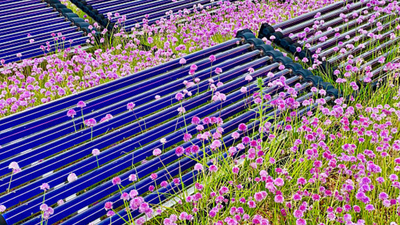
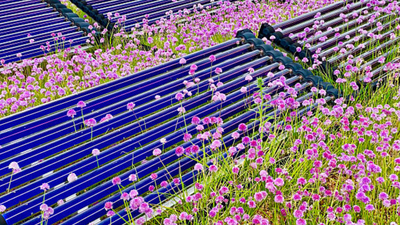
There are no limits to what a well-planned project cannot achieve and researchers in Colorado have proven it right. They have managed to make a rooftop with solar panels produce electricity while also growing the world’s most expensive spice and generating extra income.Colorado State University researchers report that saffron, grown beneath solar panels rated at 40% transparency, produced twice as many flowers and twice the dried spice yield as compared to unshaded rooftop plots. The conditions on a green roof – well-drained, nutrient-poor substrates and extreme microclimates – are surprisingly ideal for saffron production. The finding points to a promising use of agrovoltaics, which pairs agriculture with solar electricity generation.
A sunlit experiment
The research was conducted at the CSU Spur campus in Denver, where Jennifer Bousselot’s team studies planted roofs with and without solar installations. These spaces let researchers investigate how urban rooftops could produce food where farmland remains scarce. It was in 2007 that Bousselot began studying the relationship between green roofs and solar panels.In their March 2026 research summary, Reece Bailey and Bousselot warn that “too much shade can be detrimental to saffron yield.” They propose panels that transmit 30% to 40% of the light, mounted 6 to 8 feet above the growing surface.A separate 2022 experiment in eastern Morocco compared full sun with three shade levels over 24 months and found the highest saffron yield with 30% shade. That is roughly 70% of sunlight remaining, not 30% transmission. The percentages describe different things, so the studies do not establish one universal lighting recipe for every climate and panel layout.
A $60,000 figure
The Colorado team modelled five years on an existing 46-kilowatt rooftop array with 4,356 square feet of growing space. Its budget projects about $61,000 in net revenue, including electricity, dried saffron, and sales of corms (the underground structures used to grow new plants).The assumptions include $35 per gram of saffron and corms at 25 cents each. Electricity can contribute $13,470 over the five years. However, first-year costs exceed revenue and the budget does not cover building a new rooftop installation.Saffron consists of the dried red stigmas of Crocus sativus, a fall-blooming crocus harvested and processed by hand. That careful work helps explain why a tiny jar in the kitchen can carry such a large price tag.University of Vermont researchers measured just how much work sits behind the harvest. In their solar-field experiment, producing a single gram of dried saffron required 159 to 179 flowers. A larger flower count is encouraging, but it also means more flowers to pick and process before that spice reaches a customer. The timing can be useful for small farms, too. Vermont’s saffron researchers describe an October or November harvest, after much of the main growing-season rush has passed. The crop could provide additional seasonal income, although someone still has to pick the flowers and separate the delicate threads.For cities, the appeal of the project is exciting. Rooftop farming and solar generation can share the space and panel shade can reduce crop heat stress and irrigation needs under suitable conditions. CSU Extension notes that rooftop systems present installation and maintenance challenges, with planting and harvesting done by hand. In practical terms, a productive roof needs more than plants and panels. It needs a workable plan for growing, harvesting, and maintaining both systems.