










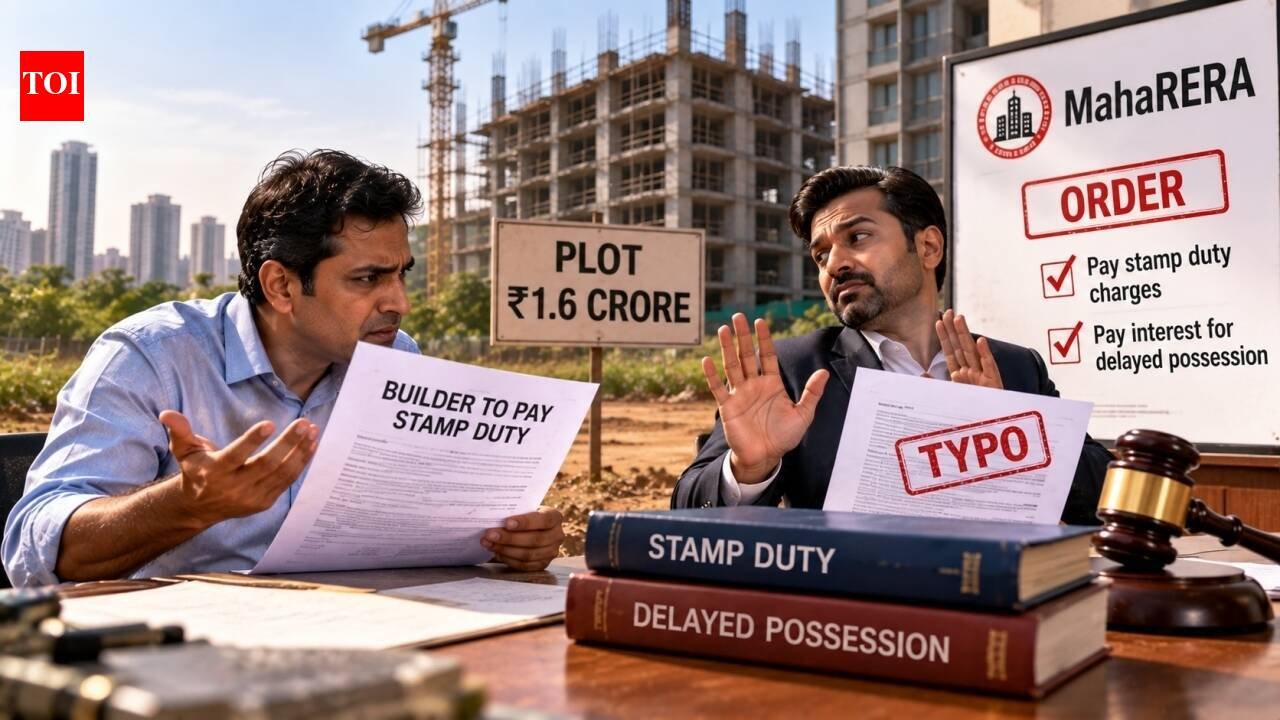

You sign an allotment letter for a property which indicates that the stamp duty and registration costs will be borne by the builder. But, at the time of the sale agreement he backtracks. What do you do then?In one such case, when the homebuyer signed the allotment letter with the builder, he paid Rs 1.6 crore. Based on what was stated in the allotment letter, he understood that the builder would take care of the stamp duty and the registration charges.
What the case is about
That understanding changed when the time came to execute the sale agreement, with the builder telling him that it would not bear those expenses.There was another issue with the project. The builder had represented that the development would be a gated township, with internal roads meant exclusively for residents and a recreational ground reserved for homebuyers.The homebuyer later found that the internal roads were open to public access. The recreational ground had also been taken over by MSRDC and was therefore accessible to the general public.The homebuyer said these changes reduced the value of his plot by around 33%, leaving him dissatisfied with the project.He subsequently approached MahaRERA with a complaint. MahaRERA ruled in the homebuyer’s favour.
Why did the homebuyer win the case against the builder?
MahaRERA examined the manner in which the transaction had been documented. Its order noted that the homebuyer had paid Rs 1.6 crore, covering the sale consideration as well as the maintenance security deposit and corpus fund.Although a sale agreement had been prepared and notarised, it had not been registered.MahaRERA consequently held that the homebuyer qualified as an allottee in the project. It also found that the builder had breached Section 13(1) of the RERA Act, 2016, after accepting almost the entire amount from the buyer without registering the sale agreement.The builder told MahaRERA that it was willing to execute a registered sale agreement, but the process had been held up because the homebuyer was contesting certain aspects of the agreement.The builder also claimed that the reference to it paying the stamp duty and registration charges on behalf of the homebuyers had been included by mistake. It described the provision as a typographical error and sought to withdraw it.MahaRERA, however, took note of Clause 8 of the deviation report submitted by the builder and uploaded on the MahaRERA website, according to an ET report. The clause clearly stated that the builder would bear the stamp duty and registration charges payable on the agreement and on documents executed pursuant to it.The model agreement for sale that had been submitted along with the disclosure contained the same provision. The amended proforma agreement subsequently prepared by the builder, however, omitted the clause. MahaRERA noted that this change was inconsistent with what the builder had disclosed in its deviation report.The authority therefore held that after agreeing to bear the stamp duty and registration charges in its original disclosures, the builder could not subsequently transfer that liability to the homebuyers.MahaRERA observed: “The respondent (builder) is bound by its own project disclosures made before MahaRERA.”Accordingly, the authority directed the builder to bear the stamp duty and registration charges in accordance with the commitments made in its project disclosures and the allotment letter.Advocate Siddharth Chandrashekhar, who practises before the Bombay High Court, told ET that MahaRERA found that a builder cannot use the sale deed to contractually pass a statutory cost on to a buyer when the earlier documents submitted to RERA had already stated that the builder would bear that cost.Chandrashekhar said the allotment letter, deviation report and model agreement for sale each independently recorded that stamp duty and registration charges were to be borne by the builder. This, he said, was the basis on which the homebuyer succeeded before MahaRERA on this issue.
Interest payout
The builder also argued that the homebuyer should not receive interest for any delay beyond the date of the occupation certificate (OC), which was issued on April 27, 2026. Its contention was that the possession had been delayed because the buyer had raised various disputes.MahaRERA partly accepted the builder’s position. It held that interest was payable to the homebuyer from January 1, 2026, until April 27, 2026, the date of the OC.The interest was to be calculated on the actual amount paid by the homebuyer for the plot, at the State Bank of India’s Marginal Cost of Funds based Lending Rate (MCLR) plus 2%, as prescribed under Section 18 of the RERA and the Rules framed under it.Based on ET’s calculation, the plot consideration appears to be Rs 1,59,91,614. Taking this as the amount on which interest is payable:Rs 1,59,91,614 × 10.70% × 116/365This works out to approximately Rs 5,43,000.MahaRERA also directed the builder to take the necessary steps to establish the association or society of allottees.Once the association or society is formed, the builder has to fulfil its obligations under RERA relating to maintenance, corpus funds, conveyance deed and other applicable requirements in accordance with the provisions of the law and the relevant RERA rules.