







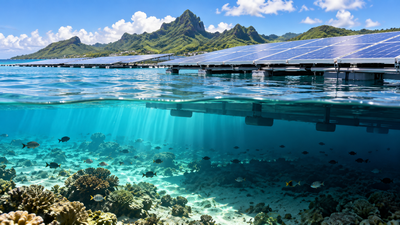
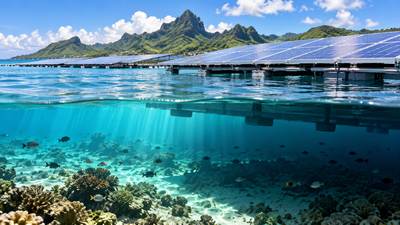
Floating photovoltaic (FPV) platforms in a French Polynesian lagoon substantially reduced the amount of light reaching the seabed but produced no detectable change in water temperature, according to a year-long study. Researchers monitored four FPV platforms and a control area in the lagoon of Tumaraa on Ra’iātea from August 2024 to September 2025. The platforms reduced photosynthetically active radiation reaching the benthic environment, with stronger attenuation recorded beneath platforms designed for higher shading levels. Measurements also showed substantial reductions in UVA and UVB radiation beneath the platforms. Despite these changes in underwater light conditions, estimated temperature differences remained below the study’s sensor accuracy.
How did floating solar platforms reduce seabed light
According to the study published in the Journal of Marine Science and Engineering, titled ‘The Effect of Shading by Floating PV on Light and Temperature in a Tropical Lagoon’, the researchers monitored photosynthetically active radiation (PAR) from August 2024 to September 2025 across four FPV platforms and a control area. Light sensors were positioned at a depth of 1 metre and recorded measurements every 15 minutes. The study reported that the FPV platforms substantially reduced the amount of light reaching the benthic environment, with shading intensity identified as the main determinant of attenuation.The results showed stronger attenuation beneath the platforms designed for 81% shading than beneath those designed for 51% shading. At one monitored position, the reported attenuation coefficients were 3.3 under SH51, 3.5 under SH51-UV, 10 under SH81 and 8.1 under SH81-UV. At another position, the corresponding coefficients were 4.1, 5.2, 18 and 8.8. The study also found spatial variation beneath some platforms, with localised shading contributing to differences in the amount of light reaching different positions.
How did floating solar platforms reduce UVA and UVB radiation
The study separately examined ultraviolet radiation beneath the four FPV platforms and a control area. UVA and UVB measurements were taken at depths of 1, 1.5 and 2 metres on three occasions between June and November 2024. The researchers reported that both UVA and UVB irradiance declined strongly beneath the FPV platforms.Between 1 and 2 metres depth, UVA intensity decreased by factors of approximately 1.9 under SH51, 5.0 under SH81, 8.2 under SH51-UV and 14.3 under SH81-UV. For UVB, the corresponding decreases were approximately 2.41, 3.5, 6.9 and 9.6. The study also found that the visible-light spectrum was affected mainly through changes in irradiance intensity, with only minor spectral changes above 600 nanometres.
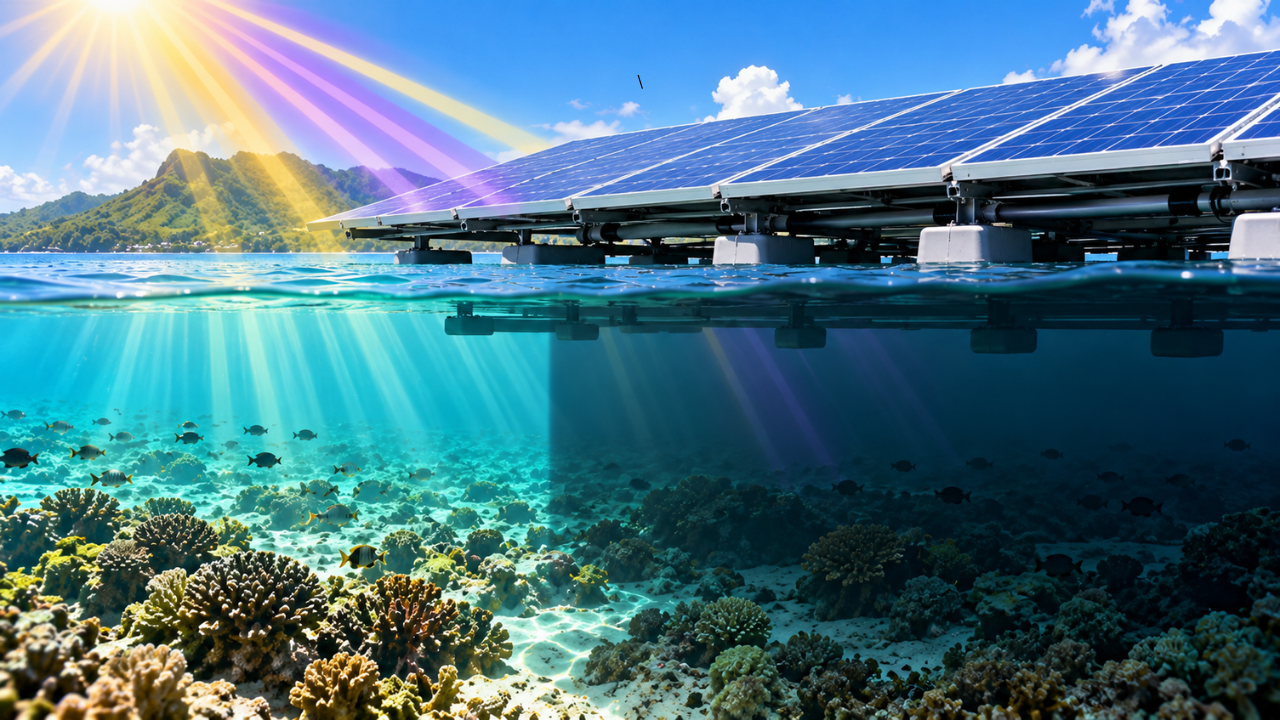
Image AI generated
How much did water temperature vary under FPV platforms
Water temperature was monitored across the four platforms and a control area from August 2024 to September 2025. Sensors were installed at 1 metre depth and recorded temperatures every 15 minutes. During the study period, temperatures in the control area followed a seasonal cycle, ranging from 26.9°C in July and August to 29.4°C in February.Although the statistical analysis identified lower temperatures under FPV conditions compared with the control, the estimated differences relative to the control ranged from −0.06°C to 0°C. The study states that these differences did not exceed the propagated accuracy of the temperature sensors, which was 0.28°C. Consequently, despite the substantial reduction in irradiance, the researchers reported that the FPV platforms did not produce detectable or biologically meaningful changes in water temperature.The researchers attributed the absence of a measurable thermal effect partly to the characteristics of the lagoon environment and the relatively small size of the experimental platforms. The discussion notes that strong water mixing and the platforms’ limited footprint could prevent the development of localised cooling effects.