








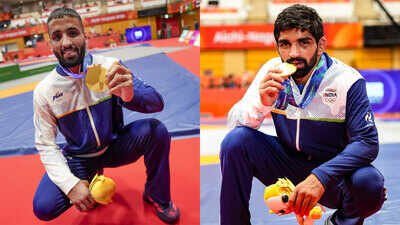
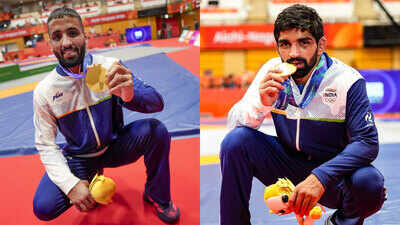
NEW DELHI: India’s wrestlers arrived in Aichi-Nagoya carrying questions over injuries, form and confidence. They left with six medals — two gold, two silver and two bronze — and a much bigger target already occupying their minds: the 2028 Los Angeles Olympics.Aman Sehrawat and Sujeet Kalkal struck gold, while Nitesh Siwach and Antim Panghal won silver and Deepak Punia and Sunil Kumar added bronze.The campaign was also marked by two major statements. Sehrawat defeated reigning world champion Han Chong Song in the men’s 57kg freestyle final, while Kalkal beat Olympic champion Kotaro Kiyooka on his way to gold in the 65kg category.For the Indian wrestlers, however, Nagoya was less about looking back at what they had achieved and more about building towards what comes next.
Sehrawat turns a difficult phase into gold
For Sehrawat, the gold was the culmination of one of the most difficult phases of his young career.The 23-year-old had won bronze at the Paris Olympics but subsequently struggled with motivation in 2025. A persistent stomach ailment also forced him to miss important competitions.In Nagoya, however, Sehrawat rediscovered his best. He defeated reigning world champion Han Chong Song 11-7 in the final, recovering after the North Korean had turned a 1-6 deficit into a 7-6 lead.It was Sehrawat’s first Asian Games gold after his bronze at Hangzhou.
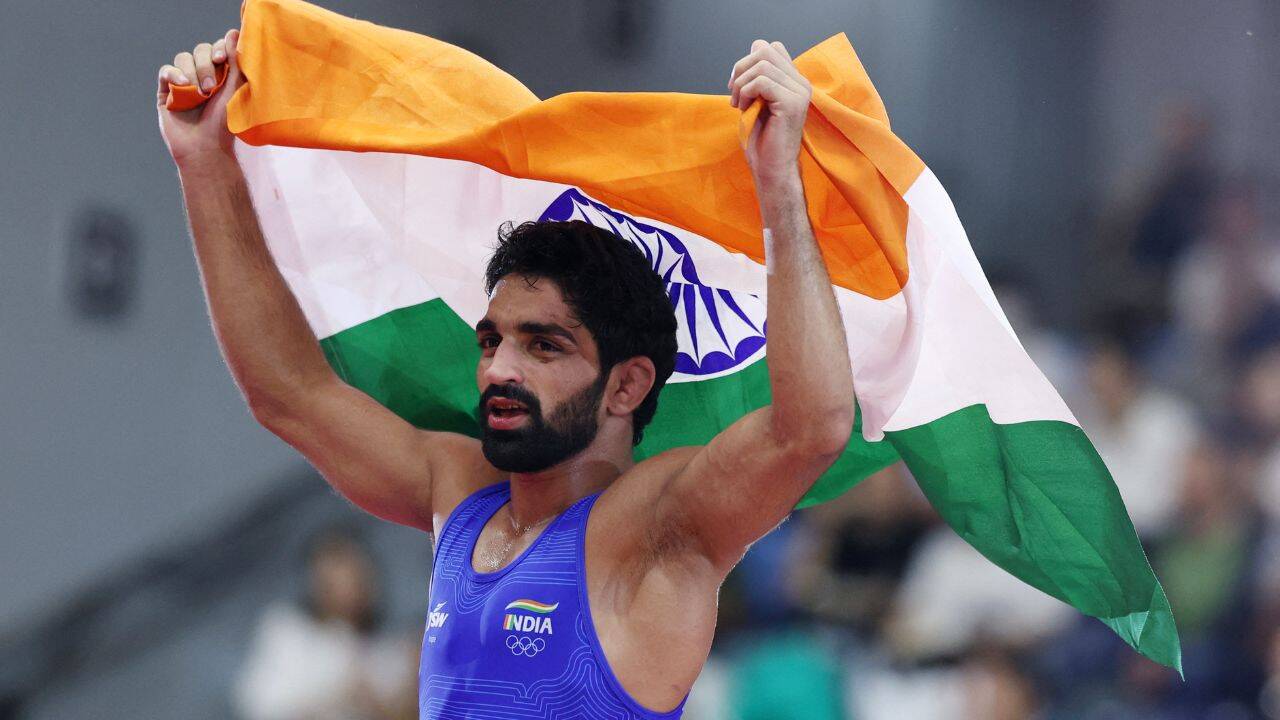
Aman Sehrawat
“Ups and downs, injuries keep happening like this. That phase also comes, but I had the belief in my mind. We should never give up, and I did the same. Today, I have won a gold medal in the Games. The future goal is the Olympics,” Sehrawat said after returning to India.He said the next goal was to replicate the achievement on the biggest stage.“We won gold for the country. The plan for the future is exactly the same — we will win gold for the country and prepare accordingly. I thank all the countrymen; it was their prayers that worked in the matches,” he added.Then came the statement that perhaps best captured the mood of India’s wrestling contingent.“…now we will do better in the future. The whole nation is giving us love. Now our national anthem will be played at the LA Olympics.”
Kalkal follows gold with an Olympic-sized ambition
If Sehrawat’s gold was a comeback story, Kalkal’s was a lesson in refusing to surrender.The world No. 2 entered the Asian Games unbeaten this season and lived up to his billing in the men’s 65kg freestyle category.Before the final, Kalkal defeated Japan’s Olympic champion Kiyooka and Iran’s Abbas Ebrahimzadehsavadkouhi. Against Tajikistan’s Abdulmazhid Kudiev in the final, he appeared to be heading towards defeat after falling 2-9 behind.Instead, he produced a stunning late comeback to win 10-9.
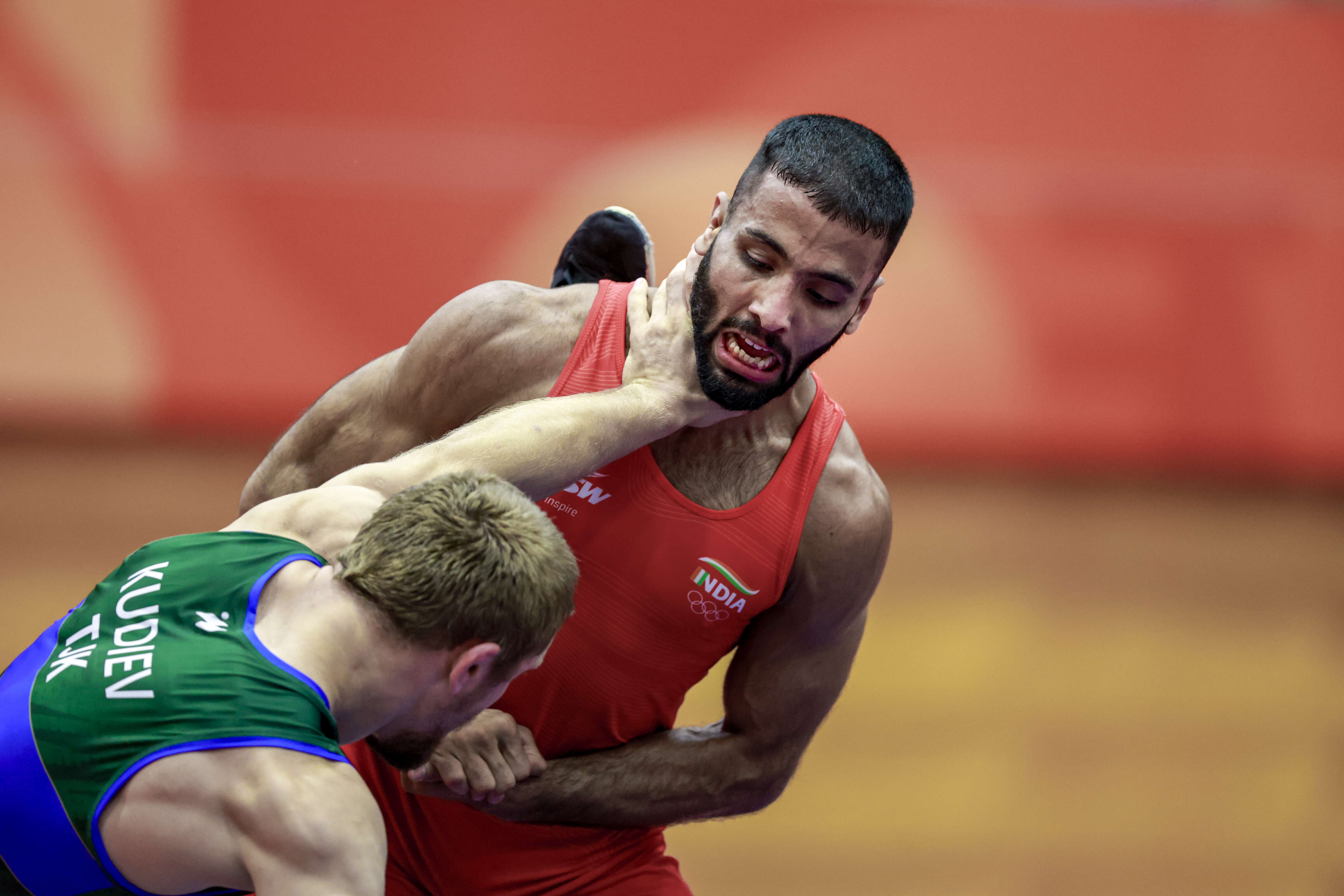
India’s Sujeet Kalkal, right, competes in the final against Tajikistan’s Abdulmazhid Kudiev in the Asian Games. (PTI Photo)
The victory restored India’s hold on the 65kg Asian Games title, a category in which Yogeshwar Dutt and Bajrang Punia had previously won gold.“Whatever struggle I did has paid off. The final match was tough, but I was only thinking of winning that time,” Kalkal said.His sights are already firmly fixed on Los Angeles.“Now we will practice more, and if all goes well, we will win gold at the Olympics too. For the Olympics, the practice has already begun,” Kalkal added.
From selling milk to a historic Greco-Roman final
Nitesh Siwach’s silver carried perhaps the most remarkable backstory of India’s six medallists.A serious knee injury as a teenager kept him away from wrestling for more than 18 months. During that period, he helped his family with its dairy business and sold milk in Panipat.His comeback culminated in an historic Asian Games final appearance in the men’s 97kg Greco-Roman category — India’s first in the weight class in 64 years.Siwach eventually lost 0-4 to Japan’s Yuri Nakazato but returned home with a silver medal and a clear Olympic target.
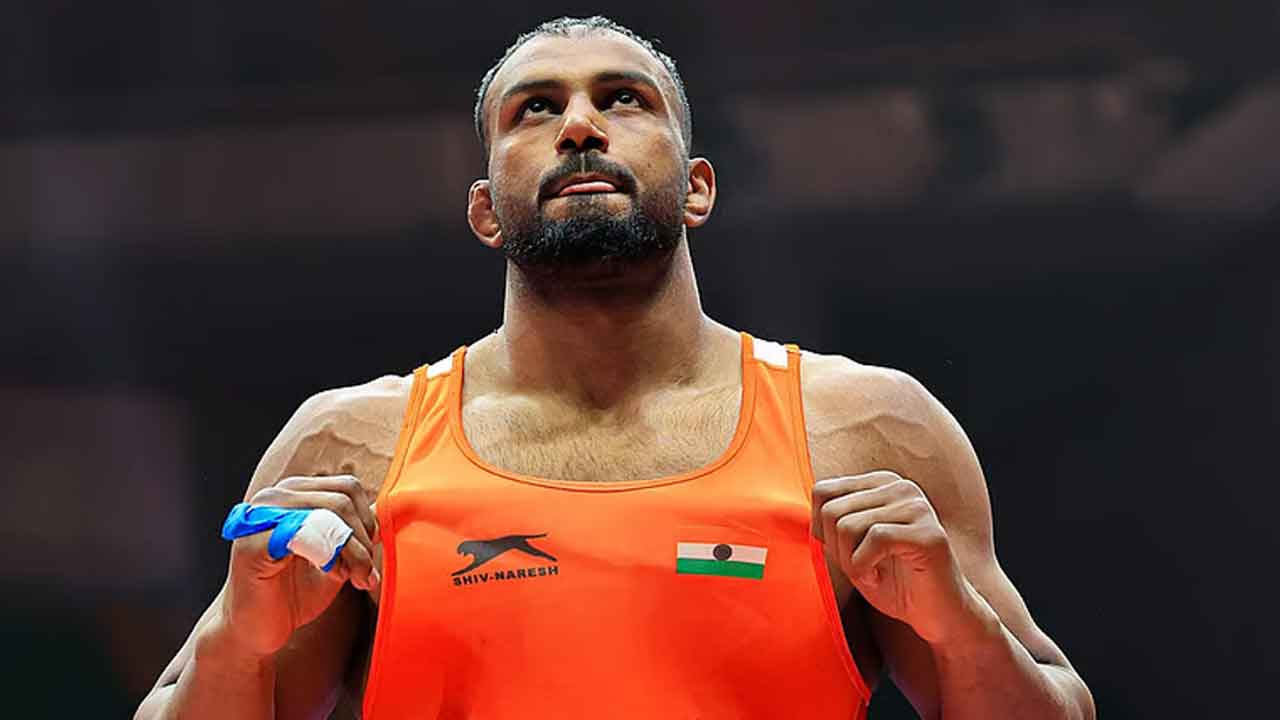
Nitesh Siwach (Image credit: X)
“I feel great. This is the first time I am getting such respect and honour. I am experiencing such a great welcome for the first time, and I am very happy,” he said. “I had aimed for gold. I didn’t win gold, but I did secure the silver medal and I am very happy about that. Since this was my first Asian Games, I am delighted with the silver.”Siwach also believes India’s Greco-Roman wrestlers can make their presence felt in Los Angeles.“People used to say we wouldn’t win medals in Greco-Roman, but we will continue to excel. We will bring home medals from the Los Angeles Olympics,” he said.His personal target is even clearer.“I made some mistakes, which is why I had to settle for silver. My goal going forward is to win gold at the 2028 Los Angeles Olympics, and I will work extremely hard for it,” he added.He has already begun that preparation.“My preparation for the Olympics has already begun, starting from the very day I won the medal. I have to bring a gold in the Olympics,” Siwach said.
Punia battles through a new weight category
Deepak Punia’s bronze was another product of perseverance.The 2019 World Championships silver medallist had competed at 86kg and 92kg before moving to 97kg this year following a muscle injury.Despite the challenges of changing weight categories, Punia earned selection for the Asian Games and defeated Mongolia’s Gankhuyag Ganbaatar 2-1 in the bronze-medal bout.
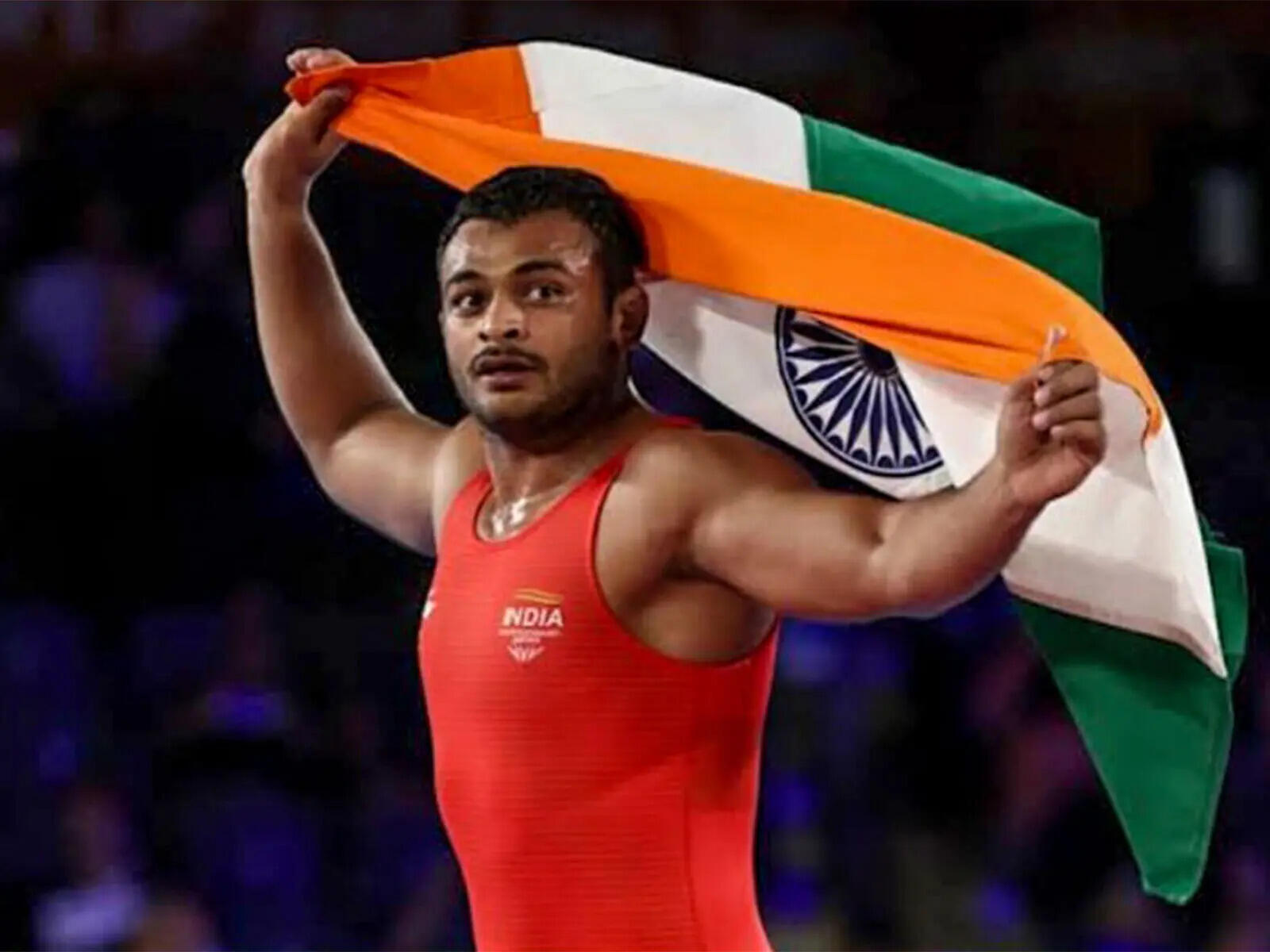
Deepak Punia (ANI Photo)
“Winning a medal was quite challenging for me because I used to compete in the 86kg category, but this time I participated in the 97kg category. There were many challenges, and my hope and goal was to win the gold medal. However, I had to settle for the bronze,” Punia said.Experience helped him deal with the pressure.“I have been playing for a long time, so there is pressure; there is pressure on every athlete. But I understood how I had to handle the pressure. In my mind, it was just that I had to give my best. It was not like I had to take over-pressure. I just had to give my 100 per cent and that’s what I did,” he said.
Panghal improves on Hangzhou, Kumar makes history
Antim Panghal also upgraded her medal from bronze at Hangzhou to silver in the women’s 53kg category.She lost 1-9 to Japan’s Moe Kiyooka in the final after coaches had worked on keeping her calm and confident before the competition.“It is my second time winning a medal. But I had thought that I had to come first, but I could not come first. In the future, I will try to do better than this,” Panghal said.Sunil Kumar, meanwhile, returned to the podium after knee surgery to win bronze in the men’s 87kg Greco-Roman category. He defeated the Philippines’ Callum Johnston Roberts 9-0 by technical superiority, becoming the first Indian Greco-Roman wrestler to win two Asian Games medals after his bronze at Hangzhou.“I am very happy and want to thank all my fellow countrymen. May your blessings and support continue to be with me,” Kumar said.
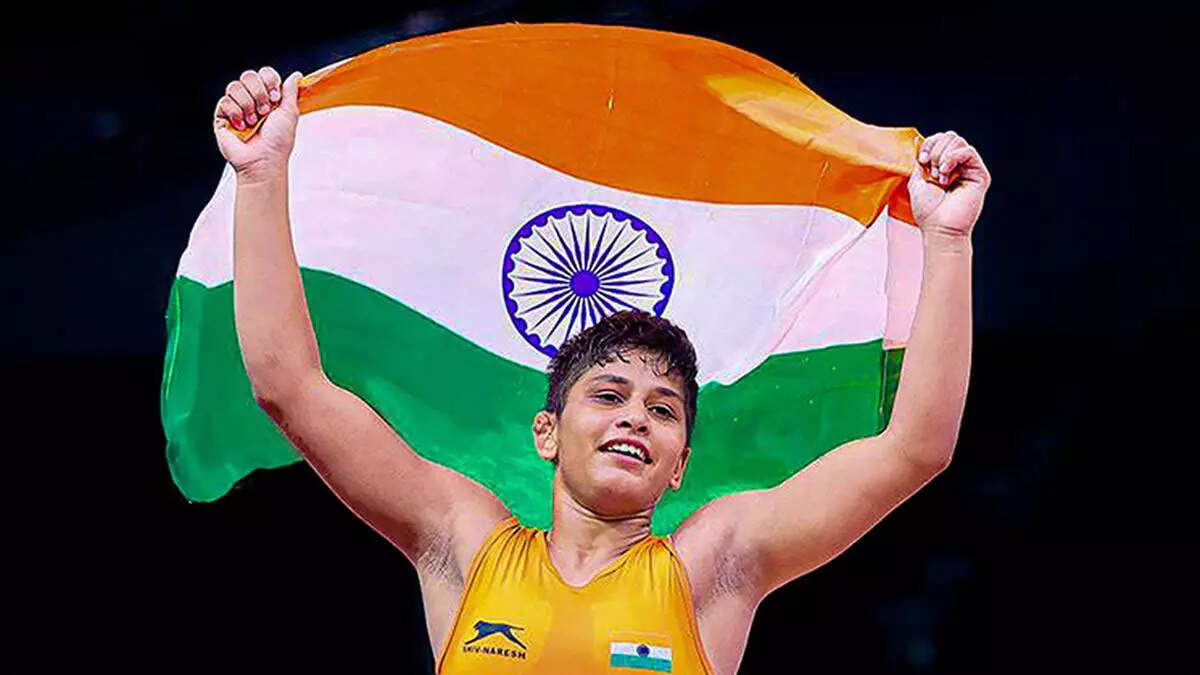
Antim Panghal
Six medals, one bigger dream
The six medals tell only part of India’s wrestling story in Nagoya.Sehrawat battled through a difficult phase to defeat a reigning world champion. Kalkal stunned an Olympic champion before producing a remarkable comeback for gold. Siwach overcame a serious teenage injury and years of struggle to reach a historic Greco-Roman final. Punia changed weight categories and still made the podium, while Panghal improved her medal colour and Kumar returned from knee surgery to make history.But beyond the six medals was a bigger message — India’s wrestlers are already looking towards Los Angeles.Their words after returning home reflected an ambition that goes far beyond Nagoya: to turn this success into Olympic gold in 2028.