










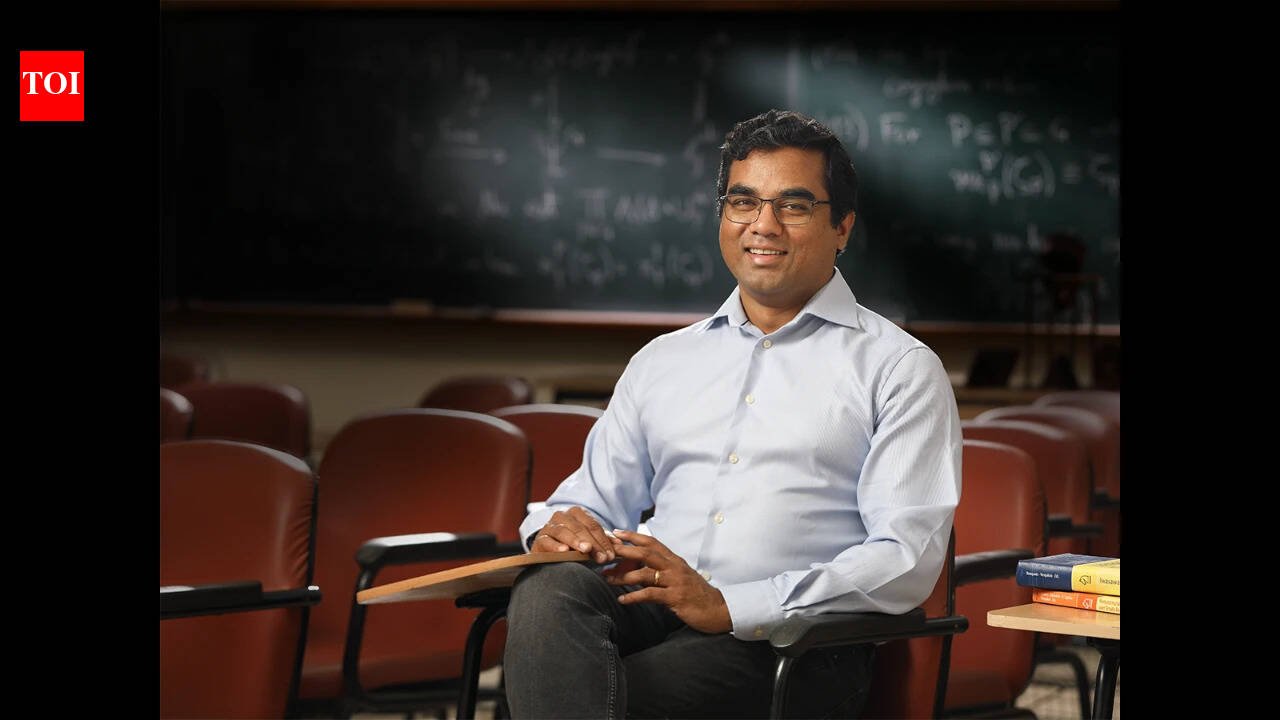
Indian mathematician and Indian Institute of Science (IISc) professor Mahesh Kakde has won the 2026 Ramanujan Prize for Young Mathematicians from Developing Countries for his work in algebraic number theory.The prize is jointly awarded by the International Centre for Theoretical Physics (ICTP) and the International Mathematical Union (IMU). It recognises researchers under the age of 45 who have carried out outstanding mathematical research while working in a developing country. The award comes with a cash prize of $10,000.Kakde, who is a professor in the Department of Mathematics at IISc in Bengaluru, was recognised for his work on noncommutative Iwasawa theory, as well as the Gross-Stark and Brumer-Stark conjectures. His research also has implications for one of the famous problems posed by German mathematician David Hilbert more than a century ago.
What does Mahesh Kakde’s work involve?
The terms used to describe Kakde’s research can sound intimidating at first.His main field is algebraic number theory, a branch of mathematics that uses ideas from algebra to study numbers and the structures built around them. At IISc, his listed research areas include number theory and arithmetic geometry.One of the areas in which Kakde has made major contributions is Iwasawa theory.In simple terms, Iwasawa theory looks at how arithmetic properties change as mathematical systems are extended through increasingly large and complicated fields. Kakde’s work includes fundamental results in noncommutative Iwasawa theory, an area where the structures involved don’t necessarily follow the simpler rules found in commutative settings.The 2026 Ramanujan Prize specifically recognises these results.
His work on long-standing mathematical conjectures
Kakde has also worked on the Gross-Stark and Brumer-Stark conjectures, two deep problems in algebraic number theory.His work with mathematicians including Samit Dasgupta and Kevin Ventullo led to important results around the Gross-Stark conjecture. IISc notes that Kakde and Dasgupta also worked on the Brumer-Stark conjecture and related questions.These aren’t problems that can be explained with a simple formula or calculation. They deal with connections between different mathematical objects, including number fields, zeta functions and L-functions.And this is where another famous name enters the story: David Hilbert.
How is Hilbert’s 12th problem connected?
In 1900, Hilbert presented a list of 23 problems that he believed would shape mathematical research in the years ahead.The 12th problem broadly asks mathematicians to find a systematic way of describing certain important numbers and field extensions using special functions and other mathematical structures.Kakde’s research, including work with Dasgupta, has implications for this problem. The Indian government citation for his Shanti Swarup Bhatnagar Award says his work contributed to a p-adic resolution of Hilbert’s 12th problem for totally real fields.That doesn’t mean Hilbert’s 12th problem has been completely solved. The general problem remains open. Kakde’s work addresses important cases, particularly those involving totally real fields.
From Bengaluru to Cambridge and back to IISc
Kakde’s academic journey has taken him from India to some of the world’s leading mathematics institutions and eventually back to Bengaluru.He completed his Bachelor of Mathematics at the Indian Statistical Institute in Bengaluru before moving to the University of Cambridge. He completed his doctoral degree in pure mathematics there in 2008.After his PhD, he worked as an instructor of mathematics at Princeton University. He then spent time at University College London and King’s College London before joining IISc as a professor in August 2019.Today, Kakde is part of IISc’s mathematics department, where his research focuses on number theory and arithmetic geometry.A growing list of honoursThe Ramanujan Prize is the latest in a series of major honours for Kakde.He won the Infosys Prize in Mathematical Sciences in 2022 for his contributions to algebraic number theory. IISc also records that he was an invited speaker at the 2022 International Congress of Mathematicians, where he presented work on the Brumer-Stark conjecture with Samit Dasgupta.In 2023, he received the London Mathematical Society’s Whitehead Prize and was elected a Fellow of the Indian Academy of Sciences. His CV also lists the 2023 Frontiers of Science Award, shared with Dasgupta and Kevin Ventullo.He was also awarded the Vigyan Yuva Shanti Swarup Bhatnagar Award in Mathematical Sciences in 2024.
What is the Ramanujan Prize?
Named after legendary Indian mathematician Srinivasa Ramanujan, the Ramanujan Prize has been awarded annually since 2005.It is meant for young mathematicians from developing countries who have carried out outstanding research while working in a developing country. The selection committee considers not only the quality of the research but also the circumstances and environment in which the work was carried out.The 2026 award makes Kakde the latest Indian mathematician to receive the honour.For a researcher working on some of the most difficult questions in number theory, it is a recognition of work that often happens far away from the public spotlight, inside equations, conjectures and mathematical structures that can take years to understand.And this time, that work has brought one of India’s mathematicians a prize named after one of the country’s greatest mathematical minds.