









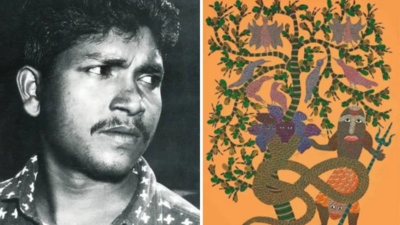
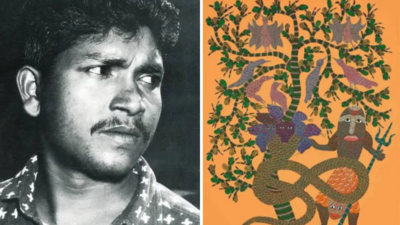
In 1985, a painting by Jangarh Singh Shyam was bought for ₹1,500. In September 2026, another milestone in the late Gond artist’s story unfolded when one of his paintings fetched ₹18 crore at an auction in Mumbai. The sale brought renewed attention to an artist whose work helped take the visual traditions of Madhya Pradesh’s Gond community to an international audience.But the significance of the sale goes beyond the price. Shyam, who died in Japan in 2001 at the age of 39, had spent his life developing an artistic language rooted in Gond traditions while navigating a contemporary art world in which indigenous artists often struggled for recognition and financial security. His journey from painting village walls to exhibiting internationally remains central to his legacy.
From a village in Madhya Pradesh to Bharat Bhavan
Born in 1962 in Patangarh village in Madhya Pradesh’s Mandla district, Shyam belonged to a Pardhan Gond family. According to Artisera, financial hardship forced him to leave school at a young age and take up agricultural work.Painting was already part of the cultural environment in which he grew up. Gond communities had long used walls to depict traditional motifs and stories, drawing on their relationship with nature, animals, forests and spiritual beliefs. Shyam began by working within this tradition, but his talent would eventually take him beyond the walls of village homes.In the early 1980s, contemporary artist Jagdish Swaminathan noticed Shyam’s work and brought him to Bhopal to work at Bharat Bhavan, the city’s multidisciplinary arts centre. Impressed by the young artist’s forms and colours, Swaminathan encouraged him to explore his abilities further.The move introduced Shyam to new materials and artistic possibilities. He began working with acrylic colours on paper and canvas, adapting imagery rooted in Gond culture to different formats without abandoning its cultural foundations.
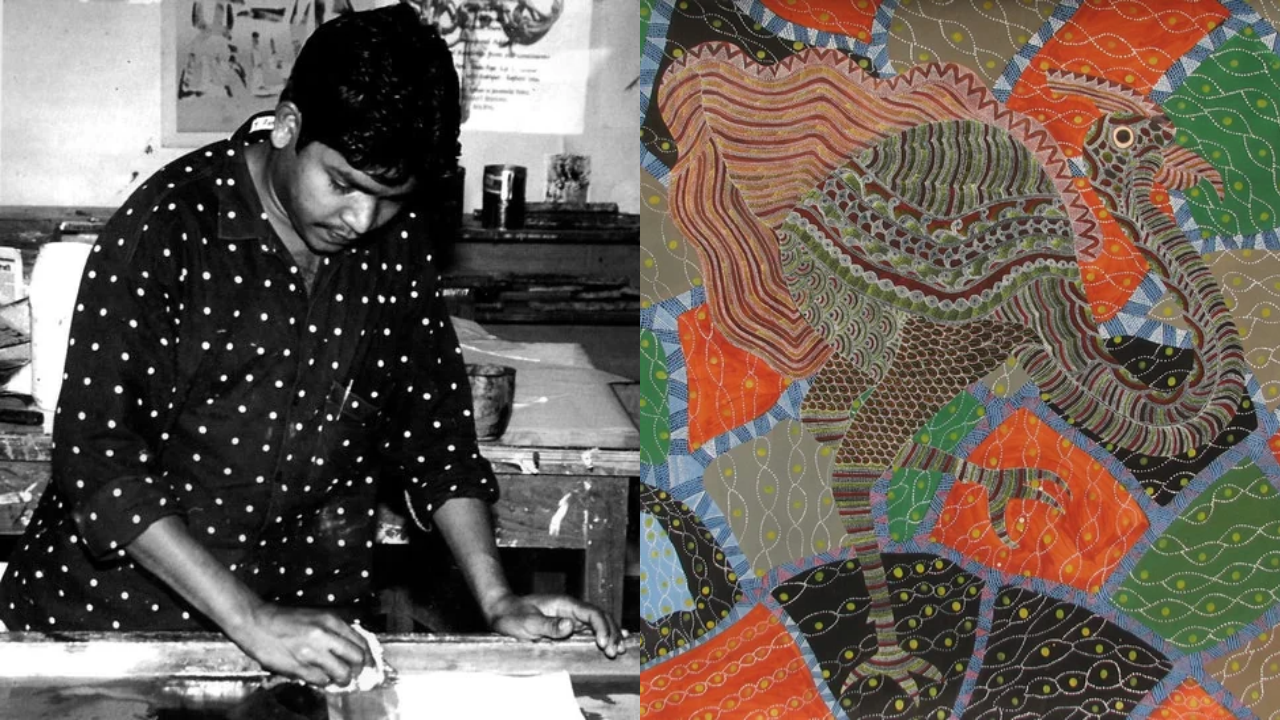
From painting village walls in Madhya Pradesh to exhibiting at the Pompidou Centre in Paris, Shyam took Gond art to an international audience.
How Jangarh Kalam developed
Shyam’s paintings became recognisable for their vivid colours, intricate patterns and repeated arrangements of dots, lines, dashes and curves. Birds, animals, trees, deities and supernatural figures appeared in compositions that drew on Gond beliefs and the natural world.Artisera notes that the rhythmic quality of Pardhan Gond music found a visual parallel in his paintings. Rather than simply reproducing traditional imagery, Shyam developed a distinctive style that combined cultural memory with experimentation.This visual language came to be known as Jangarh Kalam, named after the artist himself.His contribution was significant because it helped move Gond painting into the contemporary art world while preserving its connections to the community from which it emerged. His work showed that indigenous art could develop through individual experimentation and still remain deeply rooted in its cultural traditions.Shyam also inspired members of his family to pursue painting. His wife, Nankusia Bai, and their children, Mayank Shyam and Japani Shyam, became artists, helping carry forward the artistic tradition associated with his name.
From Bhopal to Paris
Shyam’s work soon travelled beyond Madhya Pradesh. In 1989, his paintings were exhibited at the Pompidou Centre in Paris as part of Magiciens de la Terre, an exhibition that brought together artists from different cultural backgrounds.He also painted the dome of Bharat Bhavan and the interiors of the Madhya Pradesh Vidhan Bhavan, taking his artistic vocabulary into prominent public spaces.These achievements brought him recognition, but they did not automatically ensure financial stability. Shyam continued to face prejudice and marginalisation despite growing interest in his work. He lived with his family in modest accommodation in Bhopal, and buyers for his paintings were not always readily available.
A life cut short
In July 2001, Shyam died by suicide while participating in an artist residency at the Mithila Museum in Japan. He was 39.He had written letters home describing loneliness during his stay. The precise reasons for his death remain unclear.Shyam’s short career left a lasting impact on Indian art, but his story also exposed the vulnerabilities faced by artists attempting to navigate unfamiliar institutions and markets.The September 2026 auction at Mumbai’s Pundole Gallery gave Shyam’s work renewed prominence. According to ThePrint, an untitled acrylic-on-canvas painting from 1999, measuring 91 by 69 inches and depicting a spiritual figure amid snakes, birds and a tree, sold for ₹18 crore on September 24. The work had been estimated at ₹4 crore to ₹6 crore.Just five days after this sale, another work by Shyam, Bel Mukhota (Gond), fetched ₹2.88 crore at a Saffronart auction.The ₹1,500 purchase reported from 1985 and the ₹18-crore auction in 2026 offer a striking comparison across four decades. But the value of Shyam’s legacy cannot be measured by auction prices alone.His paintings brought the stories, beliefs and visual traditions of the Gond community to audiences far beyond the region where he grew up. His family and other Gond artists continue to carry forward the tradition he helped shape.