










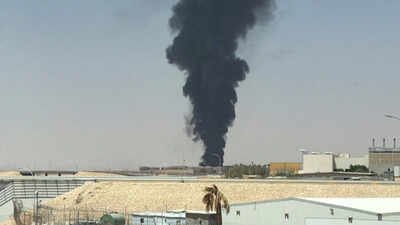
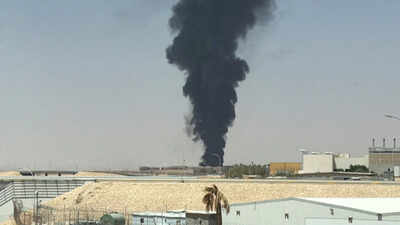
Yemen’s Iran-aligned Houthi rebels have claimed responsibility for Saturday’s deadly attack on Riyadh’s King Khalid International Airport, which killed 12 people and injured more than 300, as a fresh projectile struck the airport complex on Sunday, raising fears of a wider escalation in the Middle East conflict.The Saudi-led coalition fighting the Houthis in Yemen said Sunday’s projectile hit Terminal 4 of the airport, causing a fire. Saudi air defences also intercepted a cruise missile near the airport, although authorities did not immediately provide further details about the latest incident. The airport remained closed following Saturday’s attack.The latest developments have intensified concerns that the conflict could spread further, with US President Donald Trump considering whether Washington should join Saudi Arabia’s military campaign against the Houthis.
Houthis warn airlines to avoid Saudi airports
The Houthis have stepped up attacks on Saudi infrastructure amid escalating fighting with forces backed by Riyadh in Yemen. Saturday’s strike was the deadliest attack in a Gulf Arab country since the Iran war began, according to reports.The 12 people killed included four Saudi citizens, two Bangladeshi nationals and one citizen each from the United States, Egypt, Jordan, Palestine, Syria and Sudan. More than 300 people were injured, with some reported to be in critical condition.The Houthis have also warned airlines, airport workers and travellers against using Saudi airports and airspace, claiming these could be targeted in further attacks.In a statement carried by Houthi-run Al Masirah television, the group’s foreign ministry warned that further Saudi military action in Yemen would invite retaliation.“Unless the Saudi enemy stops its aggression and interference in Yemen, worse is yet to come, God willing,” the ministry said.The group has exempted airports in Mecca and Medina from its warning. The Saudi-led coalition, meanwhile, has intensified its military campaign and is backing Yemeni government forces attempting to reverse recent Houthi advances along the Red Sea coast.
Trump weighs US military involvement
The escalation has put Washington under pressure to decide whether to become directly involved in Saudi operations against the Houthis.Trump said on Saturday that the US was considering joining the fight. A direct American intervention could widen the conflict and increase the risk of further attacks on Saudi infrastructure.Saudi Arabia has also faced growing pressure on its air defences as the Houthis continue targeting airports, military facilities and oil infrastructure. The repeated attacks have disrupted aviation and raised concerns about the security of critical infrastructure across the Gulf.The latest violence comes amid a renewed offensive by Yemeni government forces, backed by Saudi Arabia, against Houthi positions near the Bab el-Mandeb Strait, a strategic waterway connecting the Red Sea with the Gulf of Aden.The narrow passage is an important route for international commercial shipping and energy supplies. Any further disruption could affect global trade and oil prices, particularly as the wider conflict has already placed pressure on shipping through the Strait of Hormuz.
Saudi Arabia faces growing security risks
The airport attack has also struck at a time when Riyadh is hosting a major international energy conference, with other investment-related events planned in the coming days.Saudi Crown Prince Mohammed bin Salman has sought to position the kingdom as a major destination for international business, tourism and investment. Continued attacks on civilian infrastructure could complicate those ambitions.The Houthis’ military capabilities have grown in recent years, making the group one of Iran’s key regional allies. Although fighting between the rebels and Saudi Arabia had eased following a 2022 ceasefire, tensions have risen again as the conflict in Yemen has intensified and the wider Iran war has spread across the region.Ahmed Nagi, the International Crisis Group’s senior analyst for Yemen, warned that the Houthis’ strategy could produce the opposite of its intended result.“Rather than pushing Riyadh to step back, attacks on critical Saudi infrastructure could make the Saudis more determined to continue the campaign,” he said.