









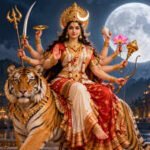
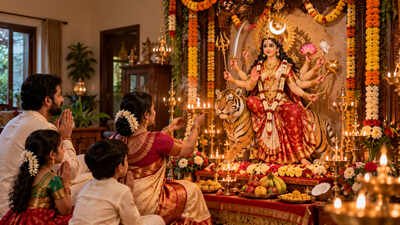
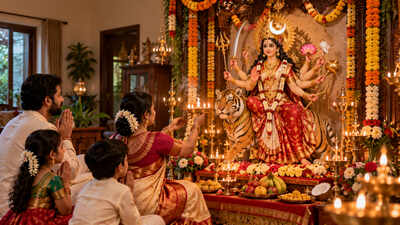
Chandraghanta means “the one with a bell-shaped crescent moon on her head.” It’s a name you can almost see: a crescent shaped like a bell resting on the Mother’s forehead, quietly announcing her presence. This Sharad Navratri, she is worshipped on Tuesday, 13 October, which falls on Tritiya, the third lunar day.Look at her not only as power but also as presence. She is a living ideal in everyday life, not merely a figure in a temple.
From birth to penance to a home
In the devotional sequence of the nine forms, Shailputri on Day 1 marks the Goddess’s birth as the daughter of the mountain. Brahmacharini on Day 2 represents her penance and unwavering focus. These are phases of a story, not merely different names.Having achieved her aim of uniting with Lord Shiva, she appears on Day 3 as a married woman, a grihastha (householder), navigating family and daily life. That shift matters. Many devotees recognise this form most easily because she represents a life familiar to them, one that unfolds even in their own kitchens.This is where devotion enters the kitchen, the storeroom, and the courtyard, alongside the endless small responsibilities of everyday life. Running a household demands stamina, steadiness, and a heart that doesn’t give up when the day feels long. In Gujarat, where the nine nights fill courtyards with circles of garba (a traditional folk dance), many women still finish their household work before the dancing begins.
Strength that doesn’t leave the room
Tradition presents Chandraghanta as an ideal for married women and for every householder who worships her. Her independent personality emerges in this form. She isn’t shown withdrawn from life. She is shown living within it, amid family and duty. That is why her worship speaks so directly to people with homes to run.Devotees believe that a family that worships her sincerely will see growth, success, and prosperity enter the household. Understand this as a belief within the tradition, a promise associated with her form, rather than a guarantee.The day also carries a quieter teaching about courage. A home encounters a difficult conversation or a lingering worry far more often than a battlefield, and Chandraghanta represents the fearlessness needed to face them. Four days later, on Day 7, Kalaratri takes up fear as her central theme.
Milk, ghee, honey, and sevai for a tiring day
Because running a household takes energy, the traditional offerings to Chandraghanta are nourishing:
- Milk
- Pure ghee
- Honey
- Kheer (sweet milk pudding) made with sevai, or vermicelli
Many families observing a fast that day can still prepare these offerings, as the ingredients are often already in the pantry. Sevai is quick to make, which suits a day when the household is already busy with its usual work and the evening aarti (a ritual offering of light) is still to come.As for colour, published lists for Sharad Navratri 2026 assign red to Day 3, symbolising energy. Follow your family’s custom if it differs, since colour lists can vary by region and almanac.Bring red flowers and add yellow marigolds if your family prefers them. Arrange them on a thali, a round steel or brass plate, with a small bowl of honey in the centre, where the lamplight catches its surface.