










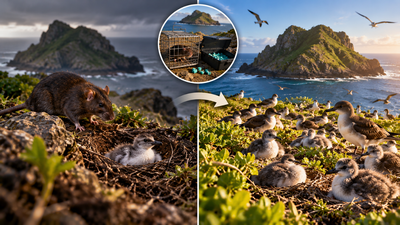
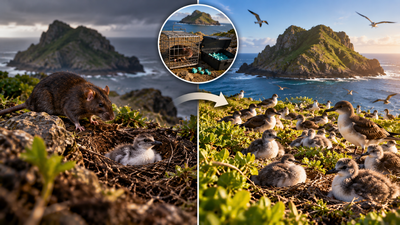
In 2002, black rats (Rattus rattus) were eradicated from Mokoliʻi, a 1.6-hectare islet off the east shore of Oʻahu, Hawaiʻi. Only a single Wedge-tailed Shearwater chick survived there from 1999 to 2001. Once the rats were gone, the number of surviving chicks reached 126 in 2002 and 185 in 2003. According to the study published in Scholar Space, titled ‘Recovery of Native Species following Rat Eradication on Mokoli‘i Island, O‘ahu, Hawai‘i1’, the team used snap traps, cage traps and diphacinone bait stations, and caught 18 black rats. Most of the labour came from local community volunteers. The authors reported apparent increases in native plants, including the endangered Carter’s panic grass, and in intertidal invertebrates.
What makes Mokoliʻi Island a unique seastack ecosystem
Mokoliʻi lies on the edge of Kāneʻohe Bay, about 500 m east of Kualoa Point on the eastern shore of Oʻahu. The island is 63 m at its highest point and is a geological example of a sea stack. It sits next to Kualoa Regional Beach Park and receives daily human recreational traffic. The authors state that thick vegetation and thorny lantana largely restrict foot traffic to existing perimeter and summit trails.The island is heavily vegetated and dominated by non-native plants such as Christmas berry and lantana. It also holds native species, including ʻilima, naupaka kahakai, pili grass, pāʻūohiʻiaka and the endangered endemic Carter’s panic grass. Mokoliʻi is also a nesting site for the Wedge-tailed Shearwater, although the authors say nesting success has been very low in recent years. They report that black rats had been present since the 1950s and are known to be a major predator of island birds, particularly ground- and burrow-nesting seabirds. They also name plants, insects, intertidal molluscs and other invertebrates among the animals and plants rats affect.
What traps and poison bait did researchers use
On 3 March 2002 one of the authors, E.K.S., and 10 volunteers from the local community reached the island by sailboat, kayaks and surfboards from Kualoa Regional Beach Park. They set out 19 bait stations, nine cage traps and 11 snap traps in a 25-m grid across the island. The paper says the design was based on a successful rat eradication programme previously conducted on Kure Atoll.Each bait station was stocked with eight 56.7-g (2-ounce) blocks of Eaton’s brand peanut butter and molasses-flavoured bait containing 0.005% diphacinone. The authors describe this bait as blue-green and the only rodenticide approved for use in Hawaiʻi. All baiting followed US Environmental Protection Agency special local need registration HI-960008 and Hawaiʻi State Department of Agriculture regulations. The cage traps, made by Haguruma of Osaka, Japan, measured 46 by 34 cm and were baited with coconut smeared with peanut butter. Snap traps were baited with plain peanut butter. Traps and stations were checked the next day and then weekly, until there was no sign of rat take on the baits and no captures for several consecutive visits.
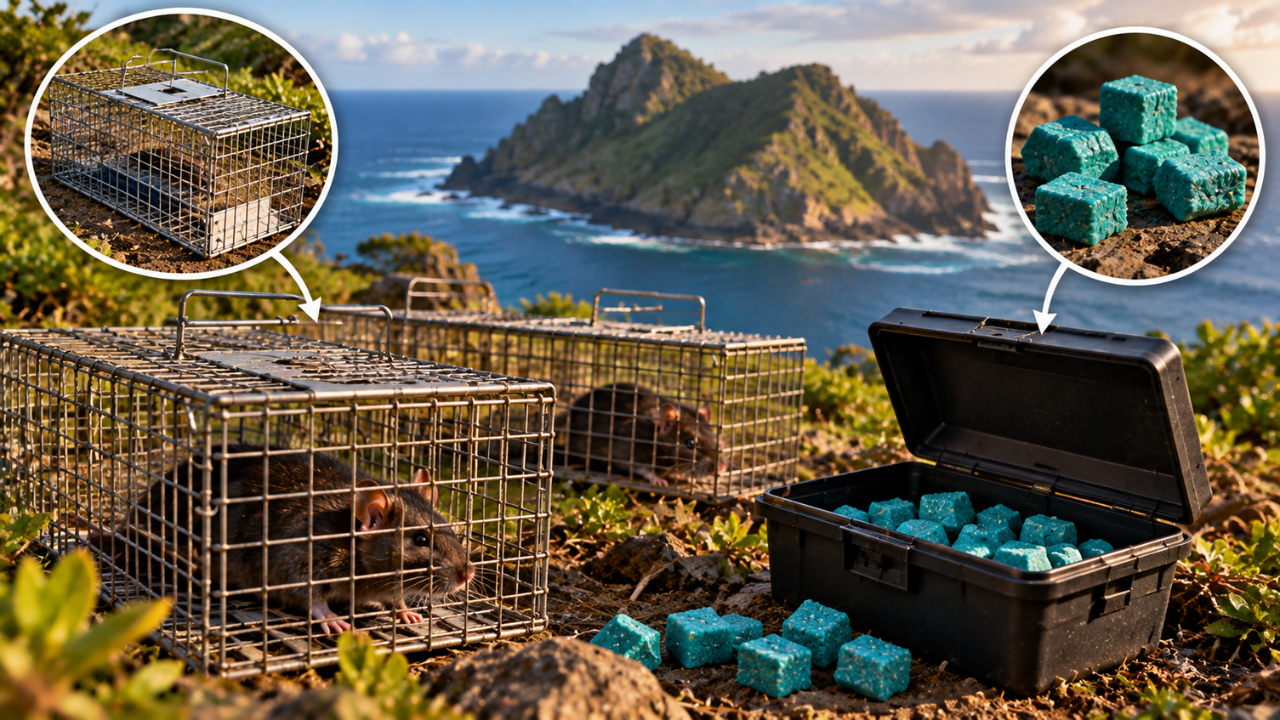
Image AI generated
Why did researchers use both cage traps and snap traps
18 black rats were caught in the first two weeks, 12 in cage traps and six in snap traps. No other rodent species were captured, and there were no further trap captures after 16 March. Snap traps were removed on 6 April and cage traps on 21 April to save labour. Several rats caught in cage traps were necropsied, which showed they had ingested the blue-green diphacinone bait.Bait take was initially high on 4 March but dropped off rapidly. It then increased again immediately after the traps were removed. The authors say this indicated that rats were still on the island and may have been trap-shy, which demonstrated the importance of using more than one method. A small increase in bait take from 4 to 18 May was attributed to cumulative foraging by insects over the previous two months rather than to rats. By 27 May there were no indications of rats, and all later bait take was attributed to insects. Sixteen visits were made from March to October, with 77.5 person-days spent checking traps and deploying 354 blocks of diphacinone bait between 3 March and 24 October 2002.
How did rat eradication boost seabird survival on Mokoliʻi Island
Only a single Wedge-tailed Shearwater chick survived on Mokoliʻi from 1999 to 2001, before the rats were eradicated. After eradication, the number of surviving chicks increased to 126 in 2002 and 185 in 2003. The authors explain that shearwaters return to nesting areas in Hawaiʻi in March or April, lay eggs in early June and usually fledge in November. The Hawaiʻi Division of Forestry and Wildlife surveys surviving chicks on most islets off Oʻahu, including Mokoliʻi, each October, which provided the baseline data for comparison.The authors note increases in other native species, although they did not collect quantitative data on them. Before the eradication, rats had extensively browsed naupaka stems and meristems, which killed several of the larger plants, and there were only 10 clumps of Carter’s panic grass. Pipipi (Nerita picea), speckled periwinkle (Littoraria pintado) and ʻaʻama crab (Grapsus tenuicrustatus) were all scarce. A survey on 4 March 2003 found an abundance of these species in the same areas, and the damaged naupaka had resprouted with the annual winter rainfall. The authors state that “Rats had a devastating impact on the flora and fauna of Mokoliʻi”. They add that rats could return on stowaways aboard private boats or through the intentional actions of people, so continued vigilance and community monitoring will be necessary.