










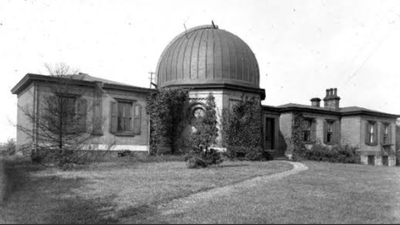
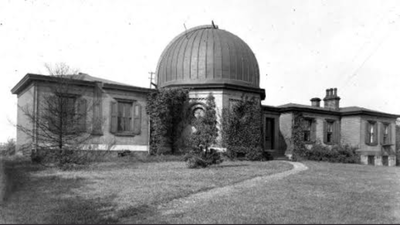
In the autumn of 1930, Leo Scanlon, a plumber from Pittsburgh, solved a problem in his backyard that would leave a lasting mark on amateur astronomy. Scanlon was building a private observatory behind his home in the Summer Hill neighbourhood on Pittsburgh’s North Side. He needed a lightweight, weather-resistant dome to protect a homemade telescope. Instead of using heavy wood or steel, he tried a material rarely used in construction at the time: sheet aluminium. The result was the Valley View Observatory, which featured what was described as the world’s first all-aluminium observatory dome. Its design became a model for later astronomy facilities and helped Scanlon secure a personal meeting with Albert Einstein four years later.
Solving a weight problem behind a terrace house
According to historical records kept in the Stellafane convention archives, Scanlon began recording daily notes about his backyard project in September 1930. Working with a friend named Bud, he drew plans for a rotating dome that did not need an internal support frame. Instead of using heavy iron supports, Scanlon joined curved sheets of aluminium with specially folded seams on the outside. This made the dome much lighter than traditional wooden structures. It could turn smoothly on rollers placed on top of a simple, eight-sided wooden building. To test the strength of the finished dome, Scanlon sat on top of it after fitting the final metal panels. Site records show that the entire observatory cost $250 to build, with $178 spent on the aluminium dome itself. The Valley View Observatory officially opened on 4 October 1930. Its rotating dome protected Scanlon’s reflecting telescope and allowed him to observe the night sky over Pittsburgh.
Founding a regional astronomy movement
The completed aluminium dome helped Scanlon move from being a keen hobbyist to becoming a recognised figure in the amateur astronomy community across the United States. In 1929, Scanlon co-founded the Amateur Astronomers’ Association of Pittsburgh (AAAP). The group aimed to support people who studied astronomy on their own and those who built their own telescopes. Historical records published by the AAAP note that Scanlon’s backyard observatory soon became a meeting place for amateur astronomers, people who worked with optical equipment and professional astronomers visiting western Pennsylvania. His aluminium dome design attracted interest from telescope makers across the country. They valued its light weight, resistance to rust and corrosion, low maintenance needs and ease of rotation. These features helped make aluminium a common choice for domes at smaller observatories.
Meeting Albert Einstein in Pittsburgh
Scanlon’s standing among local amateur scientists helped lead to a meeting with Albert Einstein in December 1934. Einstein travelled to Pittsburgh to give a major lecture on his theory of relativity at the Carnegie Institute of Technology, now Carnegie Mellon University. According to historical accounts published by Carnegie Mellon University News, local organisers arranged a busy schedule for the famous physicist. However, Einstein also asked for time to meet amateur researchers and working people with an interest in science. As a co-founder of the Amateur Astronomers’ Association of Pittsburgh, Scanlon was invited to meet Einstein during his visit. He personally invited the Nobel Prize winner to see the group’s astronomy exhibits and instruments. Historical commentary preserved in Carnegie Mellon’s archives notes that Einstein respected amateur scientists who pursued research because of their genuine interest in the subject. He reportedly appreciated meeting ordinary people who spent their free time studying the universe.
Legacy of an astronomical pioneer
The original Valley View Observatory remained in Pittsburgh for nearly seven decades. It was dismantled in August 1997, but preservationists and members of the Amateur Astronomers’ Association of Pittsburgh saved the historic aluminium dome to protect it for the future. Scanlon’s contribution to amateur science and astronomy education also received recognition from the international scientific community. Main-belt asteroid 8131, discovered by astronomers in 1976, was later officially named “Scanlon” in his honour. Through a backyard building project and his work bringing astronomy enthusiasts together, the Pittsburgh plumber showed how practical skills and a passion for science could make a lasting contribution to astronomical research and facilities.