









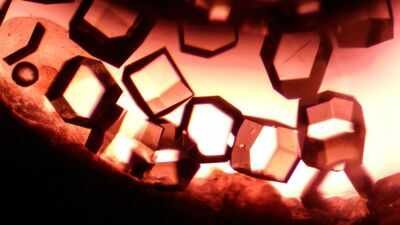
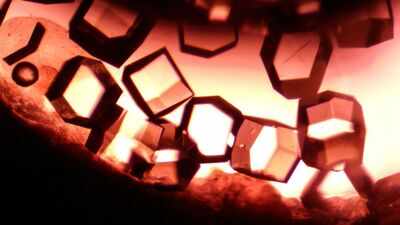
Nasa has grown crystals of lysozyme, a protein found in human tears, saliva and milk, aboard the International Space Station (ISS) to study how crystals form in microgravity. The experiment offers a closer look at how proteins develop under conditions that differ from those on Earth. According to Nasa, the crystals were produced using Redwire’s PIL-BOX hardware as part of research into crystal formation in space. Although lysozyme is a familiar biological substance, studying its crystals can help researchers understand the processes involved in producing high-quality crystals for scientific investigations.
How Nasa grew crystals from a protein found in human tears
Nasa shared an image of lysozyme crystals aboard the International Space Station, taken on June 5, 2024. In its report, the agency explained that lysozyme is present in bodily fluids, including tears, saliva and milk, and plays an important role in the body’s natural defences against harmful microorganisms.The protein helps protect the body against bacteria, viruses and fungi, making it an important component of the innate immune system. Researchers also use lysozyme as a control compound to demonstrate the formation of well-shaped crystals.The crystals were grown using Redwire’s PIL-BOX, a piece of experimental hardware used to investigate how microgravity affects crystal production. The work forms part of a broader effort to understand how crystals develop in the unusual environment of space.
Why proteins are studied in crystalline form
Proteins perform a wide range of functions in the human body, from supporting the immune system to regulating essential biological processes. Their shapes are closely linked to how they work, and even small differences in structure can influence their behaviour.Nasa explained that understanding protein structures can help researchers develop medicines that interact with specific targets in the body.Many treatments work by binding to a particular protein and changing its activity. To design medicines that interact with these targets effectively, scientists need detailed information about their 3D structures.Growing proteins into crystals provides one way to obtain that information. Researchers can examine the crystals using techniques such as X-ray diffraction, which reveals details about the arrangement of atoms within a protein.However, obtaining crystals suitable for detailed analysis can be difficult. Their quality affects how accurately scientists can determine a protein’s structure, making the conditions under which they grow an important part of the research.
Microgravity changes the way crystals develop
On Earth, gravity influences the movement of liquids and particles during crystal formation. Processes such as sedimentation, in which heavier particles settle, and convection, which causes fluids to move because of temperature or density differences, can interfere with the growth of an orderly crystal.The ISS offers a different environment. In microgravity, these gravity-driven effects are reduced, allowing protein molecules to come together and arrange themselves within a crystal more gradually.The ISS National Laboratory explained this process which examined research using the station to grow medically important molecular crystals. They noted that proteins grown in microgravity can form larger, more orderly crystals than those produced under comparable conditions on Earth.The ESA has also described in its report on the high-quality protein crystal growth experiment in the Kibo laboratory, how reduced convection and the absence of ordinary gravitational settling can help proteins form crystals with fewer structural imperfections.
Importance of this research for medical science
The study of lysozyme crystals fits into a wider programme of research exploring how microgravity can improve scientists’ understanding of proteins. Although lysozyme serves as a control compound in the experiment described by Nasa, other protein crystallisation investigations have more direct connections medical applications.According to the ISS National Laboratory, researchers have used the station to investigate proteins associated with conditions such as heart disease, liver disease and cancer. Understanding the structures of these proteins can provide information that may eventually support the development of treatments.Nasa described research involving Duchenne muscular dystrophy, a genetic disorder that affects muscles. A Japanese research team used information about the structure of a protein associated with the disease to identify potential compounds for treatment. One candidate, TAS-205, subsequently underwent clinical investigation.
Space-based experiments support research on Earth
Protein crystallisation experiments have been conducted aboard the ISS for decades. Researchers from pharmaceutical companies and academic institutions had carried out more than 500 protein crystal growth experiments on the station by 2021.Research has also explored whether improved crystallisation techniques could help pharmaceutical companies develop more stable drug formulations or medicines that are easier to administer. Nasa described investigations into monoclonal antibodies, for example, that examined ways to improve the consistency of formulations used in cancer treatment.The broader aim is to improve scientific understanding of proteins and support research that could eventually contribute to better medicines and treatments.