










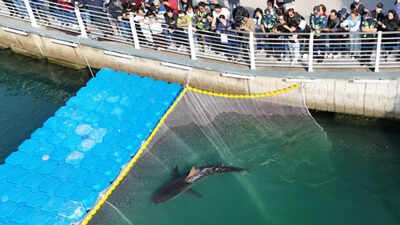
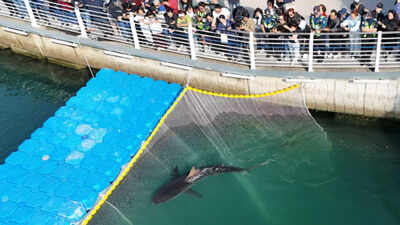
A 10-foot endangered shark in South Korea has left authorities facing an unusual rescue problem. After spending more than a month inside a canal in the port city of Busan, the shark was finally guided towards the open sea on Wednesday. But the rescue lasted only a few hours as the animal swam underneath a barrier net and returned to the canal, forcing officials to reconsider their approach after three attempts to move it out.The female dusky shark, known locally as Bukangi, has been in the North Port canal since September 18, according to news agency Associated Press. Its presence has turned the waterfront into a popular attraction, with more than 1.7 million people visiting the area. Busan authorities have also adopted the shark as a city mascot.Officials worry about how long Bukangi can remain in the confined waterway as they have found no clear signs that it has been feeding regularly during its stay. Water temperatures are also beginning to fall, raising fears about the possible effects on its health.According to Reuters, officials have placed barriers to prevent it from travelling farther inside. The outer net has also been opened in the hope that it will move towards the sea voluntarily. Meanwhile, experts have advised against another immediate rescue attempt as Bukangi’s condition remains stable.
Why three attempts to move Bukangi have failed
After two failed attempts to get the shark out of the canal, rescuers tried a new approach. Instead of relying mainly on boats and nets to block the shark’s movements, workers used floating platforms to gradually direct it towards the canal entrance. Divers also participated in the effort.On Wednesday, the plan appeared to work. Bukangi moved beyond the canal and spent several hours in nearby waters. But by night, it had found a route beneath the outer net and returned.When it subsequently became confined between two barriers near the entrance, officials strengthened the nets farther inside the canal while leaving a route towards open water.During operations carried out on September 29 and October 2, workers used boats spraying streams of water and nets across the waterway. However, Bukangi avoided the boats and managed to pass over the nets.
Busy port could be influencing the shark
The reason Bukangi has remained in the canal is still unknown. Scientists have also been examining whether conditions outside the waterway could explain its reluctance to leave.Busan’s North Port handles container ships and cruise vessels, making it a busy maritime area. Kim Hyun-woo, a senior researcher at South Korea’s National Institute of Fisheries Science, believes the activity around the port could be influencing the shark’s behaviour.According to Kim, the relatively quiet canal may appear safer than the surrounding waters. He also raised the possibility that noise from ships, bright artificial lights and electric fields generated by nearby facilities could be affecting the shark’s senses. These explanations have not been confirmed, but they offer possible reasons for the animal’s repeated return.Kim also told AP that the shark might need more time to adjust after spending so long in the canal. “The shark has been staying inside the canal for an extended period, so I didn’t expect it to head straight out into the open water,” he said. “It would be best to give it about a week to leave on its own,” he added.
Shark’s prolonged stay is concerning
Bukangi has been identified as a female dusky shark, a species listed as endangered by the International Union for Conservation of Nature (IUCN).Dusky sharks are found in tropical and temperate waters across the world. According to South Korea’s National Institute of Fisheries Science, they can grow up to 4.2 metres long and travel considerable distances in search of suitable water conditions. They generally prefer temperatures between 18 and 26 degrees Celsius and feed on fish and squid. Their slow reproductive rate also makes the species vulnerable to population declines.Reuters also reported that experts have linked more frequent shark sightings along South Korea’s east coast to warming ocean temperatures.