










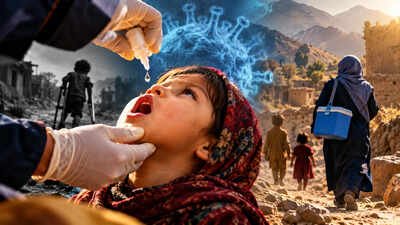
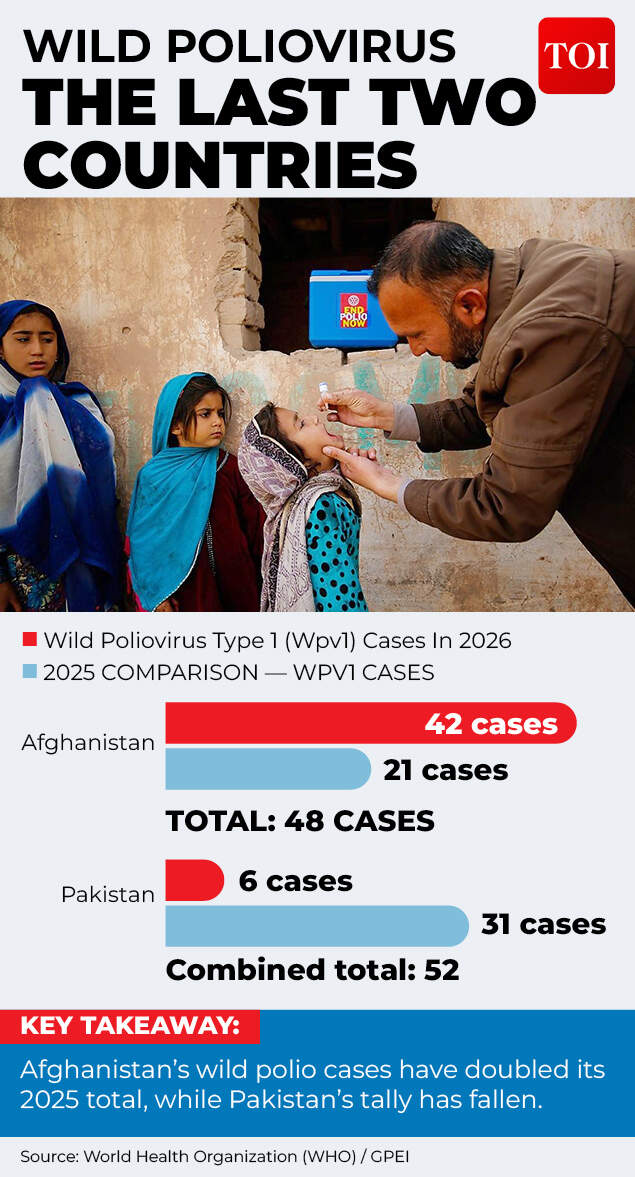
As countries mark World Polio Day, the disease remains entrenched in Pakistan and Afghanistan, even as it has been eliminated from almost every other part of the world. The Global Polio Eradication Initiative (GPEI) is marking the day with a plain message: political commitment matters more than ever.Afghanistan has emerged as the bigger concern this year, reporting 42 cases of wild poliovirus type 1 in 2026, twice the 21 recorded in the whole of 2025. Pakistan, meanwhile, has reported six cases, down sharply from 31 last year. The two countries have together reported 48 cases so far this year, against 52 in all of 2025.The resurgence follows a dramatic reversal in progress.In 2023, the two countries reported just 12 cases between them, with six each. The total surged to 99 in 2024, highlighting how fragile the gains against the virus remain.
The threat extends beyond reported cases of paralysis. Wild poliovirus continues to be detected in environmental samples, indicating that the virus is circulating even in places where no paralytic cases have been identified.
Why is polio surviving today?
Polio is a highly infectious viral disease that mainly affects children under five.It spreads primarily through the faecal-oral route, often in settings where sanitation and hygiene are inadequate.
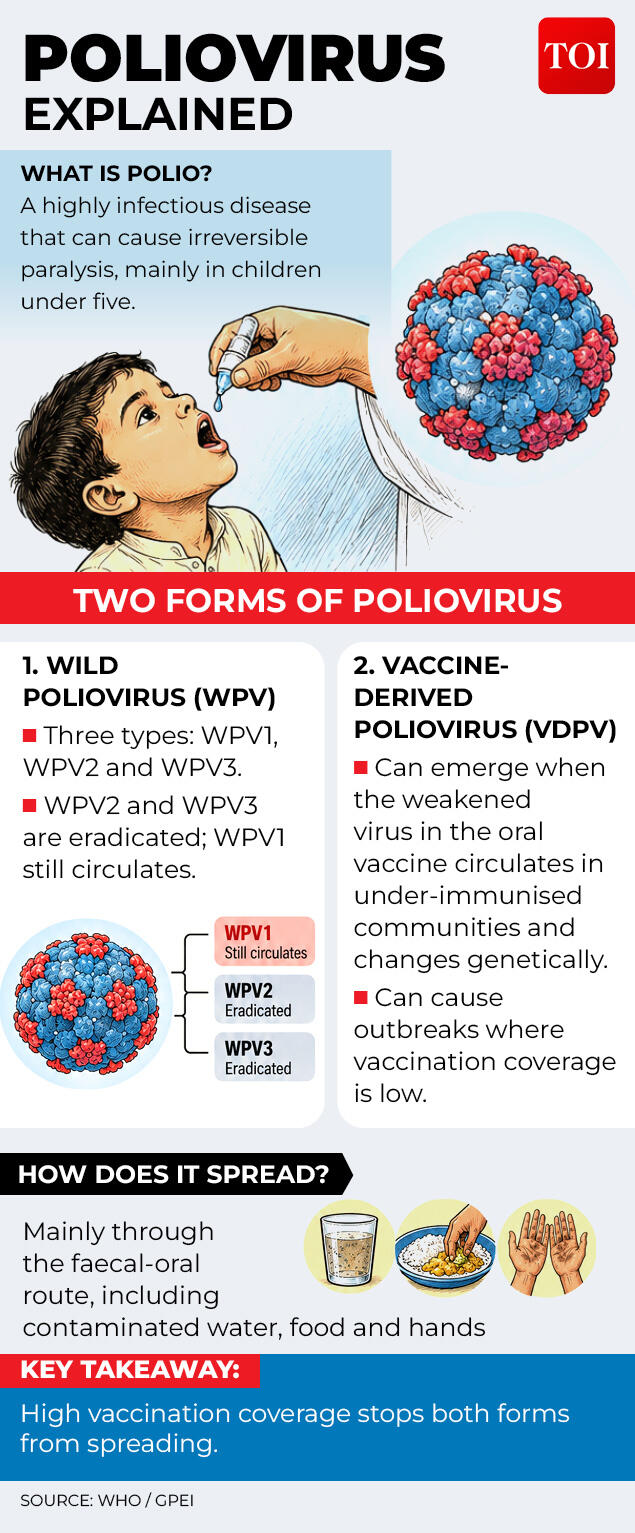
Most infections produce no obvious symptoms. In a small proportion of cases, however, the virus attacks the nervous system and causes irreversible paralysis. There is no cure for polio-induced paralysis, making vaccination the principal means of prevention.Eradication requires every child to be reached, including those who miss routine immunisation or vaccination campaigns. In Pakistan and Afghanistan, insecurity, restricted access, mistrust and population movement have left gaps that allow the virus to keep circulating.Dr Sunil Sareen, a paediatrician at Apollo Spectra Hospital in Delhi, told TOI that political instability and uneven vaccination coverage had made it harder to reach children in high-risk areas. “Even a few unvaccinated children can help spread the disease,” he said.The consequences of failure would extend far beyond the region.WHO has warned that if eradication efforts collapse, polio could cause as many as 200,000 new cases annually worldwide within a decade.
The virus has already demonstrated its ability to travel: in October 2025, wild poliovirus was detected in a routine sewage sample in Hamburg, Germany.
A chase that is almost 40 years old
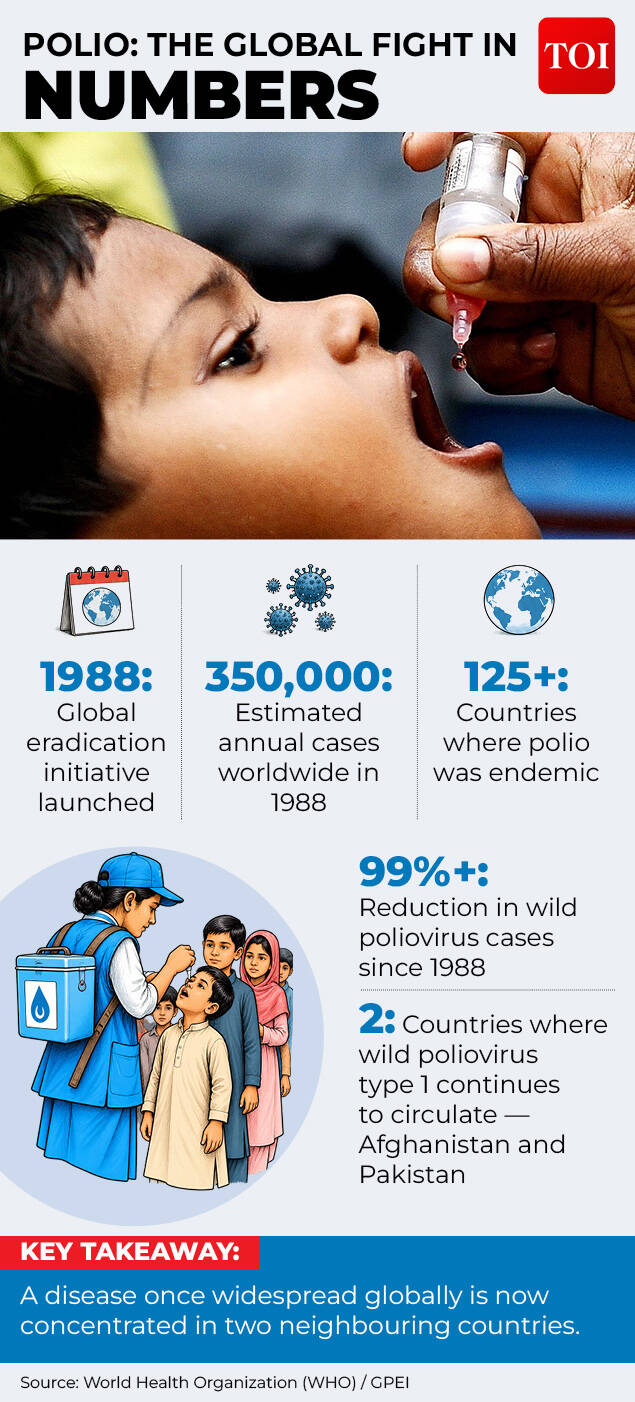
The global eradication effort began in 1988, when the World Health Assembly adopted a resolution to eliminate polio worldwide. The resulting Global Polio Eradication Initiative brought together governments, the World Health Organisation (WHO), UNICEF, Rotary International and other partners to coordinate vaccination, surveillance and outbreak response.The progress has been extraordinary. According to the WHO, the number of wild poliovirus cases has fallen by more than 99% since 1988, when an estimated 350,000 cases occurred annually across more than 125 endemic countries. Wild poliovirus types 2 and 3 have been declared eradicated. Type 1 is the only wild strain that continues to circulate.But eradication is different from simply reducing cases. A country can go years without reporting a paralytic infection and still have undetected transmission. To eradicate the virus globally, transmission must be interrupted everywhere, including in communities that are difficult to reach or where vaccination coverage remains uneven.Hence, the finish line keeps moving. The original goal was the year 2000. The GPEI now aims to certify wild poliovirus eradication by the end of 2027.In the past decade alone, more than $3 billion has been spent on the effort in Afghanistan and Pakistan.
India beat it in the hardest place
India’s own story shows that this can be done. When the Pulse Polio programme began in 1995, the country was recording an estimated 50,000 to 150,000 cases a year. As late as 2009, it still accounted for about 60% of the world’s cases.The risks were greatest in Uttar Pradesh and Bihar. Together they held about 300 million people, with roughly 5,00,000 births a month and heavy migration in and out. The CDC says that if polio could be ended there, it could be ended in the toughest settings anywhere.The method was relentless. India added house-to-house vaccination to find children who were not brought to fixed sites. During national immunisation days since 2000, more than 2.3 million vaccinators visited about 209 million households to reach over 170 million children under five. Transit teams at bus stops, railway stations and on trains vaccinated nearly 10 million children in each campaign.Trust mattered as much as logistics. Teams included at least one woman and one member of the local community, to ease entry into homes. Religious and community leaders were brought in where families were reluctant. Vaccinated children’s fingers were marked, and visited houses were marked too. Every home was numbered in detailed microplans, and independent checks measured coverage after each round.Sareen said Pakistan and Afghanistan could learn from India’s combination of door-to-door vaccination and community engagement. Local healthcare professionals, religious figures and community leaders can help counter misinformation, while follow-ups and outreach to migrant populations can help reach children who miss doses.
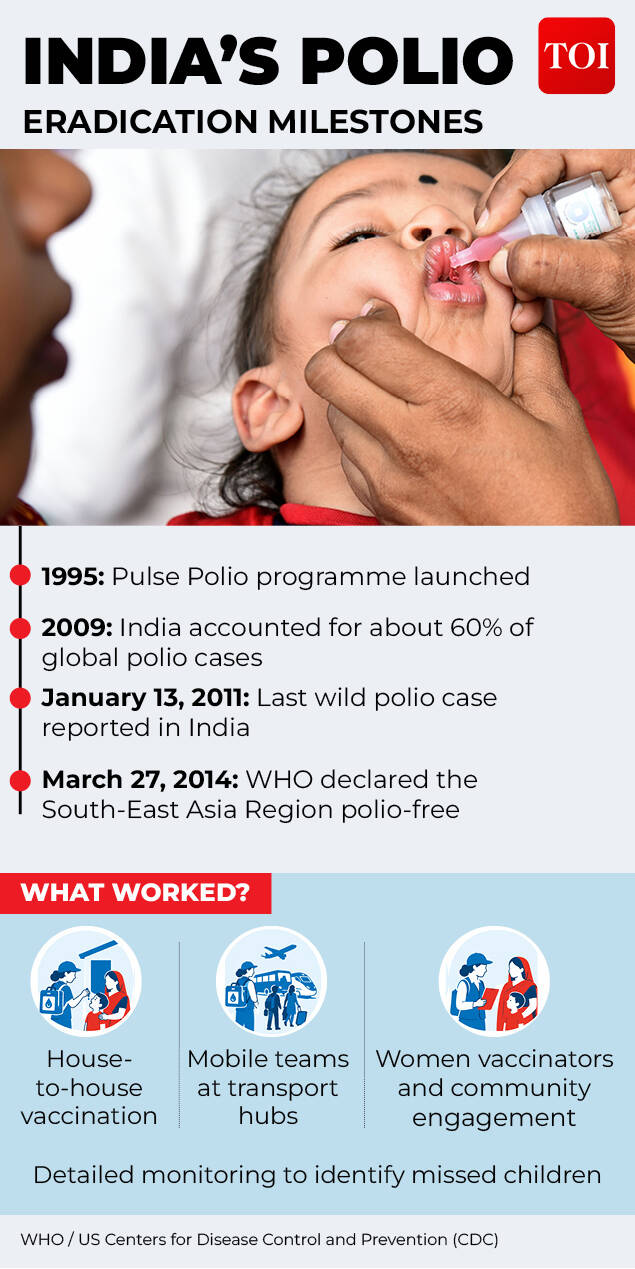
Science also helped. India switched to more effective vaccines, monovalent in 2005 and bivalent in 2010. The last case of wild polio was reported in Howrah, West Bengal, on January 13, 2011. On March 27, 2014, WHO declared the whole 11-country South-East Asia Region polio-free.India has not stopped. It still holds one national and two sub-national immunisation days every year, and has added the injectable polio vaccine to routine immunisation.Many of the tools that worked in India are exactly the ones now restricted or threatened across the border.
Afghanistan: No knocking on doors
Afghanistan’s surge traces back to how vaccines are delivered. The Taliban authorities restricted house-to-house vaccination in September 2024, after briefly allowing it across most of the country earlier that year. WHO says none has been held since October 2024. Campaigns now rely largely on mosques and other fixed sites.It had been working. In June 2024, house-to-house vaccination reached 95% of target children, the first use of the method in the South Region in more than five years, though Kandahar stayed on the site-based model.Now the WHO committee says site-based campaigns “often fail to reach all children, particularly younger children.” It also flags the limited role of women health workers, the very people India put on every team. The worst-hit area is the south, where the committee says intense transmission continues. This week’s six new cases came from Kandahar, Nangarhar and Kabul.Kamal Shah, a former Unicef communications officer, was quoted by VOA as saying that a main problem is “shortcomings in vaccination campaigns.”
Pakistan: Bullets, rumours and refusals
Pakistan has no ban on door-to-door vaccination. Its problem is safety. On May 18, the first day of a campaign to vaccinate more than 19 million children across 79 high-risk districts, gunmen killed two police officers guarding vaccination teams in Bajaur.In April, a policeman was killed in Balochistan and another was injured in Hangu. Officials say more than 200 polio workers and police escorts have died since the 1990s.Militants often claim the drives are a foreign plot to sterilise children, and rumours in rural areas include a claim that the vaccine is a CIA plot. Nature adds that some families refuse vaccines or question them when needs like clean water and sanitation go unmet.The WHO committee welcomed Pakistan’s strong political support and generally high reported coverage. But campaign quality varies by district, especially in southern Khyber Pakhtunkhwa and Balochistan. Transmission also persists in Karachi.Pakistan’s progress is real. Cases are down 99.8% from an estimated 20,000 a year in the early 1990s. On a visit this year, WHO regional director Hanan Balkhy said Pakistan “has a genuine opportunity to interrupt poliovirus transmission.”
What the sewers show
Paralytic cases reveal only part of the outbreak. Poliovirus can circulate in the intestine without causing obvious symptoms, allowing infected people to spread it before a case is identified.Health authorities therefore test sewage and other environmental samples for the virus. A positive sample can reveal transmission even when no nearby paralytic case has been reported.By mid-August, 176 sewage samples across the two countries had tested positive for wild poliovirus this year: 118 in Pakistan and 58 in Afghanistan.Pakistan had reported only three cases at that point. In 2025, the two countries recorded 745 positive samples.The WHO committee said transmission persisted through even the latest low season, from October 2025 to April 2026, and that it continues in both countries.
One virus, one border
The remaining outbreak follows a geography that crosses national boundaries. Pakistan and Afghanistan share a long border, and the movement of people between them creates opportunities for the virus to travel between communities.In its August assessment, the WHO emergency committee identified three critical areas of continued transmission: southern Afghanistan, southern Khyber Pakhtunkhwa in Pakistan, and Karachi.
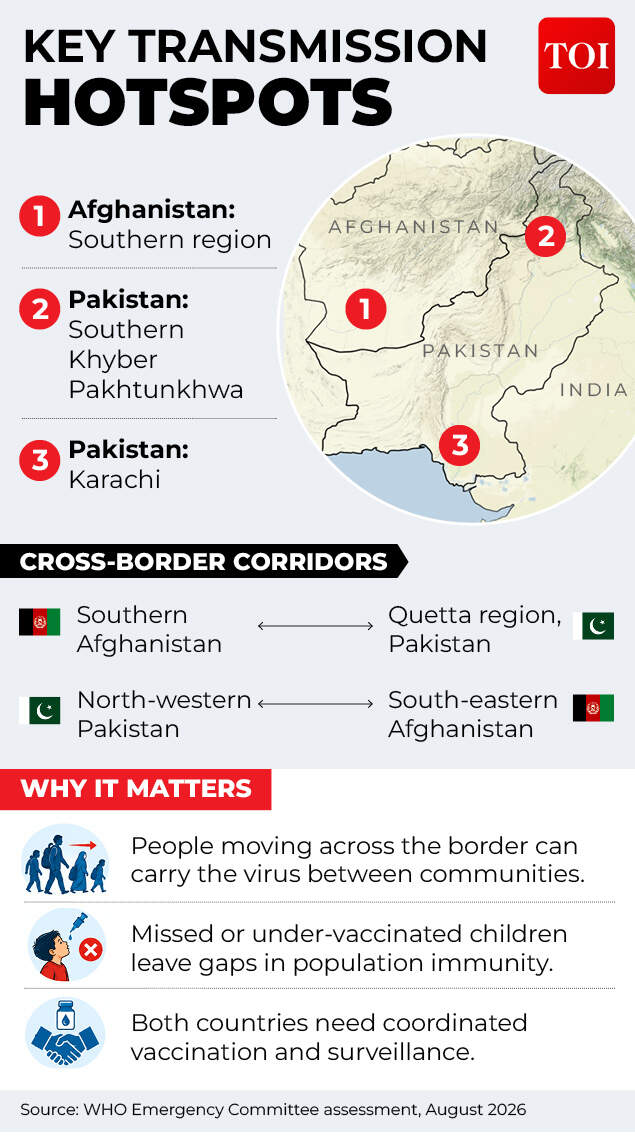
It also highlighted two cross-border corridors: southern Afghanistan and Pakistan’s Quetta region, and north-western Pakistan and south-eastern Afghanistan.The hotspots and corridors show how transmission links communities across the border, particularly where children have missed vaccination.Population movements have added to the challenge. In 2024, the committee recorded more than 600,000 returnees from Pakistan to Afghanistan, with estimates suggesting that up to 1.7 million people were affected. It also found evidence that some poliovirus strains detected in Afghanistan had been brought back by returnees.The movement remains a concern. Xinhua has reported that Afghan health authorities attributed the recent rise in cases partly to the mass return of Afghan refugees from Pakistan.Mobile and displaced families can be missed by routine and supplementary campaigns, making coordinated vaccination and surveillance essential.Sareen warned that continued transmission also posed a risk to neighbouring countries, including India. Although India was declared polio-free in 2014, he said it must maintain high immunisation coverage to reduce the risk of reintroduction through international travel.
The money is shrinking
Funding is tightening at the worst moment. The GPEI cut its 2026 operating budget by 30%. For 2027, its oversight board approved about $778 million, roughly $65 million less.Surveillance funding stays at the reduced level, and the programme admits the cuts have affected “the speed and scale” of eradication in some places.Nature ties part of the squeeze to the US exit from WHO in January, which ended American funding for WHO’s polio work, and to the earlier dismantling of USAID, which disrupted $85 million for surveillance and health communication.Sareen warned that funding cuts could weaken vaccination and surveillance. He called for sustained financing, coordinated campaigns, better monitoring of mobile populations and greater involvement of community leaders and female health workers.Others are stepping in: Rotary members raise about $50 million a year, Saudi Arabia pledged $500 million, Pakistan $154 million and the Gates Foundation $1.2 billion for 2026 to 2029.There is also fatigue. One source cited by science journal Nature said that “politicians focus on real problems, not on something that is basically gone.”
What next
Polio has not left the rest of the world either. GPEI’s latest update lists vaccine-derived cases in countries including DR Congo, Nigeria, South Sudan and Chad.These come from a weakened virus in the oral vaccine that can spread where immunisation is low. That is why the goal is finishing the job, not just holding the line.The committee has urged Afghanistan to restore house-to-house vaccination wherever possible and Pakistan to protect vaccination workers and improve campaign quality in weaker districts. GPEI is also reviewing its eradication timeline after assessing progress in 2026.Sareen said the two countries must prioritise children who have missed routine immunisation and ensure that vaccination, surveillance and cross-border coordination remain adequately funded.India’s lesson is not that polio is easy to beat. It is that it can be beaten with doors opened, women on every team, communities on board and money that does not run out. The last two countries now have the vaccine. What they lack is steady access, safety for vaccinators and the funds to keep going.The world has already shown that polio can be pushed to the brink of eradication. The final test is whether Pakistan and Afghanistan can reach the children who have been missed repeatedly and keep reaching them until the virus has nowhere left to circulate.