










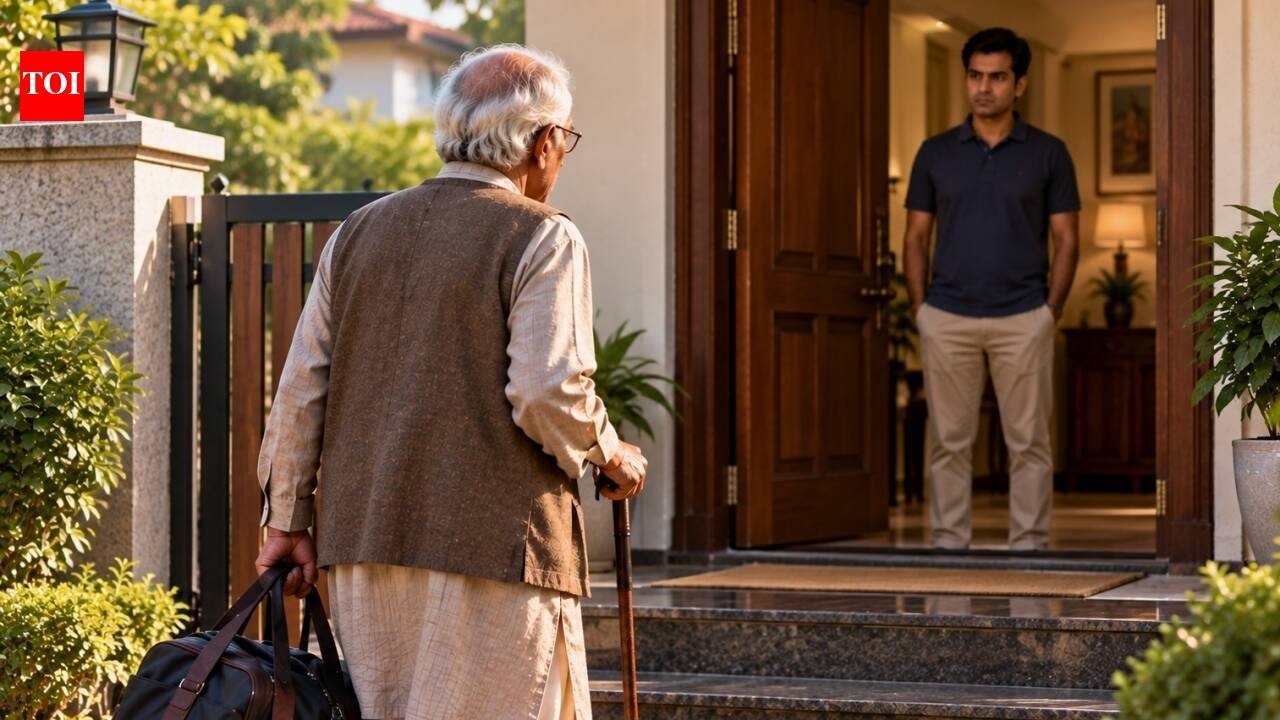
A father bought land parcels in the youngest son’s name, but their relationship turned bitter and the senior citizen alleged that he had been humiliated and tortured. Orissa High Court’s judgment in the case holds significance.When an 86-year-old man bought several parcels of land in his youngest son’s name and let him stay with him in the family’s ancestral house in Odisha, he did not expect their relationship to eventually turn bad.
What the case is about
The father alleged that repeated torture and humiliation by his son made his continued stay in the ancestral home impossible, forcing him to leave and move into the house of his middle son.The senior citizen, a retired government serviceman, has three sons. His elder and middle sons had moved out of the ancestral property a few years earlier and were living separately with their respective families. The elderly man remained at the ancestral house with his youngest son.The father claimed that the youngest subjected him to repeated torture and humiliation, eventually compelling him to leave the family home. After his departure, the youngest son allegedly took exclusive possession of the ancestral house.The man initially moved in with his eldest son and later shifted to his middle son’s residence, where he has continued to stay.The man said his relationship with the youngest son had been cordial during the earlier years. Trusting his son, he purchased multiple parcels of land in the youngest son’s name. After their relationship deteriorated, however, the father sought to have the properties restored.He subsequently initiated two separate legal proceedings: one seeking the youngest son’s eviction from the ancestral house before the Sub-Collector, Bhubaneswar, and another before the civil court seeking revocation of the youngest son’s name from the parcels of land that had been purchased in his name.After approaching the court, the senior citizen also went to the police station with his allegations of torture and humiliation. He also raised the issue of Appeal Case No.188/2024 pending before the Sub-Collector, Bhubaneswar.According to an ET report, on August 7, 2025, the Sub-Collector, Bhubaneswar-cum-Presiding Officer, Sub-Divisional Tribunal, Bhubaneswar, under the MWPSC Act, 2007, passed the following directions:
- The father and son should live peacefully at their residence.
- The son should refrain from abusing or threatening his father and should show immense respect to him.
- The son should vacate the ground floor of the house at Baramunda village to enable his father to live there safely and hand it over to him by August 22, 2025, positively, besides reporting compliance.
- The dispute relating to the property was purely civil in nature. An appeal, numbered 188/2024, was already pending before the Sub-Collector, Bhubaneswar, and was subjudice.
Both father and his youngest son challenged the order before the Orissa High Court. On March 17, 2026, the High Court partly allowed the father’s case and directed the youngest son to vacate the house.However, on the father’s request concerning the land parcels purchased in the youngest son’s name, the High Court declined to issue any direction. It held that the question of revoking the youngest son’s name from those properties was being considered by the civil court and, therefore, no order could be passed on that issue.
Why did the father win the case ancestral home case?
Shrusti Shah, Associate Partner, King Stubb & Kasiva, told ET: “The father “won” in the sense that the High Court refused to disturb the Tribunal’s protective order safeguarding his right to live in his own home with dignity, a result the Court framed as consistent with the Act’s welfare object, while the underlying property ownership dispute was left to be resolved separately through the pending appeal.”According to Shah, one of the most significant aspects of the order is that the High Court did not approach the matter as a purely technical question of law. Instead, it considered the circumstances of the person before it.The senior citizen was 86, had lost his wife and, according to his case, had effectively been forced out of the house where his family had lived. The Court interpreted the Maintenance and Welfare of Parents and Senior Citizens Act, 2007 in keeping with its intended purpose, as a welfare legislation rather than through a narrow technical lens.Shah says: “The judgment is clear that beneficial legislation like this deserves a liberal, purpose-driven interpretation rather than a literal one, and that the whole point of the Act is to let elderly parents live out their years with security and dignity, that’s almost lifted straight from Rule 19 of the state Rules.”At the same time, the father did not succeed on every aspect of his case. The High Court deliberately kept the question of ownership separate. The issue of who legally owns the disputed land was already before the appropriate forum in a pending appeal, and the Court therefore did not decide that question. The ruling, consequently, does not determine ownership of the properties.What the Court did address was the father’s immediate right to live safely and with dignity in his home while the ownership dispute continues. The son was directed to vacate the ground floor so that his father could live there safely. He was also directed to stop abusing or threatening his father and to treat him with respect.Shah also pointed to another important aspect of the ruling for senior citizens considering approaching the High Court in similar circumstances. The father’s own attempt to reopen the property-related issue before the High Court did not succeed because he had not pursued the appellate mechanism provided under the Act.Shah says: “So the takeaway is two fold – courts will lean in to protect a senior citizen’s dignity and physical safety without hesitation, but they still expect people to use the appeal process the law has laid out for the property side of things.”
Odisha High Court’s order and analysis
Justice Ananda Chandra Behera delivered the judgment in case no. WP(C) No.24893 of 2025 on March 17, 2026.The Maintenance and Welfare of Parents and Senior Citizens Act, 2007, is a beneficial lawThe purpose behind the enactment of the Maintenance and Welfare of Parents and Senior Citizens Act, 2007, along with the manner in which its provisions are required to be interpreted by tribunals and courts, has already been explained in several judicial decisions.In Philomina Vs. The Appellate Tribunal, Thiruvananthapuram, reported in 2021 (2) Civ.C.C. 806 (Kerala), the court held that the provisions of the Maintenance & Welfare of Parents and Citizens Act, 2007, are intended to provide social justice to parents and senior citizens.Similarly, Mrs. Rajani B. Somkuwar Vs. Ms. Sarita Somkuwar and Another, reported in 2020 (2) CCC 100 (Bombay), held that where children are unable to care for their parents and allow them to live peacefully, they should at least not make their parents’ lives a living hell.The Supreme Court, in Urmila Dixit Vs. Sunil Sharan Dixit & Others, reported in 2025 (3) Civ.L.J. 341 (SC), held that the Maintenance and Welfare of Parents and Senior Citizens Act, 2007, and the rules framed under it are beneficial statutes and must therefore be interpreted liberally in a manner consistent with their purpose. The Court said a purpose-oriented approach should be followed instead of a literal interpretation. It is for the courts to identify the legislative intent behind the enactment, and beneficial legislation should receive a purposive interpretation that advances its underlying objective.Applying these principles to this case, the Orissa High Court noted that the father is now 86 years old, is extremely aged and has lost his wife.It also considered that the primary purpose of the Maintenance and Welfare of Parents and Senior Citizens Act, 2007, is to provide social justice to parents and senior citizens. The Court observed that tribunals and courts exercising jurisdiction under the Act are required to keep this legislative objective in mind.The High Court also referred to Rule 19 of the Orissa Maintenance of Parents and Senior Citizens Rules, 2009. The rule provides that orders under the Act, 2007, should be such that senior citizens are able to live with security and dignity.Taking these circumstances and principles into account, the High Court declined to interfere with the order passed by the Sub-Collector, Bhubaneswar.
Land property dispute is separate from the senior citizen protection issue
The Orissa High Court made a distinction between providing protection to a senior citizen under the Act and deciding a dispute concerning ownership or rights over land. According to the Court, the Act provides a forum for senior citizens but cannot be used to adjudicate matters that fall within the jurisdiction of the civil court.Since the dispute concerning revocation of the youngest son’s name from the land parcels was already pending before the civil court, the High Court did not intervene in that issue.