










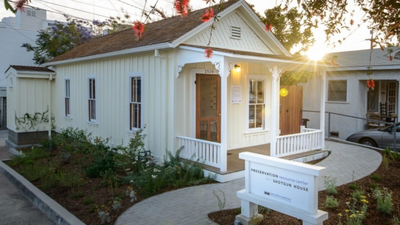
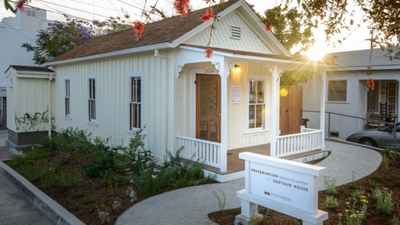
A small wooden house in Santa Monica has survived something few historic buildings ever face: demolition threats, years in storage and several moves from one location to another. Built in 1897, the Shotgun House is now recognised as the last intact example of its kind in the city. What began as a modest home near the beach has become an important piece of Santa Monica’s architectural history. Its survival is also a story of residents and preservation groups stepping in when an old building was at risk of disappearing. Today, the house stands at 2520 Second Street, where it has been given a new purpose as a Preservation Resource Center. The Santa Monica Conservancy, which has cared for the property, is marking 10 years since the restored building opened as a community resource in 2016.
From beach cottage to landmark
According to the Santa Monica Conservancy, the Shotgun House was built in 1897 at 2712 Second Street in Ocean Park, when the neighbourhood was rapidly developing as a seaside resort. Shotgun houses were practical, inexpensive structures that were particularly suited to communities where small vacation cottages were needed near the beach. The house was originally only a short distance from the Santa Fe railroad depot and local tourist attractions.The architectural form itself has a longer history. Architectural historians believe the shotgun house originated in the Caribbean through a blend of African and European influences before becoming widespread in the American South during the 19th century. Its simple design made it inexpensive to construct and relatively easy to move, while its narrow footprint allowed it to fit on small lots. Santa Monica’s example consists of three small rooms arranged in a row. It has a board-and-batten exterior, a covered front porch and a gabled roof. Although the design is relatively plain, diamond-shaped shingles on the front gable add a touch of Queen Anne styling.
Nearly lost to demolition
The house survived as a residence for almost a century, remaining occupied until 1996. By that point, however, many of Santa Monica’s other shotgun houses had already disappeared. Some had been demolished after being considered unsafe, while others were lost as development transformed the city. The Shotgun House itself came close to the same fate. The Santa Monica Conservancy says community members and preservation advocates helped save the structure from demolition beginning in the late 1990s, with the preservation effort continuing through 2002. The effort involved concerned residents, the former Ocean Park Community Organisation, the Church at Ocean Park, the Conservancy and the City of Santa Monica. The building was designated a landmark in 1999. But saving it did not mean the house immediately had a permanent home.
A house that kept moving
The structure went through a complicated relocation process. After becoming the property of the City, it was moved multiple times over the following years. The Conservancy’s history records that the house was relocated three times before reaching its permanent location in 2014. Its final journey took the historic structure to Second Street, across from the Ocean Park Library. At the time, the move was significant enough for members of the public to watch as the small house was transported on a flatbed trailer through Santa Monica streets. The move finally provided an opportunity to give the building a purpose beyond simply preserving it.
From home to resource centre
Under the Santa Monica Conservancy’s guardianship, an adaptive-reuse plan was developed to rehabilitate the house while retaining its historic character. Funds were raised to restore the structure and transform it into a Preservation Resource Center. The centre officially opened in January 2016. Rather than functioning as a private residence, the restored building now helps people understand Santa Monica’s historic places and the principles of preservation. It provides information for residents, property owners, students, visitors and others interested in local history. It also offers tours and educational programming. The building itself is also an example of adaptive reuse. The Conservancy describes it as a model showing how a historic structure can be rehabilitated and given a useful role in modern community life. The project earned a LEED Gold rating, while the surrounding Shotgun House Coastal Garden uses drought-resistant native plants.
Ten years of preservation
In 2026, the Shotgun House marks a decade as the Preservation Resource Center. The house’s story is ultimately about more than one 19th-century building. Its survival shows how preservation can work when an old structure is not treated simply as an obstacle to development. A building that once served as a modest vacation-era home, nearly disappeared in the late 20th century and spent years being moved around Santa Monica now has a permanent role in teaching the city’s history. At 129 years old, the little Shotgun House has therefore gained something its original builders could hardly have anticipated: a second life as a place dedicated to making sure historic places are not forgotten.