








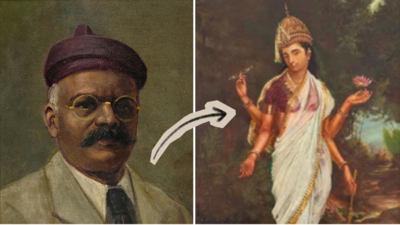
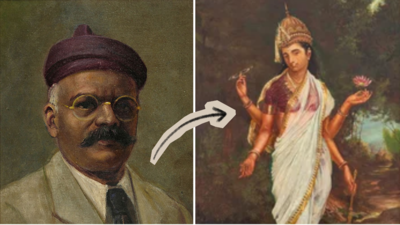
In February 1899, Indian artist Mahadev Visvanath Dhurandhar painted a nearly five-foot-tall image of Hindu goddess Mahalakshmi, dressed in a white nine-yard saree with a gold border. More than 127 years later, the oil painting sold for Rs 14.1 crore at an auction in New Delhi, after passing through the hands of a prominent publisher and collector whose printing business was briefly associated with Dadasaheb Phalke, widely regarded as the father of Indian cinema.The painting, titled ‘Shri Mahalakshmi’ was sold at Saffronart’s live Autumn Auction on September 19, 2026. According to the auction house’s official website, the work was estimated at Rs 12 crore to Rs 18 crore and achieved Rs 14.1 crore, inclusive of the buyer’s premium.The painting’s history is closely connected to Purushottam Vishram Mavji, a scholar, merchant, publisher and art collector who acquired it directly from Dhurandhar. It remained with Mavji’s family through successive generations before entering a private collection in Mumbai.
A six-foot figure in a white saree
Dhurandhar signed and dated the painting “MDhurandhar/ Feb. 1899” in the lower-left corner. The work is oil on canvas pasted on board and measures approximately 152 by 69.5 cm. Saffronart describes the figure’s height as six feet, making it one of the artist’s largest known single-deity portraits. Mahalakshmi is shown standing in a traditional Maharashtrian ‘nauvari,’ or nine-yard saree, with a gold zari border. She wears finely detailed regional jewellery, including a nath (nose ring), bugadi (an upper-ear ornament) and thick bangles known as ‘tode.’One of the painting’s most distinctive features is the goddess’s white saree. Lakshmi is more commonly depicted in red, while white is often associated with Saraswati and the qualities of purity and knowledge. Dhurandhar’s choice of white gives the figure a different visual identity while retaining details of Maharashtrian dress.According to Saffronart auction house’s website, the painting reflects a wider change in Indian art during the late 19th century, when artists increasingly depicted Hindu deities with naturalistic features rather than relying solely on established iconographic conventions. Raja Ravi Varma was a major figure in this development, using naturalistic modelling to portray mythological subjects in a form viewers could readily recognise. Dhurandhar admired Ravi Varma, whom he met in 1896, and later created several works for the Ravi Varma Press.
How European art influenced the painting
Dhurandhar studied at the Sir J. J. School of Art in Bombay, which he joined in 1890. There he encountered European academic art and classical sculpture, influences that shaped his approach to depicting the human figure. In an account quoted by Saffronart from Suhas Bahulkar’s 2018 book M V Dhurandhar: The Romantic Realist, the artist recalled his response to plaster casts of classical sculptures at the school. He added that even after leaving the school, he continued to see the figures in his mind.As per the official website of the auction house, Dhurandhar applied aspects of classical European modelling to Indian subjects. In ‘Shri Mahalakshmi,’ the goddess’s slender limbs, narrow waist, softly modelled body and carefully rendered drapery reflect this training. Her saree, jewellery and appearance, however, remain distinctly Maharashtrian. Dhurandhar also had close observation of everyday life, as per the website account. He often sketched women walking, cooking, caring for children or resting.
The publisher who bought the painting directly from the artist
The painting’s documented ownership history begins with Purushottam Vishram Mavji, who acquired it directly from Dhurandhar. Mavji was a scholar, merchant, philanthropist, publisher and collector in the early 20th century. According to Saffronart, he ran Laxmi Art Printers with Dadasaheb Phalke, the cinema pioneer who was briefly associated with the printing business.Dhurandhar began working with Mavji in 1901, two years after painting Shri Mahalakshmi. He was commissioned to illustrate Mavji’s periodical ‘Suvarnamala’ and later produced numerous mythological illustrations for the publisher’s printing press. The painting itself appeared in Suvarnamala in 1923, according to the auction catalogue. It was also reproduced in several later books on Indian art.
From a 1902 exhibition to a Rs 14.1-crore auction
The painting was exhibited at the Bombay Art Society exhibition in 1902, just three years after it was created. More than a century later, it was included in ‘Manifestations XI,’ an exhibition of 20th-century Indian art held in Mumbai and New Delhi in 2014, and in the 2018 exhibition ‘M V Dhurandhar: The Romantic Realist’ at the National Gallery of Modern Art in Mumbai.Its September 2026 auction was part of Saffronart’s Autumn sale, which also featured works by F. N. Souza, A. Ramachandran and other Indian artists. According to a TOI report, Souza’s ‘Hanuman the Monkey God’ sold for Rs 15.6 crore. Dhurandhar’s Shri Mahalakshmi also fetched Rs 14.1 crore at the same live auction. The result was the highest auction price achieved for a work by Dhurandhar, according to Saffronart. The sale also brought renewed attention to an artist whose work combined European academic techniques with Indian subjects and regional visual traditions.