









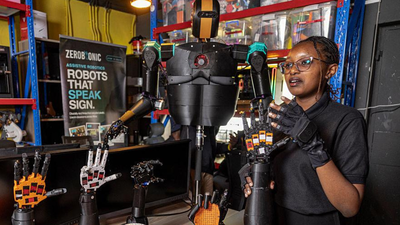
A 22-year-old Kenyan engineer has developed robotic hands designed to help deaf children follow classroom lessons by converting teachers’ spoken words into sign language in real time. Norah Kimathi, co-founder of Nairobi-based startup ZeroBionic, developed the technology to address communication barriers faced by deaf students, particularly when learning science, mathematics and other STEM subjects. The robotic hands are 3D-printed using recycled plastic and cost about US$350 each, according to reports on the project. ZeroBionic says its system can achieve a 92% speech-to-sign accuracy rate, while the technology has been introduced in schools in Kenya. The project combines artificial intelligence, robotics and locally developed sign-language data to create an assistive technology aimed at making classroom learning more accessible to deaf students.
The 22-year-old Kenyan engineer behind the 3D-printed robotic hands
Norah Kimathi is a Kenyan engineer and co-founder of ZeroBionic, a Nairobi-based technology startup established in 2021. She studied informatics and computer science at Strathmore University and became interested in using technology to solve practical problems. Her work eventually led her towards assistive technology and robotics, with a particular focus on communication barriers experienced by deaf students. Early versions of the company’s robotic hands were developed using recycled materials before the team moved towards more advanced 3D-printed designs. Kimathi and her team wanted to develop a device that could help students understand classroom instruction without depending entirely on the availability of a human sign-language interpreter. Their work has since evolved into a wider robotics project focused on accessibility and education in Kenya.
How the robotic hands translate teachers’ voices into signs
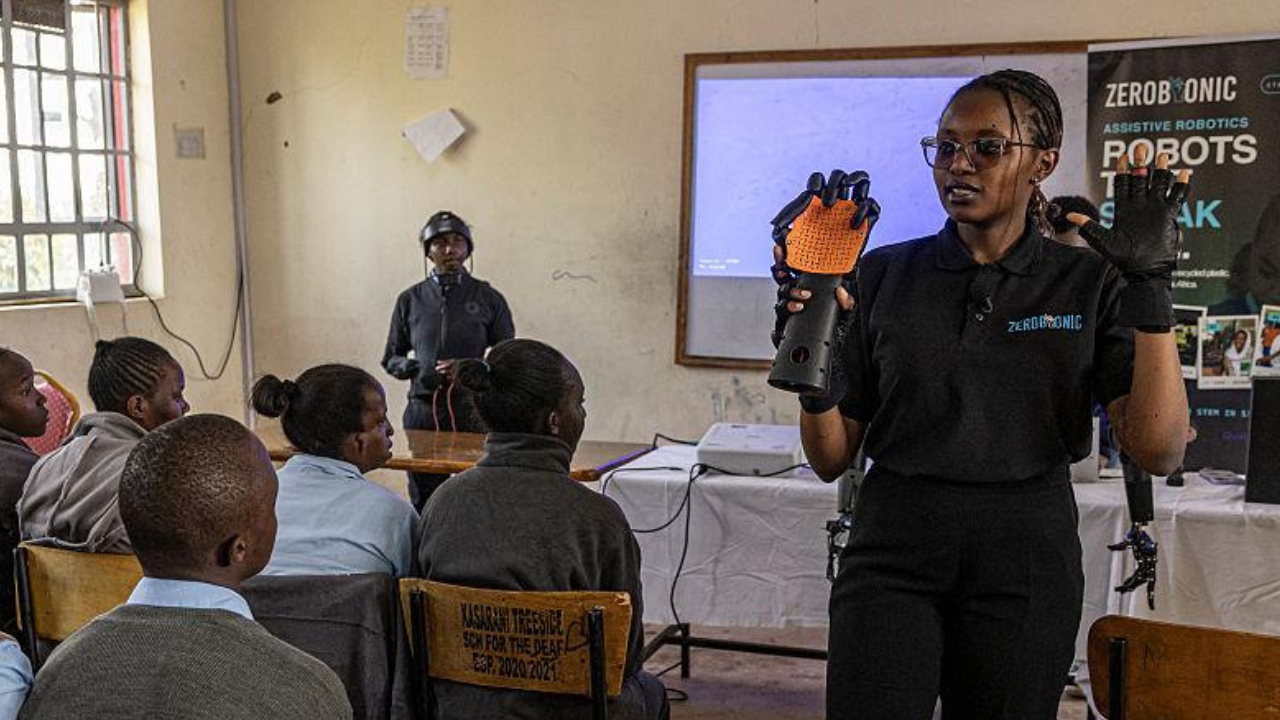
The technology is designed to listen to a teacher’s spoken words, process the speech using artificial intelligence and then reproduce the corresponding information through movements of a robotic hand. The device is intended to translate classroom content into sign language quickly enough for students to follow lessons as they happen. This is particularly relevant to subjects such as mathematics, biology and other STEM disciplines, where teachers regularly use specialised terminology. The Zero Project describes ZeroBionic’s technology as an AI-powered robotic hand capable of translating STEM content into real-time sign language. The project is also designed to operate offline, which could make it more practical in environments where reliable internet connectivity is not always available.
Why deaf students need better access to STEM lessons
The technology is being developed against a significant accessibility challenge in Kenya. AFP, citing the Kenya Society for Deaf Children, reported that there are approximately 300,000 children in Kenya who are deaf or hard of hearing, while only around 20,000 were enrolled in schools as of 2024. Access to education is affected by several factors, including a shortage of interpreters and limited resources for deaf learners. The challenge can become even more pronounced in STEM subjects because technical concepts require a large and specialised vocabulary. A teacher may be able to communicate basic ideas using commonly understood signs, but subjects such as biology, physics and mathematics can introduce terminology for which suitable signs may be limited or inconsistent. ZeroBionic’s technology is intended to help address that particular gap.
Deaf teachers are helping build the sign-language database
The robotic hand relies on more than hardware and artificial intelligence. ZeroBionic has also been building a database of signs with the help of deaf teachers and educators. The team uses motion-capture technology to record the movements made by sign-language users and incorporate those movements into its system. The database draws from Kenyan, American and English sign languages, allowing the technology to handle a wider range of vocabulary while taking local differences into account. This is particularly important because sign language is not universal, and signs can vary significantly between countries and communities. The Zero Project says ZeroBionic has worked with organisations representing people with disabilities and bilingual education consultants while developing the system. The involvement of deaf educators also allows the technology to be shaped around the needs of people who will actually use it.
The robotic hands are 3D-printed from recycled plastic
The physical design of the robotic hands is another important part of the project. ZeroBionic uses 3D printing to develop and manufacture its prototypes, with recycled plastics used in the construction of the devices. The approach allows the company to modify components and test different designs without relying on expensive conventional manufacturing methods. AFP reported that the startup develops its technology in Nairobi, while the Zero Project specifically describes the robotic hand as a 3D-printed device made using recycled plastics. Kimathi has also spoken about the company’s use of recycled materials during its earlier development work. The combination of 3D printing and recycled materials is intended to help keep production costs down while also reducing the amount of new material required to manufacture the devices.
Each robotic hand costs about US$350
The technology has already moved beyond the prototype stage. AFP reported that the robotic hands cost approximately US$350 each and were being used in 78 schools across Kenya. That price is significantly lower than the cost associated with many sophisticated robotic systems, although affordability will remain an important consideration if the technology is to reach a much larger number of students. ZeroBionic continues to develop the hardware and expand the vocabulary available to the system. Reports also differ over the expected lifespan of the devices, with AFP citing up to two years and Good News Network reporting a longer period without maintenance. For that reason, the safest figure to use in a news report is the approximately US$350 cost rather than making an unqualified claim about how long each device lasts.
ZeroBionic says its system reaches 92% accuracy
ZeroBionic says its technology has achieved a 92% speech-to-sign accuracy rate, a figure also reported in coverage of the project. The Zero Project has similarly described the system as achieving at least 92% gesture accuracy. However, the figure should be attributed to ZeroBionic rather than presented as an independently verified performance benchmark. The accuracy of a sign-language translation system can depend on several factors, including the vocabulary being used, the complexity of the sentence, the sign language involved and the conditions in which the technology is operating. As ZeroBionic expands its database and works with more deaf educators, improving the accuracy and range of the system will remain an important part of its development.
The technology is being developed around Kenyan sign language needs
One of the project’s distinguishing features is its emphasis on local requirements. Rather than relying solely on datasets created for other countries, ZeroBionic has been working to collect and organise sign-language information relevant to African users. The team has incorporated Kenyan signs alongside American and English sign languages and is working with deaf educators to understand how signs are used in real educational settings. The Zero Project says the system can adapt to local sign-language dialects. This matters because a system that performs well with one sign language may not automatically work for another. By developing the database with local participation, ZeroBionic is attempting to create technology that reflects the linguistic and educational realities of Kenyan students rather than simply adapting an existing system built for a different population.
The startup is also developing humanoid robots
ZeroBionic’s ambitions extend beyond the robotic hand. The company has also been working on humanoid robotics as part of its wider effort to improve communication between teachers and deaf students. TechCabal reported on the development of Africa One, a humanoid platform intended to build on the company’s work in robotics and artificial intelligence. The broader vision includes technology that could support two-way communication rather than simply converting a teacher’s speech into signs. In such a system, a student could potentially communicate with the robot and receive information through sign language, creating a more interactive classroom experience. These developments remain part of the company’s ongoing work, but they demonstrate that Kimathi’s team is looking at accessibility as a broader communication problem rather than limiting its work to a single robotic device.
A robotic hand could help bridge a classroom communication gap
The significance of ZeroBionic’s work lies in the problem it is attempting to solve. Deaf students can struggle to access lessons when teachers do not know sign language and trained interpreters are unavailable. A robotic system cannot replace the role of qualified teachers or interpreters, but it could provide an additional tool for schools facing shortages of specialist support. The project also demonstrates how relatively affordable robotics can be combined with AI and locally collected language data to address a specific accessibility challenge. For Kimathi and ZeroBionic, the next challenges include expanding the sign-language vocabulary, improving translation accuracy and making the technology accessible to more schools. If those challenges can be overcome, the 3D-printed robotic hand could become more than an experimental piece of technology, offering deaf students another way to participate in classrooms and access subjects that might otherwise remain difficult to follow.