










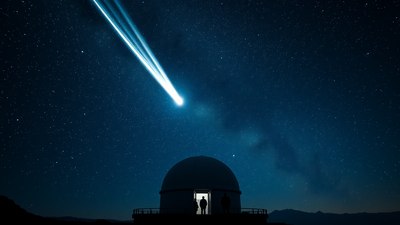
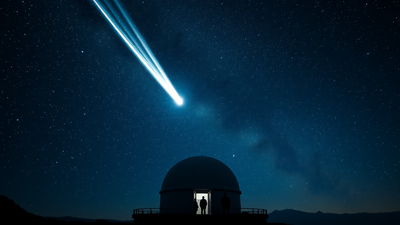
In July 2025, astronomers spotted something remarkable passing through our Solar System, an object that had not come from anywhere nearby. Called 3I/ATLAS, it was travelling so fast and on such an unusual path that scientists quickly confirmed it had originated in another star system entirely. It is only the third object of its kind ever detected, following 1I/’Oumuamua in 2017 and 2I/Borisov in 2019. And while most scientists were fairly confident it was a natural comet, a question lingered in the background: what if it wasn’t? The Search for Extraterrestrial Intelligence, better known as SETI, decided not to leave that question unanswered. Within a day of the object being announced, researchers had pointed one of the world’s most advanced radio telescope arrays at 3I/ATLAS and started listening.
What is 3I/ATLAS, and why did it get scientists so excited
3I/ATLAS is what astronomers call an interstellar object, a piece of material that formed around another star and has been travelling through the galaxy ever since, eventually passing through our own cosmic neighbourhood. These objects are incredibly rare to spot. They move very fast, they do not stick around for long, and until recently, no one was even sure we would ever catch one in time to study it properly.The first confirmed interstellar visitor, ‘Oumuamua, caused a wave of debate among scientists because it behaved in ways that were hard to fully explain with natural causes alone. The second, Borisov, looked more clearly like a comet. 3I/ATLAS also appears cometary it has a bright coma (the fuzzy cloud that forms around a comet’s icy core as it heats up near the Sun) and behaves much like comets that come from within our own Solar System. But every new interstellar visitor is a chance to learn something, and for SETI researchers, it is also a chance to check.
Why SETI decided to scan an interstellar comet for alien signals
The idea might sound far-fetched at first, listening to a comet for alien radio signals. But there is a logical reason behind it. If an advanced civilisation elsewhere in the galaxy wanted to send a probe to another star system, it would have to travel between stars just like 3I/ATLAS is doing. From Earth, a natural comet and an artificial spacecraft could look very similar at first glance. The safest approach, from a scientific standpoint, is to look for signals that nature cannot produce on its own.As Dr Sofia Sheikh, lead author of the study published in The Astronomical Journal, explained, the logic also runs the other way: our own Voyager spacecraft will eventually drift into other star systems, becoming alien artefacts themselves. Understanding how many naturally occurring interstellar objects pass through our Solar System helps scientists figure out what would count as genuinely unusual and therefore worth investigating further.
How researchers used the Allen Telescope Array to listen to 3I/ATLAS
The SETI team used the Allen Telescope Array (ATA), a network of radio dishes located at the Hat Creek Radio Observatory in Northern California. The ATA is purpose-built for this kind of work it can monitor a wide range of radio frequencies simultaneously, and it can be pointed at a new target quickly when something unexpected is discovered. In this case, observations of 3I/ATLAS began less than a day after the object was formally announced, which was a significant test of the telescope’s ability to respond rapidly to fast-moving events.Researchers observed the object for more than seven hours, scanning frequencies between 1 and 9 gigahertz. This range covers the frequencies most commonly searched in SETI work because they are relatively quiet in space and because narrowband signals signals concentrated at a very specific frequency are not known to be produced naturally. If something was broadcasting on a narrow frequency from or near 3I/ATLAS, the ATA had a good chance of detecting it, according to the study published.
74 million signals detected and what happened when scientists filtered them down
The sheer volume of data the ATA collected was staggering. During those seven hours of observation, the telescope picked up nearly 74 million narrowband signals. That sounds like a lot and it is but the vast majority of them came from a very familiar source: human technology on Earth.Mobile phones, satellites, broadcast equipment, radar, and other everyday electronics all emit radio signals that can be picked up by sensitive telescopes. The researchers applied a series of filters to remove all the signals that did not match the specific direction and movement of 3I/ATLAS itself. A signal coming from the object would need to shift in frequency at a predictable rate as the object moved relative to Earth a phenomenon called the Doppler effect, the same reason an ambulance siren sounds different as it passes you. After filtering, around 200 candidate signals remained. But when each of those was looked at more closely, every single one was traced back to a satellite or to a source on Earth. Not one came from 3I/ATLAS.
What the absence of signals actually tells scientists about 3I/ATLAS
Finding nothing is not the same as learning nothing. The observations placed clear limits on what kind of technology could be hiding near 3I/ATLAS. The search ruled out any radio transmitters more powerful than about 10 to 110 watts operating in the scanned frequency range, roughly the amount of power a household light bulb uses. If something was broadcasting from that object, it would have to be extremely faint, far quieter than anything humans have ever intentionally sent into space.This result adds to the growing body of evidence that 3I/ATLAS is simply what it looks like: a comet made of ice and rock that formed around another star and has been drifting through the galaxy for a very long time. Co-author Valeria Garcia Lopez noted that the results also show something encouraging about the tools scientists have available that the technology to detect a genuine signal, if one exists, is well within reach today.
Why scientists will keep checking every interstellar object that passes through our Solar System
Even though 3I/ATLAS turned out to be a natural object, researchers say the exercise was genuinely valuable and should be repeated for every future interstellar visitor. Each time one of these objects passes through, it is an opportunity to search for technosignatures any kind of signal or feature that suggests the work of technology rather than nature.The more natural interstellar objects scientists study, the better they understand what normal looks like. And the better they understand what normal looks like, the easier it becomes to spot something truly anomalous if one ever shows up. Right now, 3I/ATLAS is still moving through and beyond the Solar System, and astronomers around the world are studying it intensively for what it can tell them about chemistry, composition, and the material that drifts between stars. Meanwhile, SETI will remain ready because the next interstellar visitor is out there somewhere, and nobody knows yet what it will be.