









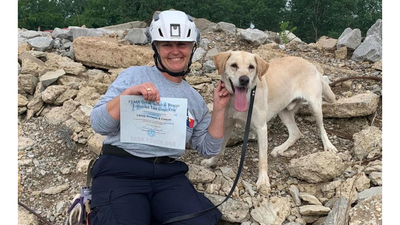
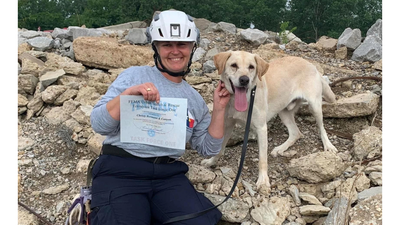
A severely malnourished stray rescued in Mississippi in 2021 has gone from months of medical care to working alongside emergency responders in some of the US’s most challenging disaster zones. Canyon was brought to the Hancock County Animal Shelter after being found as a stray, where he received extensive veterinary treatment before his intelligence and drive caught the attention of a search-and-rescue handler. He was subsequently placed with Category 5 K9, a programme that trains dogs for specialised search and detection work. After extensive training, Canyon earned dual certifications in 2023 for human-remains detection and wilderness operations. He has since deployed to major disasters, including the Maui wildfires, Hurricane Helene and the 2025 Texas floods, while also assisting investigations. The ASPCA has now named Canyon its 2026 Dog of the Year.
From severely malnourished stray to FEMA-certified search dog
Canyon’s story began in 2021, when he was rescued as a stray in Mississippi and taken to the Hancock County Animal Shelter. He was in poor condition and required months of medical care before he was ready for a new chapter. During his recovery, however, those around him noticed that he had qualities that could make him suitable for demanding work.A handler later spotted Canyon’s intelligence and drive and helped place him in the Category 5 K9 programme. The organisation works with dogs for specialised search, detection and service roles. Canyon underwent extensive training designed to turn his natural abilities into skills that could be used in real-world emergency situations.The transition required more than simply teaching Canyon to follow commands. Search-and-rescue dogs need to remain focused around unfamiliar surroundings, loud noises, difficult terrain and other distractions. They also have to work closely with their handlers, who learn to interpret changes in the dogs’ behaviour as they detect scents.
Training prepared Canyon for difficult searches
Canyon’s training focused on human-remains detection and wilderness search work. He eventually earned certifications in 2023 through FEMA for Human Remains Detection and through the International Police Work Dog Association for wilderness operations.His physical abilities have also proved valuable during deployments. According to Christy Bormann, Canyon’s handler, his size, speed and agility allow him to reach places that may be difficult or unsafe for people. His sense of smell enables him to locate human scent in environments where visual searches alone may not be enough.Texas A&M University has also highlighted the importance of veterinary support for its search-and-rescue canines. Bormann has described Canyon and another working dog, Connor, as family members and best friends, while stressing that their health and safety are essential to their ability to work.
From Maui wildfires to Texas floods
Once certified, Canyon began taking part in major search-and-rescue operations. His deployments have included the 2023 Maui wildfires and Hurricane Helene, as well as the devastating Texas floods in 2025.His work following the Texas floods was particularly extensive. Canyon spent more than 90 days searching along the Guadalupe River near Camp Mystic, where search teams worked to locate victims following the disaster. The prolonged deployment placed Canyon and his handler in difficult conditions as they searched large areas of terrain.Canyon’s work has also extended beyond major disasters. Alongside Bormann, he has assisted with missing-person searches and homicide investigations. His specialised detection abilities can help teams search areas where investigators need additional scent-detection capabilities.
A rescue dog helping others
Canyon’s career has given his original rescue story a striking turn. He entered the animal welfare system as a dog requiring care and rehabilitation. After receiving that opportunity, he became a trained working canine involved in searches for people and human remains.The ASPCA specifically highlighted this transformation when announcing its 2026 Humane Awards. The organisation described Canyon as an example of what shelter dogs can accomplish when they receive a second chance and the opportunity to develop their abilities.For Bormann, Canyon’s story also demonstrates why shelter dogs should not be defined solely by the circumstances in which they are found. His intelligence, drive and physical abilities eventually made him capable of performing specialised work in some of the most difficult environments faced by search teams.
Canyon named ASPCA’s 2026 Dog of the Year
The ASPCA announced Canyon as its 2026 Dog of the Year as part of its annual Humane Awards. The awards recognise both people and animals whose actions have contributed to animal welfare or helped their communities.Canyon is among several 2026 honourees, including miniature therapy horses Aiden and Pearl, Kid of the Year Eloise “Lulu” Peck, farm animal welfare advocate Craig Watts, NYPD Mounted Unit Detective Kyle McLaughlin and Colorado Rapid Avalanche Deployment.The ASPCA’s recognition comes after Canyon’s years of work in disaster response and investigations. His path from a severely ill stray in a Mississippi shelter to a certified search-and-rescue canine has become the defining part of his story.
Award ceremony set for October 8
Canyon and the other 2026 Humane Awards recipients are scheduled to be formally recognised at the ASPCA Humane Awards luncheon at The Plaza Hotel in New York City on October 8, 2026.Bormann has said she expects to continue working with Canyon for about two more years before he retires from operational work. After that, the search dog is expected to enjoy a quieter life away from disaster deployments.