









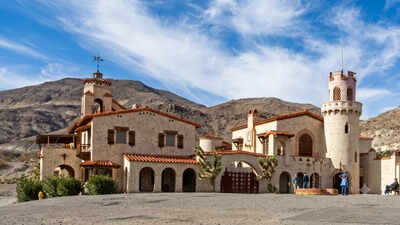
More than a decade after a devastating flash flood forced one of Death Valley National Park’s best-known historic sites to close, visitors are getting another chance to see Scotty’s Castle. The National Park Service is offering limited guided exterior tours of the historic estate beginning October 10. Tours are scheduled for most Saturdays and Sundays through April 17, while private weekday tours can also be arranged for small groups. The castle itself remains under restoration and is not yet reopening for regular interior visits.The limited access marks another step in a recovery effort that has stretched for more than 10 years and is expected to continue for at least another two.
A 2015 flood changed everything at Scotty’s Castle
Scotty’s Castle has been closed since October 2015, when an extraordinary storm hit the northern part of Death Valley.On October 18, the area received 2.75 inches of rain in about five hours, roughly equivalent to a typical year’s rainfall there. Another half-inch had fallen the previous day. Water, mud and rocks rushed through Grapevine Canyon in a flash flood estimated to be flowing at about 3,200 cubic feet per second.The flood damaged buildings, utilities, historic landscaping and roads. Much of the eight-mile Bonnie Clare Road leading toward Scotty’s Castle was destroyed. More than 20 power poles were washed away, sections of the water and sewer systems were damaged and mud and rocks piled several feet deep around some buildings.The National Park Service estimates that the overall repair effort costs about $71 million, with work divided across numerous projects and funding sources.
Visitors can now see the historic grounds again
The new tours are limited to the exterior areas of the historic district while construction continues.National Park Service rangers and guides from the Death Valley Natural History Association will lead visitors through the site, explaining its history as well as the restoration work underway. Tickets are being handled through the association.The arrangement gives visitors access to one of Death Valley’s most recognizable historic landmarks without reopening sections that remain affected by construction and preservation work.It also allows the park to tell the story of the recovery itself, including how infrastructure has been rebuilt to withstand future flooding.
Who actually built Scotty’s Castle?
Despite its name, Scotty’s Castle was not built by Walter “Scotty” Scott.The Spanish Revival-style estate dates to the 1920s and was built by Chicago businessman Albert Johnson as a winter retreat for himself and his wife, Bessie. Scott was Johnson’s friend and became closely associated with the property through colorful stories that helped turn the desert estate into an attraction.Its unusual architecture and remote desert setting eventually made Scotty’s Castle one of Death Valley’s most distinctive historic sites.The property also contains historic furnishings, archives and museum objects connected to the people who lived and worked there.
Restoration faced more than just the original flood
Repairing the site has proved complicated.Beyond the extensive 2015 flood damage, restoration was affected by funding and contracting delays, the Covid-19 pandemic and later flooding elsewhere in Death Valley.Another major setback came in April 2021, when the historic Garage caught fire while repairs were underway. The building had been about 60% through its restoration when it was destroyed. The adjoining Longshed also suffered damage.Meanwhile, the park has rebuilt water, electrical and wastewater infrastructure and added new flood-control measures. Some of those improvements successfully protected the historic district when flooding associated with the remnants of Hurricane Hilary hit Death Valley in 2023.
Full reopening could still be more than two years away
More work is planned for 2027, including repairs to the parking lot, the historic Longshed and the Gas Tank House. The Gas Tank House is expected to be adapted into a small visitor contact station.Once construction is complete, curatorial teams will still need to return historic furniture and museum collections to the castle before regular interior tours can resume.Based on the current schedule, the National Park Service says November 2028 is the earliest anticipated date for a full reopening.Until then, the limited exterior tours offer visitors a rare opportunity to step back onto the grounds of a Death Valley landmark that has remained largely inaccessible since the flood of 2015.