










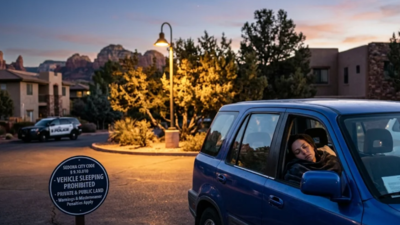
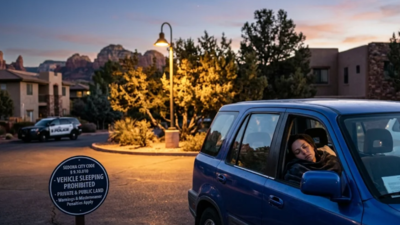
A federal appeals court has allowed a disability discrimination lawsuit filed by a woman in Sedona to move forward. The woman sleeps in her car because her severe obsessive-compulsive disorder (OCD) often makes it impossible for her to enter her own apartment. In a published ruling issued on November 12, 2026, a three-judge panel of the U.S. Court of Appeals for the Ninth Circuit found that a lower court judge was wrong to dismiss Sabrina Beram’s lawsuit against the City of Sedona under Title II of the Americans with Disabilities Act (ADA). The decision allows Beram to seek financial compensation and a court order stopping police from enforcing the city’s ban on sleeping in vehicles against her when she rests in the parking lot of her apartment complex.According to Ninth Circuit court records, Beram rents an apartment in Sedona, Arizona, and lives with severe, long-term obsessive-compulsive anxiety. When she “perceives unclean conditions in her apartment,” she “experiences a strong sensory perception” that feels like “an electric fence” that “commands her not to enter” her home, the court’s opinion states. Beram follows cleaning routines “designed to make the unclean conditions tolerable.” However, these routines can take several hours and often cannot be completed “within enough time to obtain a restful sleep,” according to the ruling written by Circuit Judge Roopali H. Desai. On these nights, which happen at least three times a week, she sleeps in her car in her apartment complex’s parking lot. If no parking spaces are available, she sleeps in other public or private places around Sedona.
Sedona vehicle ban and police warnings
Sleeping in a vehicle anywhere in Sedona, even on private property, is against the law under Sedona City Code Section 9.10.010. The law also makes it illegal for private property owners or managers to knowingly allow someone to sleep in a vehicle on their land. Breaking this rule is a class 1 misdemeanor. According to court filings, the punishment can include up to six months in jail, a fine of up to $2,500, or both. However, city rules state that police officers cannot arrest someone for sleeping in a vehicle unless an officer or property owner has first given that person a warning.Sedona police officers have warned Beram on two occasions. During the first incident, she was sleeping in her car at a public trailhead. “A Sedona police officer knocked on her window and told her she had to leave.” The officer also told her that he had “put a note in her file” so other officers would know she had already received a warning, the Ninth Circuit noted. During the second incident, an officer woke her while she was sleeping in her car at a park. The officer told her that sleeping in a vehicle was illegal, ordered her to leave, and warned that she would receive a citation if she did not follow the order.Beram’s landlord also threatened to end her lease after finding out that she slept in the apartment complex’s parking lot. Beram had made two requests for a disability accommodation, but the property manager did not respond to either one. Instead, the manager sent her a lease addendum warning that “[t]he City of Sedona does not permit sleeping in vehicles within the city limits”. It also said her lease would not be renewed if she broke the rule. Beram later reached a settlement with the property owner. However, the agreement allows the landlord to cancel it if either party receives a warning or is charged under the city ordinance.
City denies exemption under federal disability law
After receiving the lease addendum, Beram wrote to the Mayor of Sedona asking for a reasonable accommodation under Title II of the ADA. She wanted the city to make an exception so she could sleep in her car without facing enforcement of the vehicle ban. She later limited her request to the parking area of her apartment complex. The city rejected her requests. Community Legal Services then filed a federal lawsuit on her behalf in the U.S. District Court for the District of Arizona. US District Judge Diane J. Humetewa dismissed Beram’s case, saying she did not have enough legal grounds to bring the lawsuit. The judge concluded that receiving two police warnings did not prove that she faced an immediate risk of prosecution. Judge Humetewa also refused to let Beram submit updated versions of her complaint.The Ninth Circuit panel overturned that decision. It included Circuit Judge Ana de Alba and U.S. District Judge Edward M. Chen, who was serving by special appointment. Judge Desai wrote that Beram had shown enough grounds to seek financial damages. Being denied a disability accommodation was itself a real injury, she explained. This was in addition to the emotional distress and lost work time Beram said she had experienced. The appeals court also found that Beram faced a real risk of future enforcement. “The officers’ warnings were not mere threats of enforcement: they were the first step of enforcement,” Judge Desai wrote. She explained that the warnings met the legal requirement that must be completed before someone can be arrested under the ordinance. The judges also noted that Sedona had issued criminal citations to at least two other people for sleeping in vehicles on private property.
Criminal ordinances subject to disability protections
Sedona’s lawyers argued that Beram’s problem was with her landlord, not the city. They also claimed that Title II of the ADA was never intended to interfere with local criminal laws. Judge Desai rejected both arguments. “This argument ignores that the ordinance criminalizes sleeping on both public and private property,” she wrote. “And it prohibits private property owners from allowing someone to sleep in their car on the owner’s property.” The panel also referred to earlier court decisions involving civil zoning and nuisance rules. It ruled that following local government rules and regulations is a public activity covered by the ADA.“Discrimination under Title II may include the failure to provide reasonable accommodation that would allow a person with a disability to comply with a criminal ordinance,” Judge Desai stated. As Capitol Media Services reported, Thursday’s ruling does not mean Beram has won her lawsuit. The Ninth Circuit sent the case back to the Arizona district court for further proceedings. The appeals court instructed that Beram can file a fifth amended complaint. City lawyers will then have another opportunity to argue that giving her the requested exemption would be unreasonable.