








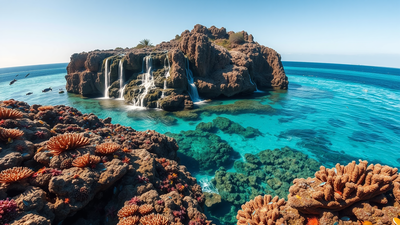
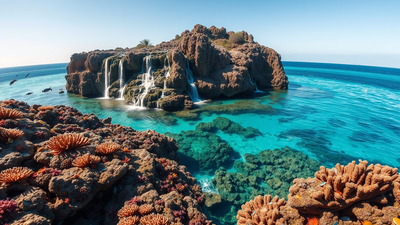
Off the remote coast of Western Australia, roughly 1,200 miles north of Perth, an entire reef spends most of its life hidden underwater, only to rise dramatically out of the sea for a few hours each day. Known to Indigenous Australians as Yowjab and more widely as Montgomery Reef, the formation sits in the Kimberley region and is considered the largest inshore reef on the planet. As the tide falls, the reef appears to rise directly out of the ocean like a stage being lifted into view, an illusion created not by the reef moving but by the water around it steadily draining away.
How Montgomery Reef briefly rises above the ocean
Covering close to 100,000 acres, according to afact sheet from Western Australia’s Department of Primary Industries and Regional Development, Yowjab can rise up to 26 feet above the surface of the ocean during low tide, a height coral biologist Zoe Richards of Curtin University says is unmatched by any other reef she is aware of. As the water drains off the exposed reef top, it cascades back into the ocean in dramatic waterfalls, a spectacle rarely witnessed at any other coral formation in the world. This entire transformation typically lasts between two and three hours before the rising tide slowly submerges the reef once again.
The unusual biology holding the reef together
Unlike many reef systems built primarily from coral, Yowjab owes its structure mainly to coralline algae, which form low ridges along its edges that trap seawater as the tide recedes. According to Richards, this creates a shifting maze of shallow pools across the reef top where corals, fish, turtles and other marine creatures continue to live even while exposed to air. Larger animals such as dugongs, crocodiles and sharks retreat into deeper surrounding channels during this period, sometimes waiting up to four hours for the tide to rise again and reconnect them with the reef’s feeding grounds. Claire Ross, a research scientist with Western Australia’s Department of Biodiversity, Conservation and Attractions, notes that species living on Kimberley reefs have developed strong resistance to heat stress and repeated exposure to air, conditions that would overwhelm most other coral ecosystems.
A landscape shaped by 1.8 billion years of tidal force
The reef’s foundation is not coral at all but an ancient mesa made of dolomite and sandstone now coated in coralline algae, a structure that traces back roughly 1.8 billion years, according to afact sheet published by Australia’s Department of Climate Change, Energy, the Environment and Water. This same geological record describes the broader Kimberley region as shaped by some of the world’s largest tides, which can rise as much as 36 feet, carving the area’s gorges, sea cliffs and other unusual formations over an immense span of geological time.
A marine park managed jointly with its traditional owners
Yowjab sits within Lalang-gaddam Marine Park, one of several marine parks across the Buccaneer Archipelago now co-managed by the Western Australian government alongside the Indigenous groups who have called this coastline home for tens of thousands of years. The Dambeemangaddee people are recognised as the traditional owners of Yowjab and its surrounding waters, and under the current co-management arrangement, Indigenous rangers monitor biodiversity, track pollution and help safeguard culturally significant sites across the region, while also playing a growing role in guiding visitors through the area’s cultural heritage.
The Dreamtime story behind the reef’s powerful tides
Yowjab’s dramatic tidal behaviour is explained through a Dreamtime creation story tied to a Wandjina spirit and a rainbow serpent, describing how a grieving mother’s search for her missing son led to the creation of the sea and its violent tidal swings. According to accounts referenced in the same regional fisheries fact sheet, this story remains an important part of Worrora cultural heritage tied directly to the reef and the surrounding Kimberley coastline.
Separating the legend of the Yawijibaya from the historical record
Adding to Montgomery Reef’s mystique is a widely circulated story describing the Yawijibaya, an Indigenous people said to have stood up to seven feet tall who reportedly vanished after being filmed by a French crew in 1929. Australian National University archaeologist Sue O’Connor, who conducted fieldwork on the nearby islands during the 1980s, has said there is no evidence to support the claim that these people disappeared, suggesting instead that their notable height likely reflected consistent access to protein-rich seafood compared with inland communities. Drawing on research by anthropologist Norman Tindale, O’Connor notes that the Yawijibaya people integrated with mainland Worrora communities in the early twentieth century rather than vanishing, meaning their descendants remain part of the region’s living Indigenous population today.
Why Montgomery Reef remains a rare natural spectacle
Taken together, Montgomery Reef stands out not just for its size or its brief daily appearance above the waterline, but for the layered history embedded in its ancient rock foundation, its unusual reliance on coralline algae rather than coral alone, and its deep ongoing connection to the Indigenous communities who continue to manage and interpret its waters. Few natural phenomena combine geology, marine biology and living cultural heritage in quite the same way, making Yowjab’s brief daily reappearance one of the more genuinely rare sights along Australia’s remote northern coastline.