









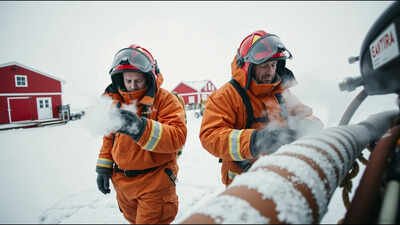
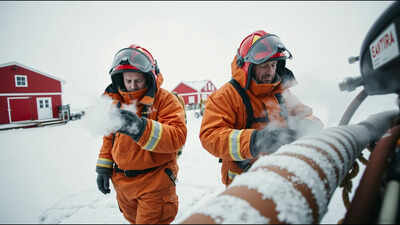
Antarctica holds roughly 75 per cent of the planet’s fresh water, locked away as ice, yet the continent is technically classified as a desert, and that combination makes fire one of the most serious hazards facing the people who live and work there. The United States maintains the only full-time professional fire department on the continent, the Antarctic Fire Department, staffed year round to protect McMurdo Station, Amundsen-Scott South Pole Station and the airfields that connect them to the outside world, in a place where the nearest outside help can be an eight-hour flight away, and where a single building fire could put an entire research station’s mission at risk, keeping a dedicated fire service running through some of the harshest conditions on Earth is treated as an operational necessity rather than a precaution.
Why ice everywhere does not actually help fight fires
The core paradox behind Antarctic firefighting is straightforward once explained. According to FireRescue1, Antarctica is a continent of extremes, covered in ice yet also technically a desert, and frozen water does firefighters no good when they actually need liquid water to fight a fire. The continent’s air is also extremely dry, dry enough that static electricity can produce a noticeable shock simply from touching an everyday object, a detail that adds an extra layer of fire risk in an environment already filled with fuel, generators and heated buildings running constantly to keep people alive.Cold temperatures create further complications specific to the job itself. Keeping firefighting agents in a usable liquid state inside hoses becomes difficult once temperatures drop below freezing, and sustained winds across the continent can reach hurricane force, a combination that can turn what would be a routine structure fire almost anywhere else in the world into a far more serious and fast-moving emergency in Antarctica.
Why a single fire poses such an outsized risk at a research station
According to the Antarctic Fire Department’s own operational overview, virtually every structure at McMurdo Station is treated as a target hazard, since all buildings are considered critical to United States Antarctic Program operations, meaning the loss of even one building could significantly disrupt station operations, or in a worst-case scenario, shut down a major portion of the station entirely. Major target hazards specifically include the Crary Scientific Laboratory, described as the operational heart of McMurdo Station’s research mission, alongside essential infrastructure such as the station’s Heavy Shop vehicle maintenance facility and its power generation systems.This heightened-stakes environment exists precisely because rescue and resupply options in Antarctica are so limited. Isolated by extreme distance, unpredictable weather and a genuinely hostile climate, a research station that loses critical infrastructure to fire cannot simply call in replacement equipment or emergency personnel on short notice the way a mainland community typically could.
How the department is staffed and equipped for the job
According to reporting on the department’s operations, McMurdo Station, the largest research base in Antarctica, hosts the largest of the continent’s three US fire departments, running two rotating shifts that cover both the main station and its two ice runways. Firefighters typically rotate in on six-month or one-year contracts, and during the Antarctic summer season beginning in mid-October, when the station’s population can swell to around 1,100 scientists, support staff and military personnel, the fire department maintains a staff of roughly 46 people, including around 21 active firefighters alongside dispatchers, lieutenants and command staff.Equipment is purpose-built for the environment. Station 1, based in central McMurdo, operates two fire engines, a water tender, an ambulance, a rescue vehicle and a specialised self-contained attack truck, while Station 2, covering the airfields, runs an ambulance alongside seven aircraft rescue firefighting vehicles fitted with fully tracked systems rather than conventional tyres, allowing them to operate across the deep snow cover surrounding the runways.
What day-to-day life actually looks like for Antarctic firefighters
Despite the scale of risk involved, actual fires remain genuinely rare across the continent. According to Nicki Schauman, a fire captain with the Antarctic Fire Department speaking to Hakai Magazine, firefighters don’t actually fight a lot of fires in Antarctica, and after two full seasons working there herself, she had not yet responded to one. The underlying danger, she explained, comes from the climate’s extreme dryness and wind, conditions under which a fire, once it does start, could spread rapidly between buildings before crews have much chance to contain it.Firefighters also serve a role well beyond structural fire response. According to the Antarctic Fire Department, personnel respond to medical emergencies across the station much as any local fire department would, staffing rescue ambulances and providing paramedic-level care, transporting patients to McMurdo General Hospital, and coordinating further evacuation to Christchurch, New Zealand, when a case requires treatment beyond what the station’s small onsite medical facility can provide.
Why the job remains genuinely dangerous despite rare fires
The risks facing Antarctic firefighters are not purely hypothetical. Fire department personnel at McMurdo have died in the line of duty in past incidents involving station infrastructure, underscoring that even with fires themselves being uncommon, the broader operational environment- extreme cold, remote generators, complex technical equipment and genuine isolation from outside emergency support- carries serious risk on its own.That combination of rarity and severity is precisely why the United States maintains a dedicated, professionally staffed fire service in Antarctica rather than relying on a volunteer or part-time model. In a place where a single serious fire could threaten both human life and the scientific mission an entire station exists to support, and where outside help may be many hours or days away under the best conditions, having trained, equipped firefighters permanently on site remains one of the more understated pieces of infrastructure keeping Antarctic research possible at all.