


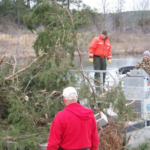






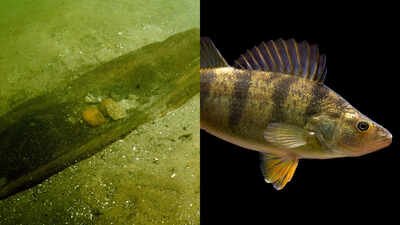
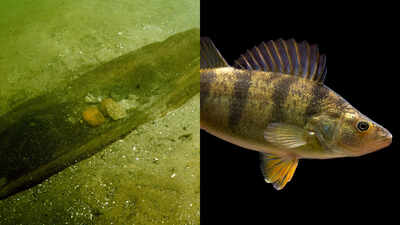
From the surface a lake might look like it is not changing at all but underneath it is a very different story. Scientists demonstrated how important fallen trees and submerged logs can be to freshwater ecosystems in an unusual whole-lake experiment under calm waters of Wisconsin’s Little Rock Lake. In the study, ‘The rapid effects of a whole-lake reduction of coarse woody debris on fish and benthic macroinvertebrates’, researchers removed over 70% of the coarse woody habitat from one basin of the lake, and the effects were quickly seen in its fish. Yellow perch, which was once the lake’s most abundant fish, plummeted to very low numbers within two years, the study adds. The study was conducted in Little Rock Lake, an 18-hectare undeveloped, unfished lake in Vilas County, Wisconsin. A large curtain divides the lake into 2 similar basins. Fish and water cannot pass between the basins. That unusual setup gave researchers a natural laboratory setting. One basin was designated as the treatment area in which approximately 70% of the coarse woody debris along the shallow shore was removed in 2002. The other basin was left as a control. The aim was to determine what happens when a key feature of the habitat is removed.
Why underwater logs are important
Fallen trees and branches might appear to be nothing more than debris but they create complex underwater environments. Logs provide fish with places to hide, feed and shelter and also increase the variety of habitat available in the lake. The two basins had broadly similar food webs dominated by aquatic prey before the experiment. But after removal of the woody habitat, the fish community started to respond differently.
Decline of yellow perch
The most striking change was the decline in yellow perch, which had been the most abundant fish species in the lake. Perch densities in the treatment basin dropped to very low levels. Researchers attributed the decline to increased predation and little or no successful recruitment of young fish. It was a stark contrast to the pristine basin. In the reference basin, yellow perch produced several generations of young in successive years, thus rebuilding the population. Thus, woody cover loss appeared to influence where fish were found and their ability to survive and maintain populations.
Bass altered their behavior
Largemouth bass also responded to the changed habitat. After log removal, bass in the treatment basin consumed less fish and relied more on terrestrial prey. Their growth also slowed relative to bass in the reference basin. The results suggest that removing underwater structure can alter predator-prey relationships across an entire ecosystem, not just impact a single species in isolation.
Not every species responded immediately
Oddly the experiment did not produce the same rapid changes in aquatic invertebrates. There was no significant difference in the composition, diversity or density of benthic macroinvertebrate communities between the treatment and reference basins during the two years following the habitat reduction. That contrast illustrates how different parts of an ecosystem can respond at very different speeds.
A warning for developed coasts
The findings have implications beyond Little Rock Lake. As shorelines are developed, riparian forests may be thinned and fallen trees removed from shallow water for esthetic or recreational reasons. The experiment shows that such small changes can have big implications for fish communities. The study, Fish Community and Food Web Responses to a Whole-Lake Removal of Coarse Woody Habitat, shows that keeping submerged woody habitat is important to support desirable fish populations and healthy fisheries. What looks like clutter from above may be, below the surface, critical infrastructure for an entire aquatic food web.Images Courtesy: Wikipedia