










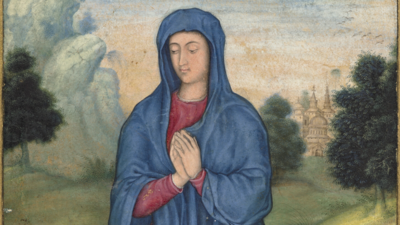
A small painting of the Virgin Mary, created in Mughal India around 1600, has sold for £152,400 (approximately Rs 1.8 crore) at Christie’s in London, fetching more than three times its highest estimate. Measuring just 14 x 8.2 cm, the artwork offers a glimpse into a period when Indian artists were encountering European religious imagery and adapting it within the artistic traditions of the Mughal court.Titled The Virgin Mary Standing in Prayer, the painting was sold on April 28, 2026, as part of The Mary and Cheney Cowles Collection of Indian Painting and Calligraphy. Executed in opaque pigments on paper, the work is set within a thin gold border. Its small size contrasts with the cultural history it represents, reflecting the exchange of artistic ideas between Europe and Mughal India in the late 16th and early 17th centuries.According to Christie’s, the painting is among the few known examples from 16th- and 17th-century Mughal art depicting the Virgin Mary standing in prayer.
How European religious imagery reached the Mughal court
The painting emerged during a period of growing contact between the Mughal court and Europe. European engravings began reaching the court after Portuguese missionaries arrived in 1580, attracting the interest of Emperor Akbar, who ruled from 1556 to 1605.These images introduced Mughal artists to new subjects, visual references and techniques. Rather than simply reproducing European works, artists adapted the imagery to their own artistic vocabulary, bringing together foreign influences and established Indian conventions.The interest in Christian subjects also developed through literary exchanges. In 1602, Akbar received a Persian translation of the Life of Christ, titled Mirat al-Quds, or Mirror of Holiness, from Jesuit Father Jerome Xavier. The work inspired the production of illustrated copies, including one for Akbar and another for his son Salim, who later became Emperor Jahangir.Mary and Jesus subsequently became popular subjects in Mughal painting, according to Christie’s.The auction house notes that the European source behind individual Mughal paintings can be difficult to establish. However, the use of European-inspired figures and details illustrates how artists at the court engaged with images arriving from outside India.
A European subject, interpreted through Mughal art
The painting’s significance lies not only in its subject but also in the way its artist interpreted it. The strong blue associated with the Virgin Mary recalls European religious imagery, while the architectural setting and stylistic details retain a distinctly Mughal character.Speaking to Christie’s, Sara Plumbly, director and head of the Islamic and Indian Art department, described the work as an example of cross-cultural exchange during the 16th and 17th centuries.“What’s fascinating here is that, although this image is remarkably faithful to its European source – for instance in the very strong blue associated with the Virgin Mary — you still see distinctly Mughal elements, like the architectural setting and certain stylistic details,” Plumbly said.She added that the work demonstrates how artists adapted European models within an Indian context, creating an image that retained elements of its source while developing its own character.Christie’s also draws attention to an open book depicted in the painting. Its writing resembles pseudo-nasta’liq, a script-like treatment that adds to the work’s attention to detail. The auction house notes that the detail recalls the naturalism associated with 15th-century Northern European art.The painting therefore reflects more than the arrival of a new religious subject in India. It shows how artists could incorporate unfamiliar visual references into an existing tradition without abandoning its distinctive features.
Why the Virgin Mary was significant in Mughal India
The presence of Mary in Mughal art was not solely the result of European influence. Christie’s notes that Mary, known as Maryam in Islamic tradition, was highly venerated under the Mughals because of her importance in the Quran, as well as her place in court literature connecting her to Timurid and Mughal ancestry.The auction house cites accounts suggesting that Jahangir kept an image of Mary on a palace wall. A painting in New Delhi’s National Museum, dated to after 1614, also depicts the emperor holding a picture of her.Representations of Mary had existed in Islamic illustrated manuscripts well before the Mughal period. Examples include the 14th-century Jami al-Tawarikh, or World History, by Rashid al-Din, and 16th-century versions of Qisas al-Anbia, or Stories of the Prophets, and the Falnama, or Book of Omens.This wider tradition provides an important context for understanding the Mughal painting. European Christian imagery entered a courtly environment in which Mary was already a recognised religious figure, allowing artists to engage with the subject through multiple cultural and artistic traditions.
A rare work with a parallel in Dublin
Christie’s identifies an almost identical painting, dated to around 1595–1600, in the Chester Beatty Library in Dublin. That version includes the Christ Child above Mary and originally formed part of the celebrated Salim Album.The auction house notes similarities in the colour palette between the Chester Beatty work and the painting sold in London. However, the London painting uses more opaque colours and features more refined European-inspired landscape details, suggesting a slightly later date.The London work’s recorded provenance lists the American art market in 2001. It later became part of the Mary and Cheney Cowles Collection, which brought together Indian paintings and calligraphy spanning several centuries.Cheney Cowles, who was director of Seattle’s Crane Gallery, and his wife Mary began collecting Indian paintings from the Mughal period in the 1980s, adding them to their existing collection of works from Japan and China. According to Christie’s, 31 works offered from their collection had featured in the 1998 exhibition Image and Word: Indian Paintings, Drawings and Calligraphy (1350–1830) at the Art Gallery of Greater Victoria in Canada.The sale of The Virgin Mary Standing in Prayer brings renewed attention to a period in Indian art when artistic traditions met and influenced one another. Created more than four centuries ago on a sheet of paper measuring little more than a handspan, the painting preserves evidence of how Mughal artists interpreted European imagery through their own visual language.