










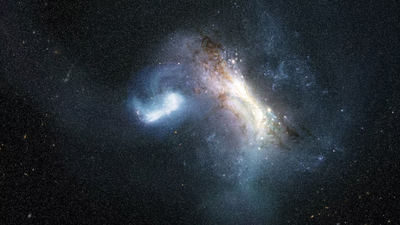
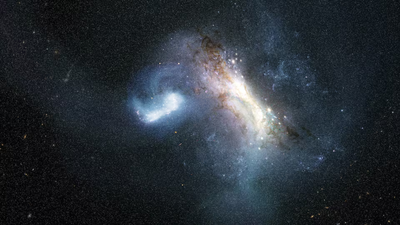
Nearly 12 billion years ago, the Milky Way was still in its infancy, assembling itself from smaller collections of stars, gas and dark matter. During that turbulent period, another galaxy came within its gravitational reach and was eventually absorbed, leaving traces that have survived to the present day. Astronomers have now identified evidence of this ancient merger by examining globular clusters deep inside the Milky Way. The event, involving a dwarf galaxy now known as Low-energy-Kraken-Heracles, or LKH, appears to have been one of the earliest substantial mergers in our galaxy’s history. Its remnants are not obvious in the night sky, but they remain encoded in the ages, chemical compositions and movements of ancient star clusters. The discovery offers a rare glimpse of the young Milky Way and helps fill in the long, complicated story of how the galaxy grew into the vast stellar system we see today.
12.3-billion-year-old LKH merger reveals clues about the Milky Way’s early history
The newly identified event occurred around 12 billion years ago, when the Milky Way was much smaller than it is now. The study published in Nature, titled ‘Evidence of a massive accretion event 1.8 billion years before the Gaia-Sausage-Enceladus merger‘, places the merger at about 12.3 billion years ago, around 1.8 billion years before the better-known Gaia-Sausage-Enceladus merger. Reuters reports the event occurring roughly 11.8 billion years ago, reflecting the uncertainties involved in reconstructing events from such an ancient period. Either way, the encounter belongs to a very early chapter of the galaxy’s history.The galaxy involved was a dwarf system that the researchers have named Low-energy-Kraken-Heracles, or LKH. Its stellar mass was estimated at 500 million times the mass of the Sun, making it comparable in stellar mass to Gaia-Sausage-Enceladus. Most of the material from LKH appears to have ended up within the inner 6 kiloparsecs of the Milky Way, leaving its remains concentrated to the galactic centre.
How globular clusters helped scientists uncover the Milky Way’s ancient galaxy merger
The clues to the merger came from globular clusters, dense groups containing enormous numbers of old stars. These clusters can preserve information about the environments in which their stars formed, including their ages and chemical composition. The researchers examined 17 globular clusters in the inner Milky Way using Hubble Space Telescope observations and combined these results with an existing sample to create a set of 39 clusters with homogeneous age measurements.When the clusters were compared in their ages, metallicities and orbital properties, three distinct populations emerged. One was linked to stars that formed within the main Milky Way progenitor, another corresponded to Gaia-Sausage-Enceladus, and a third occupied an intermediate position between them. Twelve clusters associated with this third population were confined within about 6 kiloparsecs of the galactic centre, suggesting that they originated in a separate system rather than belonging to either of the other two groups.
How the LKH merger may have triggered new star formation in the early Milky Way
The merger was not simply a matter of one collection of stars being added to another. The incoming galaxy would also have brought interstellar gas and dark matter into the young Milky Way. The collision between gas belonging to the two systems may have disturbed the material and encouraged a period of increased star formation. At the level of individual stars, however, the encounter would have been very different from a conventional collision: the distances between stars are so vast that direct star-to-star impacts are extraordinarily unlikely.Some of the stars that formed in the smaller galaxy may still be hidden in the Milky Way’s crowded inner regions. Dust makes this part of the galaxy difficult to observe, so identifying individual survivors is not straightforward. The globular clusters provide a more useful record because their collective properties have remained detectable across billions of years.
Milky Way was built through repeated galaxy mergers over billions of years
The LKH merger adds to a growing picture of the Milky Way as a galaxy assembled through repeated encounters. Gaia-Sausage-Enceladus was absorbed around 10 billion years ago and had a major influence on the development of the galaxy’s thick disc. The Sagittarius dwarf galaxy represents a much later merger that is still taking place. The newly identified LKH event pushes the known history of substantial Milky Way mergers further back into the galaxy’s first billion years.There are still parts of that early history that cannot be reconstructed with certainty. The inner Milky Way contains material from several ancient building blocks, and some smaller progenitor galaxies may have left no surviving globular clusters to identify them. The researchers say that more precise ages for large populations of inner-Galaxy stars will be needed to separate these different contributions.