









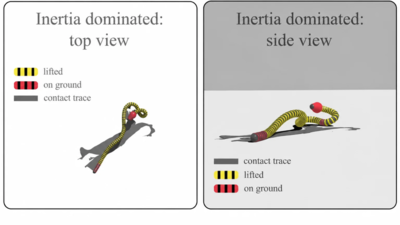
The S-start is an escape move used by baby yellow anacondas. When danger shows up, the snake folds into S-shaped curves, lifts parts of its body off the ground and then uncoils, launching itself forward like a spring. Most of us picture a snake sliding flat along the ground, belly down the whole way, and this move doesn’t fit that picture. The snake has no legs and still launches without slipping, which is the kind of skill engineers want in limbless robots that have to cross rough, uneven ground. The paper “Topological dynamics of rapid non-planar gaits in slithering snakes,” published in Nature Physics in 2025, suggests the move may even be where sidewinding began, the sideways gait of desert vipers. So a baby snake’s panic reaction could have shaped how other snakes travel. Below is how the move works, why only young anacondas can do it and what it might mean for robots.
How does the S-start work?
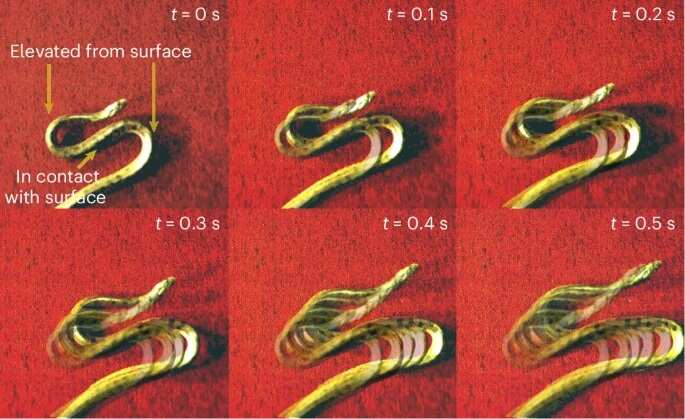
Image credits: Harvard John A. Paulson School of Engineering and Applied Sciences
Imagine a baby yellow anaconda coiled up with a threat close by. It doesn’t just crawl away. It bends its body from side to side and also lifts sections of it into the air. The raised, curved sections move backward along the body, from head to tail, like a ripple running down a rope. Then the snake uncoils and straightens, and that release throws it forward in a quick burst with no slipping. With part of the body off the ground, there is less friction to fight, which likely helps with the speed. Herpetologist Bruce Young first noticed the movement in juvenile anacondas. Physicist Raghunath Chelakkot then built a computational model of it, backed by experiments and high-speed video, since a burst this fast is hard to follow with the naked eye.
Why can only young anacondas do it?
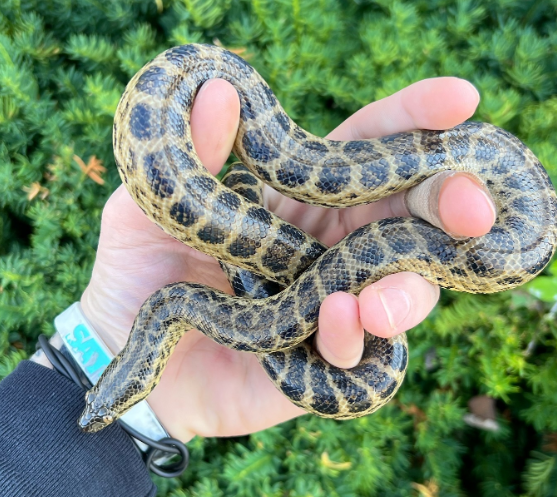
Image credits: Instagram/SATOO Reptiles & Aquatics
Adult anacondas are known for strength rather than speed, and the babies are the nimble ones. The move only works when a snake’s weight, muscle strength and girth sit inside a narrow sweet spot, and that spot disappears as the animal grows. If the snake is too heavy, it can’t lift its body off the ground. If it’s too light and too strong, it loses control. He calls it a Goldilocks zone, and nature has plenty of them. Frogs and toads leap several times their body length, and the best jumpers are usually mid-sized. Mammals shift between walking, trotting and galloping for similar reasons. The team also points out that animals are worth studying at different ages, since juveniles can show how complex movement evolved.
Could it explain how sidewinding began?
The team modeled the S-start with flexible elastic rods and three precisely timed muscular torque pulses. Repeat those pulses and the rods begin to sidewind, which caught the team off guard. A few well-placed pushes were enough to reproduce the posture. Chelakkot says the muscle activity in the two movements is so alike that sidewinding may have evolved from the S-start. Brown tree snakes on Guam, which loop their bodies to climb smooth metal poles, show S-start signatures too, hinting at a shared biomechanical origin. Anacondas aren’t closely related to sidewinders, so each may have arrived at its version separately. All of this is still a hypothesis, and nothing has been settled.
How could this help engineers?
The work holds promise for agile robots that can move over complex terrain without limbs, including machines built for tight, uneven or unstable ground. Arnab Pal of The Institute of Mathematical Sciences in Chennai, who wasn’t part of the research team, notes that robot design has a Goldilocks zone of its own. Structure, control and energy all have to fit together, much like the anaconda’s body does. He adds that the same elastic filament framework could capture how earthworms crawl, how eels and lampreys swim and how caterpillars move, which could help build soft robots that adapt to the terrain they’re on. No specific uses have been announced, and Pal says more work is needed to link theory with real-world results. Still, a robot that crosses rough ground without legs could reach places current machines can’t, and that benefits a lot more people than snake fans.
Key takeaway
A baby anaconda’s getaway looks like a small oddity, but it holds a few big ideas. The S-start lets a young snake lift, twist and uncoil into a fast launch that doesn’t slip, and it only works within a narrow range of weight, strength and girth. A model with just three timed pulses reproduces sidewinding, so that famous gait may have grown out of this simple escape. For engineers, it’s a fresh starting point for limbless robots that can handle rough terrain. Harvard’s L. Mahadevan describes the movement as “the serpentine analog of the moonwalk” in “Slithering Snakes: The Science Behind the Motion of a Young Anaconda,” published by Harvard’s Materials Research Science and Engineering Center in 2025. The research is still early, and plenty of animal movement remains to be explained.