










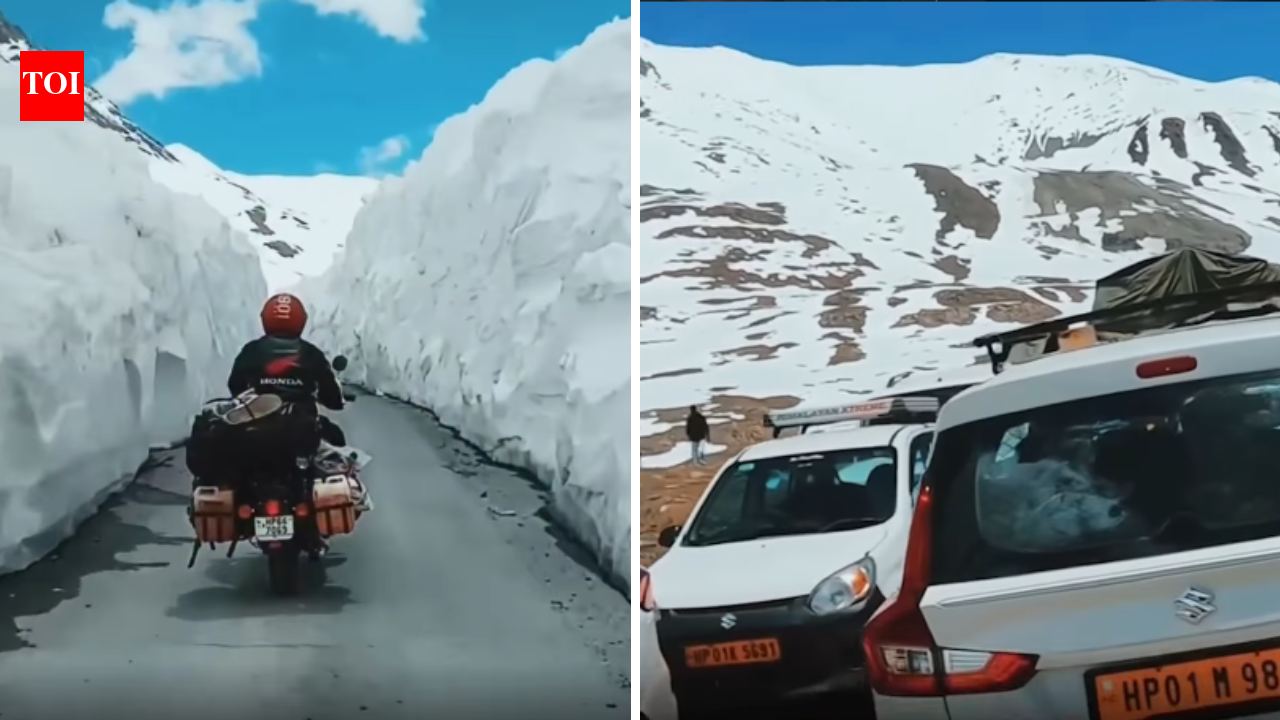
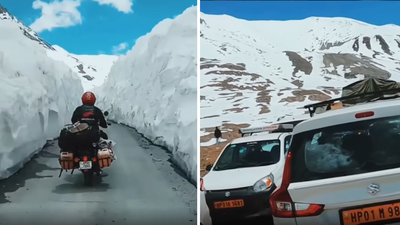
There was a time when reaching Baralacha La meant negotiating a road that could almost disappear under the snow. In winter and early summer, massive walls of snow defined the route, vehicles were few and the high-altitude pass remained out of reach for most travellers making the journey towards Ladakh.
When the milestone disappeared under snow
Then comes 2026.The snow-covered road in the old footage gives way to a scene of cars parked along both sides, tourists walking around with cameras and a stream of vehicles moving through the pass. What once looked like a remote Himalayan crossing now resembles a busy tourist stop.A widely circulated video has captured this decade-apart transformation at Baralacha La, one of the most dramatic stretches on the Manali-Leh highway.The video begins with footage from around 10 years ago. The narrator recalls seeing 15-20 feet of snow on the way to Ladakh and says only a handful of bikers and four-wheelers could make it this far. For most tourists, the journey reportedly ended around Manali.The camera then turns towards a milestone at Baralacha Pass. It is almost completely swallowed by snow. That image is difficult to reconcile with what the same spot looks like today.
From a remote pass to a crowded photo stop
In the 2026 footage, vehicles are lined up on both sides of the road. There is a crowd around the landmark, with tourists stopping to take photographs. The narrator describes the scene as a “jamb” of vehicles and points to the road infrastructure that has made the Manali-Ladakh journey far more accessible.The change is not only about the number of people arriving here. It is visible on the ground.The old milestone that could barely be seen through the snow is now fully exposed. The video describes the current structure as a roughly 20-foot milestone, standing prominently against the surrounding landscape.And where there was once an expanse of undisturbed snow, the 2026 footage shows visitors walking across it, vehicles parked nearby and patches of snow reduced to slush and mud.
The road to Ladakh is no longer what it was
For a traveller, this is perhaps the most striking part of the comparison. Baralacha La has gone from being a place that required the right weather, road conditions and a fair amount of luck to one that can draw crowds once the highway opens.The transformation has followed years of improvements along the Manali-Leh route. Better road connectivity and continued work by the Border Roads Organisation have made the route increasingly accessible. In 2026, the Manali-Leh highway was reopened after winter following extensive snow-clearance operations, once conditions allowed traffic to resume.
But what does easier access leave behind?
The video points towards food and drink stalls around the tourist stop and shows waste scattered in the area. Snow around the roadside appears trampled and mixed with mud as visitors move through the spot.It is an uncomfortable contrast: the same accessibility that allows thousands of travellers to experience the Himalayas also brings a much larger human footprint to a landscape that once seemed almost untouched.The video also compares older footage from 2017 and 2021 with the present-day scene. In one frame, the landmark is buried in snow. In another, a smaller milestone is visible. By 2026, the landmark stands tall and unobstructed as tourists gather around it.Ten years ago, the defining image of Baralacha La was the snow. Today, it may be the crowd.